-
Use Cases
-
Resources
-
Pricing
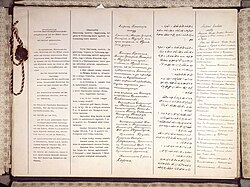
The Treaty of Brest-Litovsk was a peace treaty signed on March 3, 1918, between Soviet Russia and the Central Powers (Germany, Austria-Hungary, Bulgaria, and the Ottoman Empire), ending Russia's participation in World War I. Negotiated by Leon Trotsky and other Bolshevik representatives, it required Russia to cede vast territories, including Ukraine, Poland, Finland, the Baltic states, and parts of the Caucasus. The treaty was annulled in November 1918 following Germany's defeat in World War I. More Less
Jan 1, 1917 - Dec 31, 1917
% complete
By 1917, Germany, Austria-Hungary, and Russia were stuck in a stalemate on the Eastern Front of World War I, and the Russian economy had nearly collapsed under the strain of the war effort.
Image source: Eastern Front (World War I)
Jan 1, 1917 - Nov 7, 1917
% complete
Throughout 1917, the Bolsheviks called for the overthrow of the Provisional Government and an end to the war, a message that gained traction as the war effort continued to drain Russia's resources and morale.
Image source: October Revolution
Mar 1, 1917
% complete
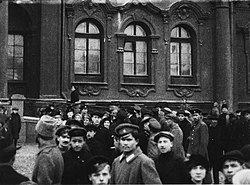
The Soviet started to form its own paramilitary power, the Red Guards, in March 1917. These armed worker detachments would later become a key force supporting the Bolshevik seizure of power and fighting in the subsequent civil war.
Image source: Red Guards (Russia)

Mar 15, 1917
% complete
The Russian Provisional Government, which replaced the Tsar in early 1917 after the February Revolution, chose to continue Russia's participation in World War I despite widespread war weariness among soldiers and civilians.
Image source: Russian Provisional Government
Apr 9, 1917 - Apr 16, 1917
% complete
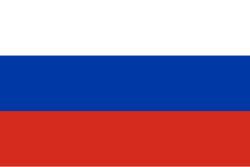
In April 1917, Germany transported Bolshevik leader Vladimir Lenin and 31 supporters in a sealed train from exile in Switzerland to Finland Station in Petrograd, hoping his anti-war agitation would destabilize and knock Russia out of the war.
Image source: Sealed train
Jul 16, 1917 - Jul 20, 1917
% complete
The defeat and ongoing hardships of war led to anti-government riots in Petrograd known as the 'July Days' of 1917, reflecting growing public anger with the Provisional Government's continuation of the war.
Image source: July Days
Nov 1, 1917 - Oct 25, 1922
% complete
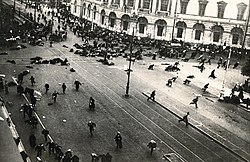
Subsequent attempts by the Soviets to restore power in the lost territories during the Russian Civil War had mixed results, with the Red Army losing the three Baltic countries but regaining Azerbaijan, Armenia, Belarus, Georgia, and Ukraine by 1921. The loss of Ukraine and the Baltics had created dangerous bases of anti-Bolshevik military activity.
Image source: Russian Civil War
Feb 12, 1919 - Mar 18, 1921
% complete
The Polish–Soviet War was particularly bitter; it ended with the Treaty of Riga in March 1921, fixing Poland's eastern border well east of the Curzon Line and confirming the loss of territory the Soviets had sought to recover.
Image source: Treaty of Riga
Oct 13, 1921
% complete
The border with Turkey established by the Treaty of Brest-Litovsk was largely affirmed by the Treaty of Kars in 1921, cementing the transfer of Kars, Ardahan, and surrounding regions from Soviet control to Turkey.
Image source: Treaty of Kars
Apr 16, 1922
% complete
Under the Treaty of Rapallo, concluded in April 1922, Germany accepted the Treaty of Brest-Litovsk's nullification, and the two powers renounced all territorial and financial claims against each other, re-establishing diplomatic relations between Weimar Germany and Soviet Russia.
Image source: Treaty of Rapallo (1922)
Dec 15, 1917
% complete
On 15 December 1917, an armistice between Soviet Russia and the Central Powers was concluded at Brest-Litovsk, halting hostilities on the Eastern Front and opening the way for formal peace negotiations.
Image source: Armistice between Russia and the Central Powers
Jan 1, 1918
% complete
In January 1918, during the peace negotiations, the Central Powers demanded the secession of all occupied territories of the former Russian Empire, presenting harsh terms that split the Bolshevik leadership over whether to accept them.
Image source: Treaty of Brest-Litovsk
Feb 9, 1918
% complete
The Central Powers signed a prior Treaty of Brest-Litovsk with the Ukrainian People's Republic on 9 February 1918, recognizing Ukrainian independence and securing grain supplies from Ukraine in exchange for military assistance against the Bolsheviks.
Image source: Treaty of Brest-Litovsk (Ukraine–Central Powers)
Feb 10, 1918
% complete
Lenin agreed to Trotsky's formula – a position summed up as 'no war – no peace' – which was announced when the negotiators reconvened on 10 February 1918. The Soviets would neither sign the harsh terms nor resume fighting, but Germany soon resumed its offensive.
Mar 3, 1918
% complete
The Treaty of Brest-Litovsk was signed at 17:50 on 3 March 1918 between Soviet Russia and the Central Powers (Germany, Austria-Hungary, the Ottoman Empire, and Bulgaria), by which Russia withdrew from World War I. It was signed at Brest-Litovsk (now Brest, Belarus), where delegates were housed in temporary wooden structures because the city had been burnt in 1915 by the retreating Russian army.
Mar 3, 1918
% complete
At the insistence of Talaat Pasha, the treaty declared that the territory the Ottoman Empire surrendered to Russia in the Russo-Turkish War (1877–1878), specifically Ardahan, Kars, and Batumi, were to be returned to Ottoman control.
Mar 3, 1918
% complete
Under the treaty, the Soviet government confirmed the independence of Finland, which it had recognized in January 1918, and pledged to end its war with the Ukrainian People's Republic, which the Central Powers had recognized under the prior treaty of 9 February 1918.
Jan 1, 1918 - Nov 11, 1918
% complete
The Germans began slowly but steadily withdrawing personnel from the occupied territories from east to west as troop transfers to the Western Front continued throughout 1918, weakening their grip on Ukraine, the Baltics, and other ceded lands.
Mar 21, 1918 - Jul 18, 1918
% complete
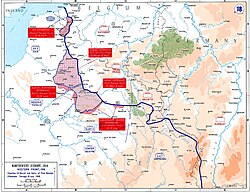
Germany transferred hundreds of thousands of veteran troops freed from the Eastern Front to the Western Front for the 1918 Spring Offensive, which shocked the Allied Powers but ultimately failed to achieve a decisive victory.
Image source: German spring offensive
May 1, 1918
% complete
The Ottoman Empire broke the terms of the treaty by invading the newly created First Republic of Armenia in May 1918, advancing into the Caucasus beyond the boundaries agreed upon at Brest-Litovsk.
Image source: First Republic of Armenia
Jul 1, 1918
% complete
Later in 1918, German aristocrats Wilhelm Karl, Duke of Urach (for Lithuania), and Adolf Friedrich, Duke of Mecklenburg-Schwerin (for the planned United Baltic Duchy), were nominally appointed but in reality never became rulers of these envisaged new pro-German countries.
Image source: United Baltic Duchy
Jul 6, 1918 - Jul 7, 1918
% complete
In July 1918 the Left SRs assassinated German Ambassador Wilhelm von Mirbach in Moscow in the hopes that it would induce Germany to annul the treaty, leading to the Left SR Uprising against the Bolshevik government.
Image source: Left SR uprising
Aug 27, 1918
% complete
In the wake of Soviet repudiation of Tsarist bonds, nationalisation of foreign-owned property, confiscation of foreign assets, and Entente forces landing on Russian territory, the Soviets and Germany signed an additional agreement on 27 August 1918 requiring Russia to pay six billion marks in war reparations.
Nov 4, 1918
% complete
On 4 November 1918, 'the Soviet courier's packing-case had come to pieces' in a Berlin railway station; it was filled with insurrectionary documents, embarrassing the Soviet embassy and straining relations with Germany.
Image source: Adolph Joffe
Nov 5, 1918
% complete
Following the discovery of insurrectionary documents, Soviet ambassador Adolf Joffe and his staff were ejected from Germany in a sealed train on 5 November 1918, ending diplomatic relations between the two governments.
Nov 11, 1918
% complete
The treaty was annulled by the Armistice of 11 November 1918, in which Germany surrendered to the western Allied Powers, ending World War I. One clause of the armistice explicitly abrogated the Brest-Litovsk treaty.
Image source: Armistice of 11 November 1918
Nov 13, 1918
% complete
Next, the Bolshevik legislature (VTsIK) annulled the treaty on 13 November 1918, and the text of the VTsIK Decision was printed in the newspaper Pravda the next day, formally voiding the agreement from the Soviet side.
Image source: All-Russian Central Executive Committee
Or browse the full history timeline directory, with more than 2,000 topics.
This Treaty of Brest-Litovsk timeline was generated with the help of AI, using information found on the internet.
We work hard to keep these timelines accurate, but mistakes do get through. If you spot one, email us at [email protected] and we'll fix it for future visitors.
Generate yours with AI or build it from scratch, for free.
Export your timeline, add your own events, edit or remove AI-generated events, and much more
No credit card required.
Cancel anytime.
Cancel anytime.
You can create an unlimited number of timelines with up to 10 events on each one, customize how they look, export them to PDF, PNG, PowerPoint, CSV, and Excel, and share them with a link. Paid plans raise the event limit and add features like spreadsheet imports and collaborators.
Yes. You can cancel your subscription from your account page at any time, and you will not be charged again. Your subscription stays active for the rest of the period you already paid for.
Yes. We will email you a reminder before the annual renewal, and we will also email you a receipt.
Yes. You can email us within 15 days of any payment, and we will issue you a full refund.
Check out our pricing docs or send us an email anytime: [email protected].