-
Resources
-
Pricing
The Adams-Onís Treaty of 1819 settled territorial disputes between the United States and Spain, transferring Florida to the United States and establishing a boundary with Spanish Mexico. More Less
Build a timeline like this one in minutes, for free. Start Yours →
1795
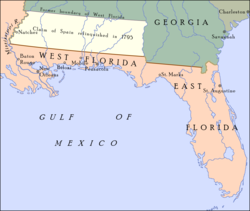
Pinckney's Treaty established borders between the United States and Spanish Florida, but continued American settlement in the region generated disputes that eventually contributed to negotiations over Florida and the broader southern boundary.
Image source: Pinckney's Treaty
1803
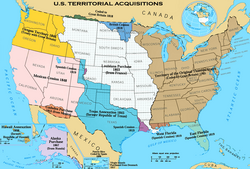
The Louisiana Purchase created disagreement over the new southern boundary of the United States. American and Spanish officials disputed whether the boundary ran along the Sabine River or as far south and west as the Rio Grande.
Image source: Louisiana Purchase
1807 - 1808
The outbreak of the Peninsular War in 1807, followed by the Spanish American wars of independence beginning in 1808, weakened Madrid's ability to defend and retain its American territories.
Image source: Peninsular War
1810 - 1813
Between 1810 and 1813, the United States annexed West Florida in stages, extending from the Mississippi River eastward to the Perdido River, which later became the modern boundary with Alabama.
Image source: West Florida Controversy
1817 - 1818
During the First Seminole War, the United States occupied the rest of Florida. The occupation gave Secretary of State John Quincy Adams an opportunity to negotiate favorable terms with Spain.
Image source: Seminole Wars
1818
The Anglo-American Convention of 1818 allowed both American and British citizens to settle land north of the 42nd parallel and west of the Continental Divide, helping establish the wider territorial context surrounding the Adams–Onís settlement.
Image source: Treaty of 1818
1819
By 1819, Spain was prepared to accept the loss of Florida in exchange for a firm boundary in Texas, resolving major territorial disputes between the two countries.
Image source: Adams–Onís Treaty
Feb 22, 1819
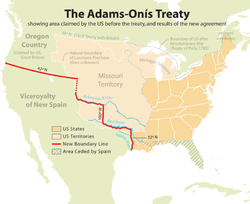
The Adams–Onís Treaty was signed by John Quincy Adams for the United States and Luis de Onís for Spain. The agreement settled territorial claims, transferred Florida to the United States, and defined a boundary extending westward toward the Pacific.
1819 - Oct 1820
Madrid delayed ratification until October 1820, hoping that diplomatic pressure would dissuade the United States from supporting anti-Spanish revolutionaries in the Americas.
Feb 24, 1819
The United States Senate approved the Adams–Onís Treaty unanimously two days after its signing, clearing the American constitutional requirement for ratification.
1821 - 1824
Under Article 11, the United States established a commission to process claims by private American citizens against Spain. Before dissolving in 1824, the commission distributed approximately $5 million.
Feb 22, 1821
After a proposal to defeat or alter the agreement was rejected, the Adams–Onís Treaty officially became effective on February 22, 1821.
Aug 24, 1821
The treaty's provisions remained in full effect only until August 24, 1821, when the Treaty of Córdoba acknowledged Mexican independence from Spain.
1823
The principles associated with American opposition to renewed European intervention in the Americas were set out in greater detail in the Monroe Doctrine of 1823.
Image source: Monroe Doctrine
Aug 24, 1821
Spain recognized Mexican independence through the Treaty of Córdoba, signed on August 24, 1821. This ended the period in which Spain could fully control the territories involved in the Adams–Onís settlement.
Image source: Treaty of Córdoba
1824
The Russo-American Treaty of 1824 led the Russian Empire to cede its claims south of the 54°40′ north parallel to the United States, clarifying the northern Pacific context of the American territorial claim.
Image source: Russo-American Treaty of 1824
1825
The Treaty of Saint Petersburg established the southern boundary of Alaska on the same 54°40′ parallel. It also addressed Russian trading rights south of the line and British navigation rights north of it.
Image source: Treaty of Saint Petersburg (1825)
1831
Although Mexico was not initially a party to the Adams–Onís Treaty, it ratified the settlement in 1831 by agreeing to the 1828 Treaty of Limits with the United States.
Image source: Treaty of Limits (Mexico–United States)
1836
The eastern boundary of Texas was not firmly established until the independence of the Republic of Texas in 1836, leaving an important part of the Adams–Onís boundary framework contested.
Image source: Republic of Texas
1848
The Treaty of Guadalupe Hidalgo concluded the Mexican–American War and established the United States–Mexico boundary. It formalized Mexico's cession of Alta California and the present-day American Southwest, except for the later Gadsden Purchase territory of 1854.
Image source: Treaty of Guadalupe Hidalgo
1850
Upon statehood in 1850, California established the 42nd parallel as its constitutional de jure northern border, preserving the line that had existed in 1819 when the region was part of Spanish Mexico.
Image source: California
1860
In 1860, Texas organized the area later known as Greer County, reflecting continuing uncertainty over the boundary described by the Adams–Onís Treaty.
Image source: Greer County, Texas
1868 - 1870
A border survey conducted from 1868 to 1870 after Oregon's admission as a state made errors in demarcating and marking the Oregon–California boundary. The resulting dispute continues to the present day.
1896
The matter concerning Greer County was settled by a United States Supreme Court ruling in 1896, which upheld federal claims to the territory. The area was subsequently added to Oklahoma Territory.
Image source: Greer County, Oklahoma
1902
The Adams–Onís Treaty was formally terminated in 1902, although many of its boundary consequences had already been superseded or incorporated into later agreements.
Build a timeline like this one in minutes, for free. Start Yours →
Or browse the full history timeline directory, with more than 2,500 topics.
This Adams-Onís Treaty timeline was generated with the help of AI, using information found on the internet.
We work hard to keep these timelines accurate, but mistakes do get through. If you spot one, email us at [email protected] and we'll fix it for future visitors.
Generate yours with AI or build it from scratch, for free.
Export your timeline, add your own events, edit or remove AI-generated events, and much more
No credit card required.
15-day money-back guarantee.
You can create an unlimited number of timelines with up to 10 events on each one, customize how they look, export them to PDF, PNG, PowerPoint, CSV, and Excel, and share them with a link. Timelines made with Timeline Maker AI keep every event the generator created, and you can add up to 5 events of your own. Paid plans remove the event limit, add spreadsheet imports and hide Preceden's branding, and the higher-priced plan also adds collaborators, a custom logo and a custom domain.
Yes. You can cancel your subscription from your account page at any time, and you will not be charged again. Your subscription stays active for the rest of the period you already paid for.
Yes. We email you a reminder 15 days before your annual renewal, and we email you a receipt after every payment.
Yes. You can email us within 15 days of any payment, and we will issue you a full refund.
Check out our pricing docs or send us an email anytime: [email protected].