-
Use Cases
-
Resources
-
Pricing
The Maastricht Treaty, formally the Treaty on European Union, was signed on 7 February 1992 in Maastricht, Netherlands, by the twelve member states of the European Community. It established the European Union, created the three-pillar structure (European Communities, Common Foreign and Security Policy, Justice and Home Affairs), set out a roadmap for Economic and Monetary Union leading to the euro, introduced EU citizenship, and required ratification through national referendums or parliamentary votes. After challenges including Denmark's initial rejection, it entered into force on 1 November 1993. More Less
1957
% complete
From the establishment of the European Economic Community in 1957, integrationists argued the free movement of workers was the logical corollary of the free movement of capital, goods and services and integral to the establishment of a common (and later single) European market.
Image source: European Economic Community
1970
% complete
Coordination in foreign and security policy had taken place since the beginning of the 1970s under the name of European Political Cooperation (EPC), which laid groundwork for the common foreign and security policy provisions later formalized by the Maastricht Treaty.
Image source: European Political Co-operation
1978
% complete
The European Monetary System (EMS) was agreed in 1978 as a means of reducing the "barrier" that exchange-rate volatility presented for intra-Community commerce (and for the management of payments under the Common Agricultural Policy). Its Exchange Rate Mechanism (ERM) was its centrepiece.
Image source: European Monetary System
1983
% complete
French President François Mitterrand was forced to abandon the centrepiece of his Socialist programme in 1983, a job creating reflation, due to speculation against the franc, illustrating the monetary pressures that pushed France toward monetary union.
Image source: François Mitterrand
1987
% complete
The Single European Act first wrote European Political Cooperation into the treaties, marking an early step toward formalizing foreign policy coordination among member states ahead of the deeper integration pursued at Maastricht.
Nov 9, 1989
% complete
After the fall of the Berlin Wall in late 1989, Germany sought re-unification. This transformed the political landscape of Europe and set in motion negotiations over Germany's role in European integration.
Image source: Fall of the Berlin Wall
1990
% complete
Britain had signed up to the ERM in 1990 as a token of the government's commitment to control inflation (then running at three times the rate of Germany), a decision with major consequences two years later.
Image source: European Exchange Rate Mechanism
1990
% complete
When German Chancellor Helmut Kohl asked for re-unification in 1990, French President Mitterrand would only accept it if Germany abandoned the Deutsche Mark and adopted a common currency — a pivotal bargain driving the Maastricht negotiations on monetary union.
Image source: Helmut Kohl
Jan 1990
% complete
From the beginning of 1990, high German interest rates, set by the Bundesbank to counteract the inflationary impact of expenditure on German reunification, caused significant stress across the whole of the ERM.
1990
% complete
Cooperation on law enforcement, criminal justice, asylum, immigration and other judicial matters was being pursued under the 1990 Schengen Agreement and Convention, providing a foundation for the Maastricht Treaty's Justice and Home Affairs pillar.
Image source: Schengen Agreement
Feb 7, 1992
% complete
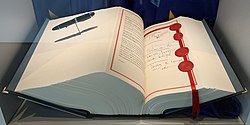
The twelve members of the European Communities signed the Maastricht Treaty on 7 February 1992: Belgium, Denmark, France, Germany, Greece, Ireland, Italy, Luxembourg, Portugal, Spain, the Netherlands and the United Kingdom. It announced "a new stage in the process of European integration," chiefly in provisions for shared European citizenship, eventual introduction of a single currency, common foreign and security policies, and changes to the institutions including a strengthened European Parliament and more majority voting on the Council of Ministers.
Image source: Maastricht Treaty
Jun 2, 1992
% complete
In the first Danish referendum, on 2 June 1992, the treaty was rejected by a margin of 50.7% to 49.3%, sending shockwaves through the ratification process across Europe.
Jun 18, 1992
% complete
In Ireland, the Eleventh Amendment of the Constitution, allowing the state to ratify the Treaty, was approved in a referendum held on 18 June 1992 with the support of 69.1% of votes cast.
Sep 1992
% complete
In September 1992, a referendum in France narrowly supported the ratification of the treaty, with 50.8% in favour, revealing deep public divisions over European integration even in a founding member state.
Sep 16, 1992
% complete
On 16 September 1992 the British government was forced to withdraw the pound sterling from the European Exchange Rate Mechanism (ERM), a humiliating episode known as Black Wednesday that shaped British attitudes toward European monetary integration.
Image source: Black Wednesday
Dec 2, 1992
% complete
In Germany, the Maastricht Treaty passed the Bundestag on 2 December 1992, with a majority of 543 out of 562, and the Bundesrat approved it with unanimity.
Image source: Bundestag
May 18, 1993
% complete
On 18 May 1993, after opt-outs were negotiated following the first rejection, the Maastricht Treaty was endorsed in Denmark by a vote of 56.7%.
Oct 12, 1993
% complete
The German court delivered its judgment on 12 October 1993, ruling the Maastricht Treaty compatible with the Grundgesetz, but providing that the European Union could not endow itself with more powers without the Bundestag's approval.
Image source: Federal Constitutional Court
Nov 1, 1993
% complete
Germany was the last member state to ratify the treaty, which then entered into force on 1 November 1993, formally establishing the European Union. The treaty provided that, with all Member States having ratified, it would come into force on this date.
1995
% complete
The common currency whose adoption was envisaged by the Treaty's convergence obligations — the "Maastricht criteria" — was designated at the 1995 Madrid European Council as the Euro. These criteria represented performance thresholds for member states to progress toward the third stage of Economic and Monetary Union.
Image source: Euro
1997
% complete
Following the EU accessions of Austria, Finland, and Sweden, the Maastricht framework was amended in turn by the treaties of Amsterdam (1997) and later Nice (2001), continuing the constitutional debate opened at Maastricht.
Image source: Treaty of Amsterdam
Jun 1, 1998
% complete
As envisaged by the Treaty, the European Central Bank replaced its shadow predecessor, the European Monetary Institute, on 1 June 1998, preparing to exercise full powers over monetary policy in the euro area.
Image source: European Central Bank
Jan 1, 1999
% complete
The ECB began exercising its full powers with the introduction of the euro on 1 January 1999, fulfilling the single currency ambition central to the Maastricht Treaty.
2001
% complete
Following enlargement, the Treaty of Nice amended the EU treaties again, continuing institutional reforms begun at Maastricht as part of an ongoing constitutional debate about the Union's structure.
2007
% complete
The constitutional debate opened by the Maastricht Treaty continued through subsequent treaties, culminating in the 2007 Treaty of Lisbon, which amends both founding treaties again and renames the TEC as the Treaty on the Functioning of the European Union (TFEU).
Image source: Treaty of Lisbon
2009
% complete
Beginning in 2009 with Greece, the governments of several Euro-zone countries (Portugal, Ireland, Spain and Cyprus) declared themselves unable to repay or refinance their government debt or to bail out over-indebted banks without third-party assistance. The Maastricht criteria became the most enduring reference point for rules of compliance in the currency union, and the constraints became a focus of political scrutiny and public protest.
Image source: European debt crisis
2016
% complete
Researchers and observers suggest that, in the United Kingdom, the Maastricht Treaty represented "a critical turning point" in terms of divisions within the Conservative Party over European integration and the ruling party's ultimate fragmentation in 2016 into Leave and Remain factions.
Or browse the full history timeline directory, with more than 2,000 topics.
This Maastricht Treaty timeline was generated with the help of AI, using information found on the internet.
We work hard to keep these timelines accurate, but mistakes do get through. If you spot one, email us at [email protected] and we'll fix it for future visitors.
Generate yours with AI or build it from scratch, for free.
Export your timeline, add your own events, edit or remove AI-generated events, and much more
No credit card required.
Cancel anytime.
Cancel anytime.
You can create an unlimited number of timelines with up to 10 events on each one, customize how they look, export them to PDF, PNG, PowerPoint, CSV, and Excel, and share them with a link. Paid plans raise the event limit and add features like spreadsheet imports and collaborators.
Yes. You can cancel your subscription from your account page at any time, and you will not be charged again. Your subscription stays active for the rest of the period you already paid for.
Yes. We will email you a reminder before the annual renewal, and we will also email you a receipt.
Yes. You can email us within 15 days of any payment, and we will issue you a full refund.
Check out our pricing docs or send us an email anytime: [email protected].