-
Use Cases
-
Resources
-
Pricing
The Treaty of Paris, signed on September 3, 1783, officially ended the American Revolutionary War between Great Britain and the United States. Negotiated by American delegates Benjamin Franklin, John Adams, and John Jay, the treaty recognized the United States as an independent nation and established generous territorial boundaries extending to the Mississippi River. The agreement also addressed fishing rights, debts, and the return of Loyalist property, laying the diplomatic foundation for the new republic. More Less
Oct 19, 1781
% complete
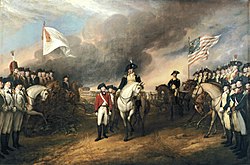
The British defeat at Yorktown in Virginia was a decisive American and French victory that effectively ended major combat in the War of American Independence. The surrender of General Cornwallis's army shattered Prime Minister North's government's position and set in motion the chain of events that would lead to peace negotiations in Paris.
Image source: Siege of Yorktown
Mar 20, 1782
% complete
In the wake of the British defeat at Yorktown, Prime Minister Lord North's government fell on March 20, 1782. The collapse of North's ministry opened the way for a new British government willing to pursue peace with the United States and its allies.
Image source: Treaty of Paris (1783)
Apr 1782
% complete
Following the fall of Prime Minister North's government, peace negotiations began in Paris in April 1782. Representatives of Great Britain and the United States met to discuss terms that would end the War of American Independence.
Jun 1782 - Aug 1782
% complete
The peace negotiations continued through the summer of 1782, with American commissioners John Adams, Benjamin Franklin, and John Jay pressing for recognition of American independence and favorable boundaries, while Britain sought to separate the Americans from their French ally.
Sep 1782
% complete
In September 1782, French Foreign Minister Vergennes proposed a solution to the deadlocked negotiations between the United States and the British. The proposal was rejected by the United States, whose commissioners preferred to negotiate directly with Britain on more favorable terms.
Sep 1782 - Nov 1782
% complete
During the late stages of negotiation, the American diplomats insisted that Great Britain formally recognize the Thirteen Colonies as free, sovereign, and independent states. This demand became the cornerstone of the eventual agreement drafted in November 1782.
Oct 1782 - Nov 1782
% complete
American negotiators won important concessions guaranteeing fishing rights off the Newfoundland coast. These provisions were vital to New England's economy and were hard-won during the drafting of the treaty in the fall of 1782.
Oct 1782 - Nov 1782
% complete
A central element of the negotiations was the definition of the new United States' boundaries. The drafters agreed on borders extending westward to the Mississippi River, granting the new nation vast territory that had been part of colonial British America.
Oct 1782 - Nov 1782
% complete
The draft treaty included articles addressing debts owed to creditors on either side and recommending restitution for Loyalists whose property had been confiscated. These clauses left unfinished business that would complicate Anglo-American relations for years after the war.
Nov 30, 1782
% complete
On November 30, 1782, the treaty was drafted, establishing preliminary articles of peace between Great Britain and the United States. The document recognized American independence and laid out the boundaries and terms that would form the basis of the final Treaty of Paris.
Jan 1783 - Feb 1783
% complete
As part of the Peace of Paris, France and Spain concluded their own treaties with Great Britain in early 1783. The Treaty of Paris between the United States and Britain forms one treaty out of many that are collectively named the Peace of Paris (1783).
Image source: Peace of Paris (1783)
Sep 3, 1783
% complete
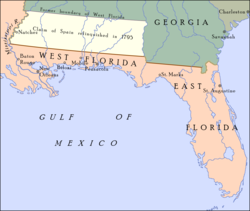
Under the treaty between Britain and Spain concluded as part of the Peace of Paris, the territories of East and West Florida were ceded to Spain without a clear northern boundary. This ambiguity created a territorial dispute that persisted for years.
Sep 3, 1783
% complete
The Spanish government assumed that the northern boundary of its newly acquired Floridas was the same as in the 1763 agreement by which it had first given its territory in Florida to Great Britain. This assumption clashed with British and later American interpretations of the cession.
1784
% complete
The treaty returning Dutch possessions captured in 1781 and granting Britain trading privileges in the Dutch East Indies was not finalized until 1784, illustrating how the various agreements of the Peace of Paris took years to complete.
Image source: Treaty of Paris (1783)
1784 - 1795
% complete
The unclear northern boundary of Spanish East and West Florida, ceded without precise limits in 1783, produced a prolonged territorial dispute between Spain and the United States. The disagreement was ultimately resolved by the Treaty of Madrid in 1795.
Image source: Pinckney's Treaty
1784
% complete
The American diplomats' expectation of negotiating a commercial treaty with Britain to resolve some of the unfinished business of the Treaty of Paris failed to materialize in 1784. The absence of such an agreement left trade relations between the two countries unresolved.
May 20, 1784
% complete
Dutch possessions in the East Indies, captured by Britain in 1781 during the Fourth Anglo-Dutch War, were returned to the Netherlands in exchange for trading privileges in the Dutch East Indies. The treaty implementing this exchange was part of the broader Peace of Paris settlements.
Image source: Fourth Anglo-Dutch War
Sep 3, 1783
% complete
The Treaty of Paris was signed at the Hôtel d'York, at present-day 56 Rue Jacob in Paris, on September 3, 1783. The signing officially ended the War of American Independence and marked the formal birth of American independence in international law.
Sep 3, 1783
% complete
John Adams signed the Treaty of Paris on behalf of the United States on September 3, 1783. One of America's most tireless advocates of independence, Adams played a crucial role in securing recognition of the United States as free, sovereign, and independent.
Image source: John Adams
Sep 3, 1783
% complete
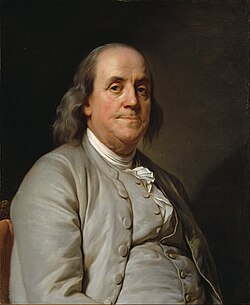
Benjamin Franklin signed the Treaty of Paris on September 3, 1783, as one of the American commissioners. His diplomatic skill in Paris, cultivated over years of cultivating French support for the American cause, proved decisive in achieving favorable peace terms.
Image source: Benjamin Franklin
Sep 3, 1783
% complete
John Jay signed the Treaty of Paris on September 3, 1783. Jay was instrumental in insisting that Britain recognize American independence outright before any other negotiations proceeded, strengthening the American position considerably.
Image source: John Jay
Sep 3, 1783
% complete
David Hartley signed the Treaty of Paris on behalf of King George III of Great Britain on September 3, 1783. As the British representative, Hartley affixed his name alongside Adams, Franklin, and Jay, formally concluding the War of American Independence.
Image source: David Hartley (philosopher)
Sep 3, 1783
% complete
With the signing of the Treaty of Paris, Great Britain officially recognized the Thirteen Colonies, formerly part of colonial British America, to be free, sovereign and independent unified states. This recognition ended the War of American Independence and legitimized the new nation on the world stage.
Jan 14, 1784
% complete
The Congress of the Confederation, operating as the legislative body of the newly established United States, ratified the Treaty of Paris on January 14, 1784, in Annapolis, Maryland. The ratification took place in the Old Senate Chamber of the Maryland State House.
Jan 14, 1784 - Mar 1784
% complete
After ratification by the Congress of the Confederation, copies of the treaty were sent back to Europe for ratification by the other parties involved. The first copy reached France in March 1784, beginning the process of completing the international ratification of the peace settlement.
Mar 1784
% complete
In March 1784, the first ratified copy of the Treaty of Paris reached France. This delivery was an important step in exchanging the ratified versions among the signatories and bringing the treaty fully into force.
Apr 9, 1784
% complete
Great Britain formally ratified the Treaty of Paris on April 9, 1784. With this act, the British government confirmed the terms recognizing American independence and setting the boundaries of the new nation.
May 12, 1784
% complete
The ratified versions of the Treaty of Paris were exchanged in Paris on May 12, 1784. This exchange completed the formal ratification process, making the treaty fully operative under international law.
Or browse the full history timeline directory, with more than 2,000 topics.
This Treaty of Paris 1783 timeline was generated with the help of AI, using information found on the internet.
We work hard to keep these timelines accurate, but mistakes do get through. If you spot one, email us at [email protected] and we'll fix it for future visitors.
Generate yours with AI or build it from scratch, for free.
Export your timeline, add your own events, edit or remove AI-generated events, and much more
No credit card required.
Cancel anytime.
Cancel anytime.
You can create an unlimited number of timelines with up to 10 events on each one, customize how they look, export them to PDF, PNG, PowerPoint, CSV, and Excel, and share them with a link. Paid plans raise the event limit and add features like spreadsheet imports and collaborators.
Yes. You can cancel your subscription from your account page at any time, and you will not be charged again. Your subscription stays active for the rest of the period you already paid for.
Yes. We will email you a reminder before the annual renewal, and we will also email you a receipt.
Yes. You can email us within 15 days of any payment, and we will issue you a full refund.
Check out our pricing docs or send us an email anytime: [email protected].