
-
Use Cases
-
Resources
-
Pricing
The Treaty of Utrecht refers to a series of individual peace treaties signed in 1713 in the Dutch city of Utrecht between France, Spain, Great Britain, the Dutch Republic, Portugal, Savoy, and Prussia. Together with later agreements such as the Treaty of Rastatt (1714), they brought an end to the War of the Spanish Succession. The treaties recognized Philip V as King of Spain while prohibiting the union of the French and Spanish crowns, and they significantly redrew colonial boundaries, granting Britain Gibraltar, Minorca, Newfoundland, and key trading rights, establishing a new balance of power in Europe. More Less
1701
% complete
The concept of the balance of power was first mentioned in 1701 by Charles Davenant in his Essays on the Balance of Power. The idea would later be widely publicised in Britain by Daniel Defoe and reflected in the wording of the treaties.
Image source: Charles Davenant
1709
% complete
Author and Tory satirist Daniel Defoe widely publicised the idea of the balance of power in Britain through his 1709 article A Review of the Affairs of France.
Image source: Daniel Defoe
1713
% complete
The Pragmatic Sanction of 1713 established Habsburg succession rules, but these gains were later diminished when Charles disinherited his nieces in favour of his daughter Maria Theresa.
Image source: Pragmatic Sanction of 1713
Aug 1714
% complete
France accepted the Protestant succession on the British throne under the treaties, ensuring a smooth transition when Queen Anne died in August 1714.
Image source: Anne, Queen of Great Britain
1715
% complete
The Dutch achieved their condominium in the Austrian Netherlands through the Austro-Dutch Barrier Treaty of 1715, securing their defensive positions in the Southern Netherlands.
Image source: Barrier Treaty
1716
% complete
Under the 1716 Anglo-French Treaty, France ended its support for the Stuart claimants to the British throne, cementing the acceptance of the Hanoverian succession agreed at Utrecht.
1718
% complete
Spain recovered remarkably quickly after the war; the recapture of Naples and Sicily in 1718 was prevented by British naval power, though a second Spanish attempt succeeded in 1734.
Image source: War of the Quadruple Alliance
1740
% complete
Though France remained a great power, concern at its relative decline in military and economic terms compared to Britain was an underlying cause of the War of the Austrian Succession in 1740.
Image source: War of the Austrian Succession
1742
% complete
The dispute over the Pragmatic Sanction loosened Habsburg control over the Empire; Bavaria, Hanover, Prussia and Saxony acted as independent powers, and in 1742 Charles of Bavaria became the first non-Habsburg Emperor in over 300 years.
Image source: Charles VII, Holy Roman Emperor
Feb 1701
% complete
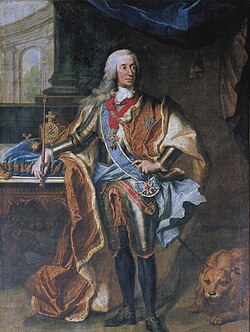
While the final settlement at Utrecht proved far more favourable to France than the Allied offer of 1709 had been, France had gained little that had not already been achieved through diplomacy by February 1701.
Image source: Peace of Utrecht
1709
% complete
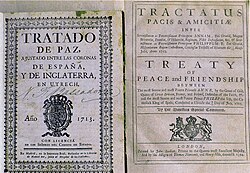
The treaty's territorial provisions did not go as far as the Whigs in Britain would have liked, considering that the French had made overtures for peace in 1706 and again in 1709 before rejecting the Allied terms.
1710
% complete
In the Parliament of 1710 the Tories gained control of the House of Commons, and they wished for an end to Great Britain's participation in a European war that had drained the nation's resources for years.
Jan 2, 1710
% complete
On 2 January 1710, King Louis XIV of France agreed to commence peace negotiations with the Allies in the city of Geertruidenberg in the Netherlands, marking an early attempt to end the War of the Spanish Succession.
May 1711
% complete
Trevelyan noted that the finances of the country were based in May 1711 on the assumption that the Asiento, or monopoly of the slave trade with Spanish America, would be wrested from France as an integral part of the terms of peace.
May 23, 1711
% complete
Robert Harley was created Earl of Oxford and Mortimer on 23 May 1711. His administration, together with Viscount Bolingbroke, proved more flexible at the bargaining table and were characterised by the Whigs as 'pro-French'.
Image source: Robert Harley, 1st Earl of Oxford and Earl Mortimer
Oct 1711
% complete
France and Great Britain came to terms in October 1711, when the preliminaries of peace had been signed in London, paving the way for a broader congress among all belligerents.
Jan 29, 1712
% complete
The Congress of Utrecht opened on 29 January 1712, with the British representatives being John Robinson, Bishop of Bristol, and Thomas Wentworth, Lord Strafford, beginning formal negotiations to end the war.
Image source: Peace of Utrecht
1707 - 1716
% complete
The 1707, 1715 and 1716 Nueva Planta decrees abolished regional political structures in the kingdoms of Aragon, Valencia, Majorca and the Principality of Catalonia, although Catalonia and Aragon retained some rights until 1767.
Image source: Nueva Planta decrees
1712 - 1714
% complete
A series of deaths between 1712 and 1714 left the five-year-old Louis XV as his great-grandfather Louis XIV's heir, making the guarantees surrounding the separation of the French and Spanish crowns increasingly important.
Image source: Louis XV
1713
% complete
Under Article XIII, despite British demands to preserve Catalan constitutions and rights, Spain only agreed to grant an amnesty to Habsburg supporters, implying the imposition of Castilian laws and institutions on the Principality of Catalonia.
1713 - 1714
% complete
The lack of guarantees led to the prolongation of the war between the Principality of Catalonia and the Bourbon Crown, in a separate conflict known as the War of the Catalans (1713–1714).
Jul 10, 1712
% complete
One of the first questions discussed at Utrecht was the nature of the guarantees to be given by France and Spain that their crowns would be kept separate. Little progress was made until 10 July 1712, when Philip signed a renunciation.
Image source: Philip V of Spain
Nov 7, 1712
% complete
The first treaty signed at Utrecht was the truce between France and Portugal on 7 November 1712, marking the beginning of the series of agreements concluded in the Dutch city.
Mar 14, 1713
% complete
The truce between France and Savoy was signed on 14 March 1713, following the earlier Franco-Portuguese truce and preceding the main treaties of peace.
Apr 11, 1713
% complete
On 11 April 1713, France signed treaties of commerce and navigation with Great Britain and the Dutch Republic, opening new trading relationships between the former enemies.
Apr 11, 1713
% complete
The main treaties of peace between the belligerents of the War of the Spanish Succession were signed on 11 April 1713 at Utrecht, reshaping the balance of power in Europe.
Dec 9, 1713
% complete
Great Britain signed a like treaty of commerce and navigation with Spain on 9 December 1713, securing trade advantages including access to Spanish markets.
1714
% complete
The successful French Rhineland campaign of 1713 finally induced Charles to sign the 1714 treaties of Rastatt and Baden, ending hostilities between Austria and France.
Image source: Treaty of Rastatt
Jun 26, 1714
% complete
Negotiations at Utrecht dragged on into the next year; the peace treaty between Spain and the Netherlands was finally signed on 26 June 1714, concluding one of the last bilateral settlements.
Feb 6, 1715
% complete
The peace treaty between Spain and Portugal, signed on 6 February 1715, was the final agreement of the Utrecht negotiations, which had stretched from April 1713 into early 1715.
Or browse the full history timeline directory, with more than 2,000 topics.
This Treaty of Utrecht timeline was generated with the help of AI, using information found on the internet.
We work hard to keep these timelines accurate, but mistakes do get through. If you spot one, email us at [email protected] and we'll fix it for future visitors.
Generate yours with AI or build it from scratch, for free.
Export your timeline, add your own events, edit or remove AI-generated events, and much more
No credit card required.
Cancel anytime.
Cancel anytime.
You can create an unlimited number of timelines with up to 10 events on each one, customize how they look, export them to PDF, PNG, PowerPoint, CSV, and Excel, and share them with a link. Paid plans raise the event limit and add features like spreadsheet imports and collaborators.
Yes. You can cancel your subscription from your account page at any time, and you will not be charged again. Your subscription stays active for the rest of the period you already paid for.
Yes. We will email you a reminder before the annual renewal, and we will also email you a receipt.
Yes. You can email us within 15 days of any payment, and we will issue you a full refund.
Check out our pricing docs or send us an email anytime: [email protected].