
-
Use Cases
-
Resources
-
Pricing
The Treaty of Guadalupe Hidalgo, signed on February 2, 1848, ended the Mexican-American War between the United States and Mexico. Under its terms, Mexico ceded vast territories—including present-day California, Nevada, Utah, Arizona, New Mexico, and parts of Colorado and Wyoming—to the U.S. for $15 million. The treaty established the Rio Grande as the border of Texas and granted citizenship protections to Mexicans remaining in the ceded lands. More Less
Mar 1, 1845
% complete
On 1 March 1845, U.S. President John Tyler signed legislation to authorize the United States to annex the Republic of Texas, effective on 29 December 1845.
Image source: Texas annexation
Dec 29, 1845
% complete
The annexation of Texas by the United States became effective on 29 December 1845, a move Mexico disputed, including the right of the Republic of Texas to arrange the annexation.
Nov 10, 1845
% complete
On 10 November 1845, before the outbreak of hostilities, President James K. Polk sent an envoy to Mexico as tensions mounted over Texas and territorial claims.
Image source: James K. Polk
Apr 23, 1846
% complete
The Mexican Congress responded to rising hostilities with its own war declaration on 23 April 1846.
Image source: Mexican–American War
Apr 25, 1846 - Apr 26, 1846
% complete
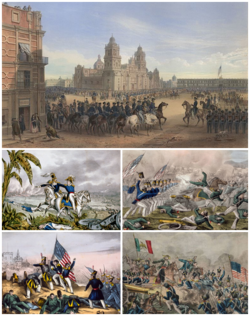
During the Thornton Affair of 25–26 April, Mexican forces attacked an American unit in the disputed area, killing 11 Americans, wounding five, and capturing 49.
Image source: Thornton Affair
May 13, 1846
% complete
After the Thornton Affair, Congress passed a declaration of war, which President Polk signed on 13 May 1846, beginning the Mexican–American War (1846–1848).
Jun 15, 1846
% complete
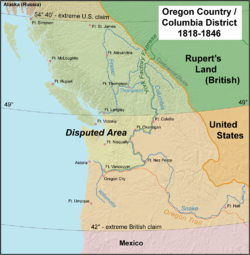
Meanwhile, Polk settled a major territorial dispute with Britain via the Oregon Treaty, which was signed on 15 June 1846.
Image source: Oregon Treaty
Jan 13, 1847
% complete
Fighting there ended on 13 January 1847 with the signing of the 'Capitulation Agreement' at 'Campo de Cahuenga' and the end of the Taos Revolt.
Image source: Treaty of Cahuenga
Sep 14, 1847
% complete
By the middle of September 1847, U.S. forces had taken the Mexican capital. After the defeat of its army and the fall of the capital in September 1847, Mexico entered into peace negotiations with the U.S.
Image source: Battle for Mexico City
Dec 1847
% complete
President Polk's State of the Union address in December 1847 upheld Mexican independence and argued at length that occupation and any further military operations in Mexico were aimed at securing a treaty ceding California and New Mexico up to approximately the 32nd parallel north, and possibly Baja California and transit rights across the Isthmus of Tehuantepec.
Feb 2, 1848
% complete
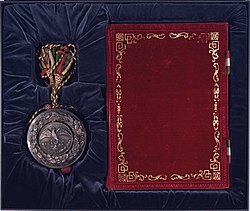
The Treaty of Guadalupe Hidalgo was signed on 2 February 1848 by Nicholas Trist for the United States and Luis G. Cuevas, Bernardo Couto, and Miguel Atristain as plenipotentiary representatives of Mexico at the main altar of the old Basilica of Guadalupe at Villa Hidalgo, officially ending the Mexican–American War.
Image source: Treaty of Guadalupe Hidalgo
Mar 10, 1848
% complete
The U.S. Senate ratified the treaty by a vote of 38 to 14 on 10 March 1848, after which Mexico ratified it through a legislative vote of 51 to 34 and a Senate vote of 33 to 4 on 19 May 1848.
May 1848
% complete
The Mexican Congress and President Manuel de la Peña y Peña met at Querétaro City in May 1848 while Mexico City was occupied, and were now faced with the task of negotiating the treaty while dealing with separatism and anarchy spreading throughout the country.
Image source: Manuel de la Peña y Peña
May 26, 1848
% complete
On 26 May 1848 the Mexican government received the commissioners Nathan Clifford and Ambrose Hundley Sevier, who were in Mexico to negotiate the treaty after congress had approved it with some slight modifications.
Image source: Nathan Clifford
May 30, 1848
% complete
On 30 May 1848, when the two countries exchanged ratifications of the treaty of Guadalupe Hidalgo, they further negotiated a three-article protocol to explain the amendments.
Jun 3, 1848
% complete
As the peace treaty was concluded and the occupiers were on the point of leaving the country, congress named José Joaquín Herrera to the presidency of the republic, and Peña y Peña left his post as president in exchange for the presidency of the Supreme Court on 3 June 1848.
Image source: José Joaquín de Herrera
Jul 4, 1848
% complete
The ratifications were exchanged on 30 May, and the treaty was formally proclaimed on 4 July 1848, officially ending the Mexican–American War (1846–1848).
1853
% complete
In 1853, American filibuster William Walker led an unauthorized expedition into Baja California and Sonora, proclaiming the short-lived Republic of Lower California with the aim of being annexed by the United States.
Image source: William Walker (filibuster)
1853
% complete
The remainder of New Mexico and Arizona was peacefully acquired under the Gadsden Purchase, carried out in 1853. The amount of land gained by the United States from Mexico was further increased, ceding parts of present-day southern Arizona and New Mexico.
Image source: Gadsden Purchase
1853
% complete
In 1853, in the Treaty of Mesilla concluding the Gadsden Purchase, Article XI of the Treaty of Guadalupe Hidalgo—which had obligated the U.S. government for damages done by Comanche and Apache raids between 1848 and 1853—was annulled.
Dec 30, 1853
% complete
On 30 December 1853, the countries, by agreement, altered the border from the initial one by increasing the number of border markers from 6 to 53.
Image source: Mexico–United States border
Jan 1854
% complete
Although Walker's unrecognized state collapsed in January 1854, Mexican president Antonio López de Santa Anna continued to see the US as a threat amid Mexico's persisting economic problems. Desiring to stave off American expansionist desires as well as alleviate domestic financial problems, Santa Anna sought to sell an area as small as possible to the US for as much money as possible, leading to the controversial $15 million Gadsden Purchase in 1854.
Image source: Antonio López de Santa Anna
1881
% complete
In the Gadsden transfer, the United States paid an additional $10 million (equivalent to $300 million in 2024) for land intended to accommodate a transcontinental railroad. The American Civil War delayed construction, but in 1881 the Southern Pacific Railroad was finally completed as a second transcontinental railroad, fulfilling the purpose of the acquisition.
Image source: Southern Pacific Railroad
1882 - 1889
% complete
Two later conventions, in 1882 and 1889, further clarified the boundaries, as some of the markers had been moved or destroyed.
1889
% complete
The Treaty of Guadalupe Hidalgo led to the establishment in 1889 of the International Boundary and Water Commission to maintain the border and, according to newer treaties, to allocate river waters between the two nations and to provide for flood control and water sanitation.
Image source: International Boundary and Water Commission
Or browse the full history timeline directory, with more than 2,000 topics.
This Treaty of Guadalupe Hidalgo timeline was generated with the help of AI, using information found on the internet.
We work hard to keep these timelines accurate, but mistakes do get through. If you spot one, email us at [email protected] and we'll fix it for future visitors.
Generate yours with AI or build it from scratch, for free.
Export your timeline, add your own events, edit or remove AI-generated events, and much more
No credit card required.
Cancel anytime.
Cancel anytime.
You can create an unlimited number of timelines with up to 10 events on each one, customize how they look, export them to PDF, PNG, PowerPoint, CSV, and Excel, and share them with a link. Paid plans raise the event limit and add features like spreadsheet imports and collaborators.
Yes. You can cancel your subscription from your account page at any time, and you will not be charged again. Your subscription stays active for the rest of the period you already paid for.
Yes. We will email you a reminder before the annual renewal, and we will also email you a receipt.
Yes. You can email us within 15 days of any payment, and we will issue you a full refund.
Check out our pricing docs or send us an email anytime: [email protected].