-
Use Cases
-
Resources
-
Pricing
The Treaty of Ghent was the peace agreement signed on December 24, 1814, in Ghent, Belgium (then part of the Netherlands), that formally ended the War of 1812 between the United States and Great Britain. Negotiated over several months by American and British delegates, the treaty restored pre-war boundaries, returned captured territory, and notably made no mention of the maritime grievances—such as impressment of sailors—that had originally sparked the conflict. Because communication was slow in that era, the Battle of New Orleans was fought on January 8, 1815, weeks after the treaty had already been signed. The treaty was ratified by the U.S. Senate on February 17, 1815. More Less
1813
% complete
All of Spanish West Florida west of the Perdido River, including the important port of Mobile, was occupied by the Americans in 1813, but the Treaty of Ghent did not force the Americans to leave this section of West Florida.
Image source: Treaty of Ghent
Dec 27, 1814 - Dec 30, 1814
% complete
It was ratified by George IV at the Carlton House on December 27, 1814, and the treaty was approved by the British Parliament and signed into law by the Prince Regent (the future King George IV) on December 30, 1814.
Jan 8, 1815
% complete
It took a month for news of the treaty to reach the United States, during which American forces under Andrew Jackson won the Battle of New Orleans on January 8, 1815, a decisive American victory fought after the treaty had already been signed.
Image source: Battle of New Orleans
Feb 16, 1815
% complete
The US Senate unanimously approved the treaty on February 16, 1815, moving the agreement one step closer to taking full effect.
Feb 17, 1815
% complete
President James Madison signed the treaty and exchanged final ratified copies with the British ambassador on February 17, 1815, formally ending the war. The treaty took effect in February 1815.
Feb 23, 1815
% complete
The Daily National Intelligencer announced the United States' ratification of the Treaty of Ghent on February 23, 1815, spreading word of the war's official end across the nation.
Mar 13, 1815
% complete
She brought back the ratification by the United States Senate (dated February 17, 1815), which arrived at the Foreign Office on March 13, 1815, completing the exchange of ratifications between the two governments.
1826
% complete
However, in 1826, Britain instead paid the U.S. government US$1,204,960 (equivalent to $34,288,200 in 2025) to compensate American slaveholders.
Oct 1, 1813 - Dec 31, 1813
% complete
In late 1813, Emperor Alexander I of Russia offered to mediate peace negotiations between the British and Americans at Saint Petersburg, but the British rejected Russian mediation and never sent a delegation.
Jan 1814
% complete
A new arrangement was made in early January 1814 to hold direct peace talks at Gothenburg in Sweden, yet the British again failed to show up for several months.
1814
% complete
The British government's main diplomatic focus in 1814 was not ending the war in North America, but the European balance of power after the apparent defeat of Napoleonic France and the return to power in Paris of the pro-British Bourbons.
Mar 1814 - Apr 1814
% complete
With the defeat of Napoleon in March–April 1814, the main British goals of stopping American trade with France and impressment of sailors from American ships were dead letters. Each side was tired of the war since export trade was all but paralyzed, and France was no longer an enemy of Britain, so the Royal Navy no longer needed to stop American shipments or take more seamen.
Apr 1814
% complete
After the abdication of Napoleon in April 1814, British public opinion demanded major gains in the war against the United States.
Jun 20, 1814 - Jun 30, 1814
% complete
A meeting between the negotiators eventually took place in late June 1814, where it was decided to move the site of peace talks to Ghent in the Southern Netherlands.
Aug 7, 1814
% complete
The British commissioners Gambier, Goulburn, Adams and Baker arrived in Ghent on the 7th of August 1814, ready to begin formal discussions with their American counterparts.
Aug 8, 1814
% complete
The first formal meeting with the American plenipotentiaries began on 8 August 1814 at 1 p.m., and peace discussions began in neutral Ghent.
Dec 24, 1814
% complete
On December 24, 1814, the members of the British and American negotiating teams signed and affixed their individual seals to the document in the city of Ghent, United Netherlands (now in Belgium). The treaty ended the War of 1812 between the United States and the United Kingdom and restored relations between the two parties to status quo ante bellum by restoring the pre-war borders of June 1812. Signing did not itself end the war, which required formal ratification by both governments, which came in February 1815.
1838 - 1839
% complete
Despite a few tense moments such as the Aroostook War in 1838–39, the treaty began more than two centuries of peaceful relations between the United States and the United Kingdom.
Image source: Aroostook War
1859
% complete
The Pig War in 1859 was another tense moment in Anglo-American relations after the Treaty of Ghent, but like other disputes, it was ultimately resolved peacefully.
Image source: Pig War (1859)
1861
% complete
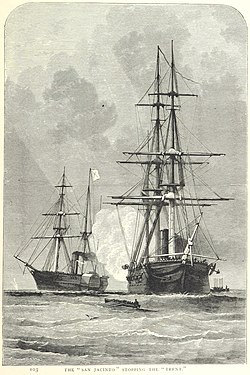
The Trent Affair in 1861 was another tense moment between the United States and Britain following the Treaty of Ghent, but peaceful relations nonetheless endured through this crisis during the American Civil War.
Image source: Trent Affair
1914
% complete
In the century of peace between both countries that followed from 1815 to World War I, several more territorial and diplomatic disputes arose, but all were resolved peacefully, sometimes by arbitration.
Sep 1921
% complete
The Peace Arch, dedicated in September 1921, stands 20.5 metres (67 ft) tall at the Douglas–Blaine border crossing between the province of British Columbia and the state of Washington, commemorating lasting peace.
Image source: Peace Arch
1922
% complete
In 1922, the Fountain of Time was dedicated in Washington Park, Chicago, commemorating 110 years of peace between the United States and Britain since the signing of the Treaty of Ghent.
Image source: Fountain of Time
1927
% complete
The Peace Bridge between Buffalo, New York, and Fort Erie, Ontario, opened in 1927 to commemorate more than a century of peace between the United States and Canada.
Image source: Peace Bridge
1936
% complete
Perry's Victory and International Peace Memorial (1936) commemorates the Battle of Lake Erie that took place near Ohio's South Bass Island, in which Commodore Oliver Hazard Perry led a fleet to victory in one of the most significant naval battles of the War of 1812.
Image source: Perry's Victory and International Peace Memorial
Or browse the full history timeline directory, with more than 2,000 topics.
This Treaty of Ghent timeline was generated with the help of AI, using information found on the internet.
We work hard to keep these timelines accurate, but mistakes do get through. If you spot one, email us at [email protected] and we'll fix it for future visitors.
Generate yours with AI or build it from scratch, for free.
Export your timeline, add your own events, edit or remove AI-generated events, and much more
No credit card required.
Cancel anytime.
Cancel anytime.
You can create an unlimited number of timelines with up to 10 events on each one, customize how they look, export them to PDF, PNG, PowerPoint, CSV, and Excel, and share them with a link. Paid plans raise the event limit and add features like spreadsheet imports and collaborators.
Yes. You can cancel your subscription from your account page at any time, and you will not be charged again. Your subscription stays active for the rest of the period you already paid for.
Yes. We will email you a reminder before the annual renewal, and we will also email you a receipt.
Yes. You can email us within 15 days of any payment, and we will issue you a full refund.
Check out our pricing docs or send us an email anytime: [email protected].