-
Use Cases
-
Resources
-
Pricing
1492
Christopher Columbus's first voyage to the Americas in 1492 initiated the Columbian exchange, the large-scale transfer of plants, animals, diseases, people, and commodities between the Americas and Afro-Eurasia.
Image source: Columbian exchange

1492
The Columbian exchange became closely connected to European colonization and expanding global trade after Columbus's voyage, transforming cultures and livelihoods in both hemispheres.
Image source: European colonization of the Americas

1972
Alfred W. Crosby published The Columbian Exchange while working at the University of Texas at Austin, establishing a major framework for studying the ecological consequences of European expansion.
Image source: Columbian exchange
1972
American historian Alfred W. Crosby first used the term Columbian exchange in 1972 to describe the intercontinental transfer of organisms and diseases following European contact with the Americas.
1986
Crosby's 1986 book Ecological Imperialism presented further research on how European organisms, environments, and diseases helped shape colonial expansion.
1492
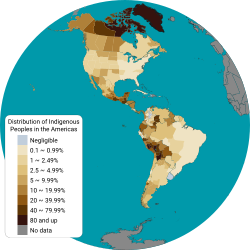
Communicable diseases originating in the Old World caused catastrophic mortality among Indigenous peoples of the Americas, reducing their population by an estimated 80 to 95 percent from the 15th century onward and contributing to near extinction in the Caribbean.
Image source: Population history of the Indigenous peoples of the Americas
1492 - 1642
An estimated 80 to 95 percent of the Native American population died in epidemics during the first 100 to 150 years after 1492.
1493 - 1526
Hispaniola's pre-contact population was probably at least 500,000, but fewer than 500 people were estimated to remain alive by 1526 amid disease, exploitation, and colonial disruption.
Image source: Hispaniola
1493
An epidemic of swine influenza beginning in 1493 killed many Taíno people living on Caribbean islands.
Image source: Taíno
1493
The first written descriptions of syphilis in the Old World appeared in 1493, soon after Columbus's voyage and the beginning of sustained transatlantic contact.
Image source: History of syphilis
1494 - 1495
The first large European outbreak of syphilis occurred in 1494–1495 among the army of Charles VIII during his invasion of Naples.
1501 - 1620
The Indigenous population of Peru fell from about nine million in the pre-Columbian era to approximately 600,000 by 1620.
1501 - 1599
Disease and Spanish exploitation reduced Mexico's population from an estimated 20 million to barely more than one million during the 16th century.
Image source: History of Mexico
1518
Smallpox was first recorded in the Americas in 1518 and became the deadliest imported Old World disease affecting Indigenous populations.
Image source: Smallpox
1520
An estimated 40 percent of the 200,000 people living in Tenochtitlan died of smallpox in 1520 during the Aztec war with conquistador Hernán Cortés.
1492 - 1500
Before 1500, potatoes were not grown outside South America, where Indigenous societies had cultivated them as an important food crop.
Image source: Potato
1501 - 1599
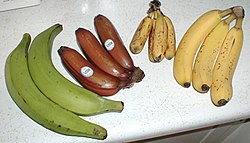
Portuguese sailors introduced bananas into the Americas during the 16th century after bringing them from West Africa.
Image source: Banana
1501 - 1599
Sugarcane was introduced from the Indian subcontinent to the Spanish West Indies and became a principal export crop of extensive Latin American plantations.
Image source: History of sugar
1501 - 1799
After their transfer from the Americas, potatoes were cultivated and widely consumed in Europe by the 18th century.
1501 - 1599
Portuguese traders introduced cassava from South America to Africa during the 16th century.
Image source: Cassava
1501 - 1800
After its introduction, cassava gradually replaced sorghum and millet in many areas and became Africa's most important food crop.
1501 - 1599
Spanish colonizers introduced American crops including maize and sweet potatoes to Asia during the 16th century, contributing to population growth there.
1544
In 1544, Tuscan physician and botanist Pietro Andrea Mattioli wrote that tomatoes were eaten fried in oil, providing an early written description of their culinary use in Europe.
Image source: Tomato
1590
The Spanish were the first Europeans to grow cacao, beginning in 1590, as American crops were adapted to New World colonial agriculture.
1600 - 1899
Planters initially struggled to adapt crops such as cacao, coffee, and sugarcane to New World climates, but by the late 19th century these crops were cultivated consistently.
Image source: Plantation
1692 - 1694
Italian chef Antonio Latini's cookbook Lo Scalco alla Moderna, published in two volumes in 1692 and 1694, became the first Italian cookbook to include tomato sauce.
1700 - 1799
By the 18th century, potatoes had become important crops not only in Europe but also in India and North America.
1700 - 1900
Potatoes became a staple in many European diets and are estimated to have contributed 12 to 25 percent of population growth in Afro-Eurasia between 1700 and 1900.
1700 - 1900
The introduction of the potato to the Old World is credited with 47 percent of the increase in urbanization between 1700 and 1900.
1720
Coffee was introduced to the Americas from Africa and the Middle East around 1720 and later became a major commodity crop of Latin American plantations.
Image source: History of coffee
1790
In 1790, Francesco Leonardi's cookbook L'Apicio Moderno provided the first recorded appearance of tomato sauce used with pasta in an Italian cookbook.
1501 - 1840
During the first centuries after Columbus, the number of Africans involuntarily taken to the New World was far greater than the number of Europeans who migrated there, most of whom moved voluntarily.
Image source: Atlantic slave trade
1501 - 1599
Thousands of Native Americans crossed the Atlantic during the 16th century, some voluntarily, demonstrating that Indigenous people were active participants in transatlantic encounters rather than merely passive recipients.
Image source: Indigenous peoples of the Americas
1501 - 1900
The Atlantic slave trade forcibly transported an estimated 11.7 million Africans, primarily from West Africa, to the Americas between the 16th and 19th centuries. Their numbers greatly exceeded the approximately 3.4 million Europeans who migrated voluntarily between 1492 and 1840.
1650
Anecdotal evidence from the mid-17th century indicates that introduced sheep had become far more numerous than llamas in parts of the Andes.
1750 - 1799
Llama numbers declined through the 18th century, reaching a point in the late 18th century when only the Mapuche from Mariquina and the Huequén next to Angol raised the species.
Image source: Llama
Or browse the full history timeline directory, with more than 2,500 topics.
This Columbian Exchange timeline was generated with the help of AI, using information found on the internet.
We work hard to keep these timelines accurate, but mistakes do get through. If you spot one, email us at [email protected] and we'll fix it for future visitors.
Generate yours with AI or build it from scratch, for free.
Export your timeline, add your own events, edit or remove AI-generated events, and much more
No credit card required.
Cancel anytime.
Cancel anytime.
You can create an unlimited number of timelines with up to 10 events on each one, customize how they look, export them to PDF, PNG, PowerPoint, CSV, and Excel, and share them with a link. Paid plans raise the event limit and add features like spreadsheet imports and collaborators.
Yes. You can cancel your subscription from your account page at any time, and you will not be charged again. Your subscription stays active for the rest of the period you already paid for.
Yes. We will email you a reminder before the annual renewal, and we will also email you a receipt.
Yes. You can email us within 15 days of any payment, and we will issue you a full refund.
Check out our pricing docs or send us an email anytime: [email protected].