-
Use Cases
-
Resources
-
Pricing
The Portuguese Empire was the first and one of the longest-lived global colonial empires in history, beginning with the conquest of Ceuta in 1415 and expanding across Africa, Asia, and South America. Driven by maritime exploration, trade in spices, gold, and slaves, it established a vast network of colonies and trading posts, lasting nearly six centuries until the final decolonization of Macau in 1999. More Less
Aug 21, 1415
% complete
Portuguese forces under King John I captured the North African city of Ceuta, marking the beginning of Portuguese overseas expansion. The conquest gave Portugal a foothold in Africa and inspired further exploration along the African coast.
Image source: Portuguese conquest of Ceuta
1419
% complete
Portuguese explorers João Gonçalves Zarco and Tristão Vaz Teixeira rediscovered and colonized the uninhabited Madeira archipelago, which became a lucrative sugar-producing colony and an early model for Atlantic colonization.
Image source: Madeira
1420
% complete
Prince Henry the Navigator began systematically sponsoring voyages of exploration down the West African coast, establishing a school of navigation at Sagres and driving advances in shipbuilding and cartography that enabled later discoveries.
Image source: Prince Henry the Navigator
1427
% complete
Portuguese navigators discovered the Azores archipelago in the mid-Atlantic. Its settlement provided vital staging points for transatlantic voyages and expanded Portugal's maritime presence in the Atlantic.
Image source: History of the Azores
1434
% complete
Gil Eanes successfully rounded Cape Bojador, breaking a psychological barrier that had long deterred sailors. This achievement opened the way for continued Portuguese exploration along the West African coast.
Image source: Cape Bojador
Jun 7, 1494
% complete
Spain and Portugal signed the Treaty of Tordesillas, dividing newly discovered lands outside Europe along a meridian 370 leagues west of the Cape Verde islands. The agreement granted Portugal claim to Brazil and secured its route to India.
Image source: Treaty of Tordesillas
1444
% complete
Following exploration of the West African coast, the Portuguese began transporting enslaved Africans to Portugal and later to Atlantic colonies. This trade grew massively after the colonization of Brazil, fueling plantation economies.
Image source: Atlantic slave trade
Apr 22, 1500
% complete
En route to India, Pedro Álvares Cabral landed on the coast of Brazil, claiming it for Portugal. This accidental discovery laid the foundation for what would become Portugal's largest and most valuable colony.
Image source: Pedro Álvares Cabral
1532
% complete
Portugal began large-scale sugar cultivation in Brazil around São Vicente. The booming plantation economy relied on enslaved labor and made Brazil the centerpiece of Portuguese colonial wealth by the late 16th century.
Image source: Sugarcane
1695
% complete
Gold was discovered in the Brazilian interior region of Minas Gerais, sparking a gold rush that transformed the colonial economy, shifted population toward the interior, and enriched the Portuguese crown through taxation.
Image source: Brazilian gold rush
Nov 29, 1807 - 1821
% complete
Fleeing Napoleon's invasion, Prince Regent John moved the entire Portuguese court to Rio de Janeiro, making Brazil the de facto center of the empire—the only time a European capital was located outside Europe.
Image source: Transfer of the Portuguese court to Brazil
Sep 7, 1822
% complete
Prince Pedro declared Brazil independent from Portugal, becoming Emperor Pedro I. The loss of Brazil removed the largest and richest part of the Portuguese Empire and redirected imperial ambitions toward Africa.
Image source: Independence of Brazil
Nov 15, 1884 - Feb 26, 1885
% complete
European powers met in Berlin to formalize rules for partitioning Africa. Portugal's long-standing coastal claims were recognized but constrained, forcing it to compete with larger powers for interior territories like Angola and Mozambique.
Image source: Berlin Conference
May 13, 1888
% complete
Slavery was finally abolished throughout the Portuguese world with Brazil's Lei Áurea, ending centuries of forced labor that had underpinned the empire's plantation economies.
Image source: Slavery in Brazil
May 20, 1498
% complete
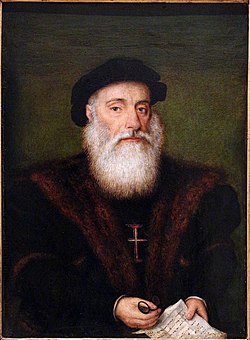
Vasco da Gama arrived at Calicut, India, after pioneering the sea route around Africa. His voyage established direct maritime trade between Europe and Asia, launching Portugal's profitable spice trade empire.
Image source: Vasco da Gama
1505 - 1509
% complete
Francisco de Almeida was appointed the first Portuguese viceroy of India. He established Portuguese naval dominance in the Indian Ocean, defeating combined Muslim fleets at the Battle of Diu in 1509.
Image source: Francisco de Almeida
Mar 1, 1510
% complete
Afonso de Albuquerque seized Goa from the Sultanate of Bijapur, making it the capital of Portuguese India. Goa became the administrative and commercial hub of Portuguese power in Asia for over four centuries.
Image source: Portuguese conquest of Goa
Aug 24, 1511
% complete
Afonso de Albuquerque captured Malacca, the great spice-trading port on the Strait of Malacca. The conquest gave Portugal control of the crucial gateway between the Indian Ocean and East Asian trade networks.
Image source: Capture of Malacca (1511)
1557
% complete
The Portuguese established a permanent trading post at Macau with Chinese acquiescence. It became the major European entrepôt for trade with China and Japan, and remained under Portuguese administration until 1999.
Image source: History of Macau
Jan 14, 1641
% complete
The Dutch captured Malacca from the Portuguese after a prolonged siege, marking a major loss of Portugal's Asian trade network as Dutch and English competitors eroded its eastern empire.
Aug 4, 1578
% complete
King Sebastian of Portugal was killed leading a disastrous invasion of Morocco. His death without an heir triggered a succession crisis that led to Spanish rule over Portugal.
Image source: Battle of Alcácer Quibir
1580 - 1640
% complete
After King Sebastian died without an heir, Philip II of Spain claimed the Portuguese throne, uniting the crowns for sixty years. Portugal was drawn into Spain's wars with England and the Dutch, exposing its colonies to attacks.
Image source: Iberian Union
Dec 1, 1640 - 1668
% complete
Portugal revolted against Spanish rule, restoring independence under the House of Braganza with John IV as king. The war ended in 1668 when Spain formally recognized Portuguese sovereignty.
Image source: Portuguese Restoration War
Dec 27, 1703
% complete
Portugal signed a commercial treaty with Britain exchanging Portuguese wine for English textiles. The agreement deepened Portugal's economic dependence on Britain, a relationship that shaped imperial policy for two centuries.
Image source: Methuen Treaty
Nov 1, 1755
% complete
The catastrophic Lisbon earthquake destroyed much of the capital. Marquis of Pombal led a sweeping reconstruction and used the crisis to centralize royal power and modernize the Portuguese economy and empire.
Image source: 1755 Lisbon earthquake
Sep 1, 1759
% complete
Prime Minister Pombal expelled the Jesuits from Portugal and all its colonies, confiscating their property and asserting state control over education and missions across the empire.
Image source: Suppression of the Society of Jesus
Jan 11, 1890
% complete
Britain issued an ultimatum demanding Portugal abandon its proposed map-coloring territory linking Angola and Mozambique. The humiliating capitulation damaged the monarchy's prestige and fueled republican sentiment.
Image source: 1890 British Ultimatum
Oct 5, 1910
% complete
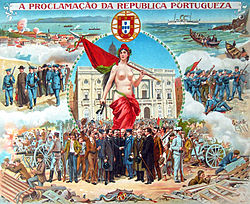
Revolutionaries toppled the Braganza monarchy, proclaiming the Portuguese First Republic. The new regime pursued secularization and grappled with the costs and administration of the overseas empire.
Image source: 5 October 1910 revolution
1933 - 1974
% complete
António de Oliveira Salazar consolidated the authoritarian Estado Novo, which enshrined the preservation of the overseas colonies as central to national identity and resisted decolonization for four decades.
Image source: Estado Novo (Portugal)
Feb 4, 1961 - Apr 25, 1974
% complete
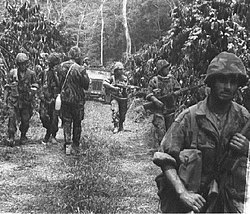
Armed independence movements in Angola, Mozambique, Guinea-Bissau and other colonies launched guerrilla wars against Portuguese rule. The costly thirteen-year conflict drained Portugal's resources and discredited the regime.
Image source: Portuguese Colonial War
Apr 25, 1974
% complete
A military coup led by left-wing officers overthrew the Estado Novo almost bloodlessly, symbolized by carnations placed in soldiers' rifles. The revolution initiated rapid decolonization across Africa and Asia.
Image source: Carnation Revolution
Nov 11, 1975
% complete
Angola and Mozambique gained independence from Portugal, marking the effective end of five centuries of Portuguese colonialism in Africa and triggering mass repatriation of Portuguese settlers.
Image source: Angolan War of Independence
Dec 20, 1999
% complete
Portugal transferred Macau to China, ending nearly 450 years of continuous Portuguese presence in Asia and marking the final dissolution of the Portuguese Empire.
Image source: Transfer of sovereignty over Macau
Or browse the full history timeline directory, with more than 2,000 topics.
This Portuguese Empire timeline was generated with the help of AI, using information found on the internet.
We work hard to keep these timelines accurate, but mistakes do get through. If you spot one, email us at [email protected] and we'll fix it for future visitors.
Generate yours with AI or build it from scratch, for free.
Export your timeline, add your own events, edit or remove AI-generated events, and much more
No credit card required.
Cancel anytime.
Cancel anytime.
You can create an unlimited number of timelines with up to 10 events on each one, customize how they look, export them to PDF, PNG, PowerPoint, CSV, and Excel, and share them with a link. Paid plans raise the event limit and add features like spreadsheet imports and collaborators.
Yes. You can cancel your subscription from your account page at any time, and you will not be charged again. Your subscription stays active for the rest of the period you already paid for.
Yes. We will email you a reminder before the annual renewal, and we will also email you a receipt.
Yes. You can email us within 15 days of any payment, and we will issue you a full refund.
Check out our pricing docs or send us an email anytime: [email protected].