-
Use Cases
-
Resources
-
Pricing
The French Colonial Empire was one of the largest empires in world history, second only to the British Empire at its height. Beginning with early settlements in North America and the Caribbean in the 17th century, France expanded its influence across Africa, Southeast Asia, the Pacific, and the Indian Ocean. The empire played a major role in global trade, culture, and politics before gradually dismantling through wars of independence and decolonization movements, particularly after World War II. More Less
Jul 24, 1534
% complete
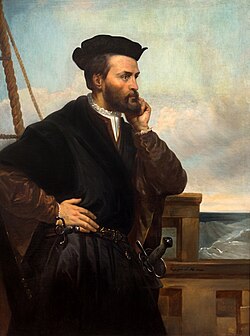
French navigator Jacques Cartier planted a cross at Gaspé Bay and claimed the lands around the St. Lawrence River for King Francis I, marking the beginning of French overseas expansion in North America.
Image source: Jacques Cartier
Jul 3, 1608
% complete
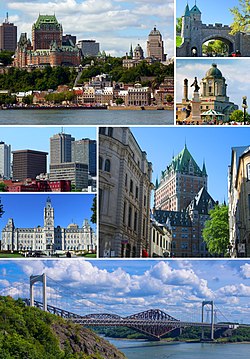
Samuel de Champlain founded Quebec City, the first permanent French settlement in North America, which became the capital of New France and the heart of the fur trade with Indigenous peoples.
Image source: Quebec City
Sep 1, 1664
% complete
King Louis XIV chartered the Compagnie française des Indes orientales to compete with Dutch and English trading companies in Asia, establishing French posts in India such as Pondichéry.
Image source: French East India Company
1697
% complete
The Treaty of Ryswick formally ceded the western third of Hispaniola to France. Saint-Domingue became the wealthiest colony in the world through sugar and coffee plantations worked by enslaved Africans.
Image source: Saint-Domingue
Apr 11, 1713
% complete
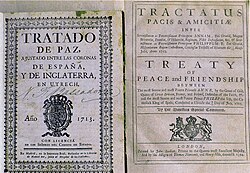
France ceded Newfoundland, Acadia, and Hudson Bay territory to Britain, its first major colonial losses, signaling growing Anglo-French imperial rivalry.
Image source: Peace of Utrecht
May 28, 1754
% complete
Conflict erupted between French and British forces over the Ohio Valley, escalating into the global Seven Years' War and setting the stage for the loss of New France.
Image source: French and Indian War
Feb 10, 1763
% complete
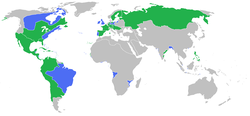
France ceded Canada and lands east of the Mississippi to Britain and Louisiana west of the Mississippi to Spain, marking the collapse of the First French Colonial Empire.
Image source: Treaty of Paris (1763)
Apr 30, 1803
% complete
Facing the failure to retake Saint-Domingue and looming war with Britain, Napoleon sold the vast Louisiana territory to the United States for $15 million, ending French ambitions in mainland North America.
Image source: Louisiana Purchase
Aug 22, 1791
% complete
Enslaved Africans in Saint-Domingue rose up against French plantation rule in the largest slave revolt in history, ultimately destroying France's richest colony.
Image source: Haitian Revolution
Jan 1, 1804
% complete
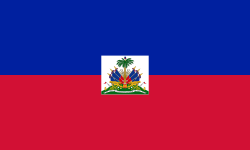
Jean-Jacques Dessalines proclaimed Haiti's independence after defeating French expeditionary forces sent by Napoleon, creating the first Black republic and first state born of a successful slave revolt.
Image source: Haiti
Jun 18, 1940
% complete
Charles de Gaulle's BBC appeal called on the French Empire to continue fighting Germany. Many African colonies rallied to Free France, making the empire crucial to Allied victory.
Image source: Free France
Dec 19, 1946 - Aug 1, 1954
% complete
War broke out between French forces and Ho Chi Minh's Viet Minh. Eight years of grinding guerrilla warfare ended with France's humiliating defeat at Dien Bien Phu and withdrawal from Indochina.
Image source: First Indochina War
Mar 29, 1947 - 1948
% complete
Nationalist revolt against French rule in Madagascar was crushed with extreme violence; estimates of deaths range into the tens of thousands, fueling anti-colonial sentiment across the empire.
Image source: Malagasy Uprising
Mar 13, 1954 - May 7, 1954
% complete
Viet Minh forces besieged and destroyed the fortified French garrison at Dien Bien Phu, forcing France to negotiate independence for Vietnam, Laos, and Cambodia at Geneva.
Image source: Battle of Dien Bien Phu
Nov 1, 1954 - Mar 19, 1962
% complete
The FLN launched attacks on All Saints' Day, beginning an eight-year bloody war. The conflict toppled the Fourth Republic, brought de Gaulle back to power, and ended with Algerian independence.
Image source: Algerian War
Mar 2, 1956 - Mar 20, 1956
% complete
Following mounting nationalist pressure and armed resistance, France granted independence to Morocco on March 2 and Tunisia on March 20, 1956, ending its protectorates in the Maghreb.
Image source: Tunisian independence
Sep 28, 1958
% complete
De Gaulle's referendum offered African colonies immediate independence or autonomy within the new French Community; only Guinea chose independence, becoming the first francophone African state to break away.
Image source: 1958 French constitutional referendum
Jan 1, 1960 - Dec 31, 1960
% complete
In the 'Year of Africa,' fourteen French colonies gained independence, including Cameroon, Togo, Madagascar, Senegal, Mali, Ivory Coast, Chad, Gabon, and others, largely dismantling the empire peacefully.
Image source: 1960 in Africa
Mar 18, 1962 - Jul 5, 1962
% complete
Negotiations between France and the FLN produced cease-fire agreements leading to Algeria's independence on July 5, 1962, closing the book on France's most contentious colonial conflict.
Image source: Évian Accords
Jun 27, 1977
% complete
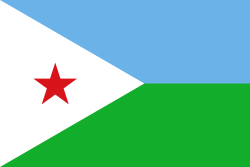
After a 1958 referendum chose continued association and decades of gradual autonomy, the French Territory of the Afars and the Issas became independent Djibouti, the last major African decolonization from France.
Image source: Djibouti
Jul 30, 1980
% complete
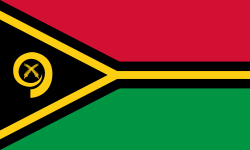
The New Hebrides, jointly ruled by France and Britain as the world's only condominium, achieved independence as Vanuatu, marking one of the final chapters of formal French decolonization in the Pacific.
Image source: Vanuatu
Jun 14, 1830 - 1847
% complete
France invaded Algiers under Charles X, beginning a brutal decades-long conquest. Algeria became France's longest-held major Muslim territory and was eventually administered as an integral part of France.
Image source: French conquest of Algeria
Nov 9, 1842
% complete
France declared a protectorate over Tahiti under Queen Pōmare IV, extending its Pacific presence that would grow into French Polynesia.
Image source: French Polynesia
Dec 2, 1852 - 1870
% complete
Under Napoleon III, France aggressively expanded overseas, seizing Senegal's interior, Cochinchina, New Caledonia, and intervening in Mexico, rebuilding the empire lost in 1763.
Feb 17, 1859
% complete
Franco-Spanish forces captured Saigon, launching the conquest of Vietnam that would evolve into French Cochinchina and eventually the union of French Indochina.
Image source: Siege of Saigon
Aug 11, 1863
% complete
King Norodom of Cambodia accepted French protection to escape Siamese and Vietnamese influence, adding Cambodia to the expanding French sphere in Southeast Asia.
Image source: French protectorate of Cambodia
Nov 17, 1869
% complete
Built by French engineer Ferdinand de Lesseps, the Suez Canal opened, dramatically shortening routes to Asia and boosting French commercial and strategic interests in the region.
Image source: Suez Canal
1895
% complete
France consolidated its Sahelian and coastal possessions into the federation of French West Africa, governed from Dakar, spanning eight territories including Senegal, Mali, and Ivory Coast.
Sep 18, 1898 - Nov 4, 1898
% complete
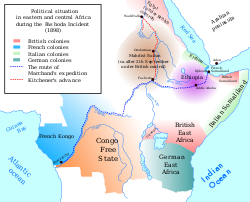
French and British expeditions confronted each other at Fashoda in Sudan. France's eventual withdrawal confirmed British dominance of the Nile valley but paved the way for the Entente Cordiale.
Image source: Fashoda Incident
Jan 27, 1910
% complete
France federated Gabon, Middle Congo, Ubangi-Shari, and Chad into French Equatorial Africa, a vast but sparsely populated tropical territory governed from Brazzaville.
Image source: French Equatorial Africa
Mar 30, 1912
% complete
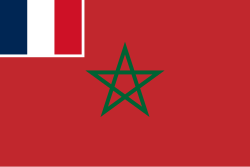
After international crisis with Germany, Sultan Abd al-Hafid accepted French protection, making Morocco the final major piece of France's North African empire under Resident-General Lyautey.
Image source: French protectorate in Morocco
Jul 28, 1914 - Nov 11, 1918
% complete
Hundreds of thousands of soldiers from Senegal, Algeria, Indochina, and other colonies served in the French army during World War I, sustaining the metropole's war effort at enormous cost.
Image source: Senegalese Tirailleurs
Sep 29, 1923
% complete
The League of Nations assigned France mandates over former Ottoman territories, where French administrators carved out Lebanon and governed Syria until independence movements succeeded after WWII.
Image source: Mandate for Syria and the Lebanon
Feb 9, 1930
% complete
Vietnamese soldiers of the Garde indigène revolted against French officers; the uprising was crushed but galvanized nationalist resistance led by Ho Chi Minh's movement.
Image source: Yên Bái mutiny
May 6, 1931 - Nov 15, 1931
% complete
A grand exhibition in the Bois de Vincennes displayed reconstructed pavilions from across the colonies, attracting millions of visitors and promoting imperial ideology to the French public at the empire's height.
Image source: Paris Colonial Exposition
Jan 30, 1944 - Feb 8, 1944
% complete
De Gaulle convened Free French officials in Brazzaville to plan colonial reform, promising greater rights while rejecting full self-government — promises that proved too limited as nationalism surged.
Image source: Brazzaville Conference
Oct 27, 1946
% complete
The Fourth Republic's constitution replaced the old empire with the French Union, nominally granting colonized peoples citizenship and representation while retaining Parisian control.
Or browse the full history timeline directory, with more than 2,000 topics.
This French Colonial Empire timeline was generated with the help of AI, using information found on the internet.
We work hard to keep these timelines accurate, but mistakes do get through. If you spot one, email us at [email protected] and we'll fix it for future visitors.
Generate yours with AI or build it from scratch, for free.
Export your timeline, add your own events, edit or remove AI-generated events, and much more
No credit card required.
Cancel anytime.
Cancel anytime.
You can create an unlimited number of timelines with up to 10 events on each one, customize how they look, export them to PDF, PNG, PowerPoint, CSV, and Excel, and share them with a link. Paid plans raise the event limit and add features like spreadsheet imports and collaborators.
Yes. You can cancel your subscription from your account page at any time, and you will not be charged again. Your subscription stays active for the rest of the period you already paid for.
Yes. We will email you a reminder before the annual renewal, and we will also email you a receipt.
Yes. You can email us within 15 days of any payment, and we will issue you a full refund.
Check out our pricing docs or send us an email anytime: [email protected].