-
Use Cases
-
Resources
-
Pricing
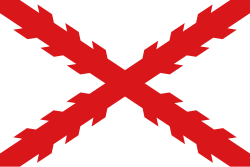
The Spanish Empire was one of the largest and most powerful empires in world history, spanning Europe, the Americas, Africa, and Asia. Beginning with Columbus's voyages in 1492, Spain built a vast colonial network fueled by conquest, silver mining, and missionary work. At its height in the 16th and 17th centuries, it dominated global trade and politics before gradually declining through wars, independence movements, and the loss of its final colonies in 1898. More Less
Oct 19, 1469
% complete
The marriage of Isabella I of Castile and Ferdinand II of Aragon united the two most powerful kingdoms of Spain, laying the political foundation for a unified Spanish state that would sponsor overseas exploration and build one of history's largest empires.
Image source: Catholic Monarchs of Spain
Jan 2, 1492
% complete
Spanish forces under the Catholic Monarchs captured Granada, the last Muslim kingdom on the Iberian Peninsula, completing centuries-long reconquest and freeing resources and ambition for overseas expansion.
Image source: Reconquista
Oct 12, 1492
% complete
Sailing under the Spanish crown, Christopher Columbus made landfall in the Bahamas, opening the New World to Spanish exploration, conquest, and colonization and marking the beginning of Spain's global empire.
Image source: Voyages of Christopher Columbus
1519 - Aug 13, 1521
% complete
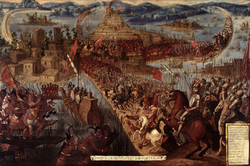
Hernán Cortés, allied with indigenous enemies of the Aztecs, captured Tenochtitlán and toppled the Aztec Empire. The conquest brought vast territory and silver wealth under Spanish control and founded New Spain.
Image source: Fall of Tenochtitlan
Sep 20, 1519 - Sep 6, 1522
% complete
The Spanish-sponsored expedition led by Ferdinand Magellan, completed by Juan Sebastián Elcano after Magellan's death, achieved the first circumnavigation of the Earth, proving global reach for the Spanish crown.
Image source: Magellan expedition
1532 - 1572
% complete
Francisco Pizarro captured Inca emperor Atahualpa at Cajamarca in 1532 and eventually seized Cusco, dismantling the Inca Empire and establishing the Viceroyalty of Peru, one of the richest colonies in the world.
Image source: Spanish conquest of the Inca Empire
1493
% complete
Columbus established La Isabela on Hispaniola, one of the first permanent European settlements in the Americas, launching the pattern of Spanish colonial towns that would spread across the Caribbean.
Image source: La Isabela
Jun 7, 1494
% complete
Spain and Portugal signed the Treaty of Tordesillas, drawing a line through the Atlantic dividing newly discovered lands between them. Spain received rights to most of the Americas, formalizing the legal basis for its colonial empire.
Image source: Treaty of Tordesillas
1535
% complete
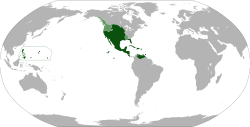
Spain created the Viceroyalty of New Spain with its capital at Mexico City, establishing formal administrative structures to govern its North American and Caribbean territories.
Image source: New Spain
1545
% complete
The discovery of massive silver deposits at Cerro Rico in Potosí, in modern Bolivia, transformed the global economy. Silver from Potosí and Mexico financed Spanish power in Europe for over a century.
Image source: Potosí
Sep 1565
% complete
Pedro Menéndez de Avilés established St. Augustine, the oldest continuously inhabited European-founded city in the continental United States, securing Florida for Spain.
Image source: St. Augustine, Florida
1571
% complete
Miguel López de Legazpi founded Manila, establishing Spanish rule over the Philippines and creating the base for the Manila galleon trade that connected Asia, the Americas, and Europe.
Image source: Manila
1580 - 1640
% complete
Philip II of Spain claimed the Portuguese throne after the death of King Sebastian, uniting the Iberian crowns for sixty years and briefly placing Portugal's global empire under Spanish rule.
Image source: Iberian Union
1717
% complete
Spain carved a new viceroyalty out of northern South America centered on Bogotá, reflecting Bourbon administrative reforms aimed at tightening control over its American possessions.
Image source: Viceroyalty of New Granada
1750 - 1800
% complete
Under the Bourbon kings, Spain modernized its empire with new intendants, trade liberalization, and military strengthening, increasing revenue but alienating creole elites who resented reduced influence.
Image source: Bourbon Reforms
1776
% complete
Spain created a viceroyalty centered on Buenos Aires to defend the region against Portuguese expansion and improve administration of southern South America.
Image source: Viceroyalty of the Río de la Plata
Oct 7, 1571
% complete
A Holy League fleet led by Spain's Don John of Austria decisively defeated the Ottoman fleet near Corinth, halting Ottoman naval expansion in the Mediterranean in one of the era's largest naval battles.
Image source: Battle of Lepanto
Jul 1588 - Aug 1588
% complete
England's navy and devastating storms destroyed much of Philip II's invasion fleet bound for England. The defeat damaged Spain's aura of invincibility but did not end its status as a great power.
Image source: Spanish Armada
1609 - 1621
% complete
Spain agreed to a truce with the rebellious northern Netherlands, effectively recognizing Dutch independence in all but name and pausing the Eighty Years' War while Dutch trade expanded globally.
Image source: Twelve Years' Truce
1618 - 1648
% complete
Spain fought alongside Austria in the devastating European religious war, achieving early victories before exhaustion and defeats eroded Habsburg dominance across the continent.
Image source: Thirty Years' War
Oct 24, 1648
% complete
The treaties ending the Thirty Years' War recognized Dutch independence from Spain and marked the beginning of a shift in European power away from Madrid toward France and other rising states.
Image source: Peace of Westphalia
1701 - 1714
% complete
The death of Charles II without an heir sparked a continent-wide war over who should rule Spain. Philip V prevailed, founding the Bourbon dynasty, but Spain ceded Gibraltar and Menorca to Britain and lost access to Spanish territories in Italy and the Low Countries.
Image source: War of the Spanish Succession
1779 - 1783
% complete
Allied with France and the American rebels, Spain recaptured Minorca and Florida from Britain and expanded Louisiana territory, recovering some prestige lost earlier in the century.
Image source: Spain and the American Revolutionary War
Oct 21, 1805
% complete
Admiral Nelson's Royal Navy annihilated the combined Franco-Spanish fleet off Cape Trafalgar, crippling Spain's naval power and severing links between Spain and its American colonies.
Image source: Battle of Trafalgar
May 1808 - 1814
% complete
Napoleon invaded Spain and placed his brother Joseph Bonaparte on the throne. Spanish guerrilla resistance aided by Britain drained French forces, but the chaos fatally weakened imperial control over the Americas.
Image source: Peninsular War
Oct 10, 1868 - 1878
% complete
Cuban rebels launched their first major struggle for independence from Spain, foreshadowing the final conflict that would end Spanish rule in the Caribbean.
Image source: Ten Years' War
Feb 15, 1898
% complete
The mysterious explosion of the American battleship Maine in Havana harbor inflamed U.S. public opinion and helped precipitate war with Spain over Cuba.
Image source: USS Maine (1890)
Apr 21, 1898 - Aug 13, 1898
% complete
In a brief conflict, the United States defeated Spain in the Caribbean and Pacific, destroying the Spanish fleets at Santiago de Cuba and Manila Bay and ending Spanish colonial power overseas.
Image source: Spanish–American War
Dec 1, 1640
% complete
A coup in Lisbon ended the Iberian Union, restoring Portuguese sovereignty after a long war and stripping Spain of control over Portugal's empire.
Image source: Portuguese Restoration War
1810 - 1825
% complete
Independence movements led by figures such as Simón Bolívar and José de San Martín swept across South America, dismantling Spanish rule in Venezuela, Colombia, Argentina, Chile, Peru, and beyond within fifteen years.
Image source: Spanish American wars of independence
Sep 16, 1810 - Sep 27, 1821
% complete
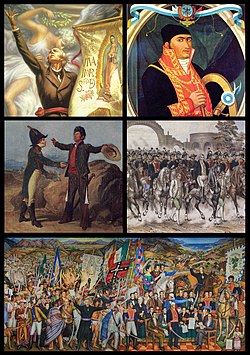
Inspired by Napoleon's occupation of Spain, Miguel Hidalgo launched the Grito de Dolores, beginning Mexico's fight for independence, achieved in 1821 when Agustín de Iturbide entered Mexico City.
Image source: Mexican War of Independence
Dec 2, 1823
% complete
The United States proclaimed that further European colonization in the Americas would not be tolerated, effectively signaling opposition to any Spanish attempt to reclaim its former colonies.
Image source: Monroe Doctrine
1824
% complete
With royalist defeats at Ayacucho in Peru and the fall of the last strongholds, Spain retained only Cuba, Puerto Rico, the Philippines, and scattered islands, marking the effective end of its vast American empire.
Aug 1896 - Aug 1898
% complete
Filipino nationalists, led by figures such as Emilio Aguinaldo, rose against Spanish colonial authority in the Philippines, weakening the last major outpost of the empire in Asia.
Image source: Philippine Revolution
Dec 10, 1898
% complete
Spain ceded Puerto Rico, Guam, and the Philippines to the United States and renounced sovereignty over Cuba, formally dissolving what remained of its once-global colonial empire.
Image source: Treaty of Paris (1898)
1899
% complete
After losing the Philippines and Guam, Spain sold its remaining Micronesian islands, including the Carolines and Marianas, to Germany, liquidating nearly all of its Pacific holdings.
Image source: German–Spanish Treaty (1899)
Or browse the full history timeline directory, with more than 2,000 topics.
This Spanish Empire timeline was generated with the help of AI, using information found on the internet.
We work hard to keep these timelines accurate, but mistakes do get through. If you spot one, email us at [email protected] and we'll fix it for future visitors.
Generate yours with AI or build it from scratch, for free.
Export your timeline, add your own events, edit or remove AI-generated events, and much more
No credit card required.
Cancel anytime.
Cancel anytime.
You can create an unlimited number of timelines with up to 10 events on each one, customize how they look, export them to PDF, PNG, PowerPoint, CSV, and Excel, and share them with a link. Paid plans raise the event limit and add features like spreadsheet imports and collaborators.
Yes. You can cancel your subscription from your account page at any time, and you will not be charged again. Your subscription stays active for the rest of the period you already paid for.
Yes. We will email you a reminder before the annual renewal, and we will also email you a receipt.
Yes. You can email us within 15 days of any payment, and we will issue you a full refund.
Check out our pricing docs or send us an email anytime: [email protected].