-
Use Cases
-
Resources
-
Pricing
Socialism is a political and economic ideology advocating for collective or state ownership of the means of production and a more equal distribution of wealth. Emerging from the Industrial Revolution as a response to capitalism's inequalities, socialism has taken many forms—from utopian ideas of Owen and Fourier to Marxist theory, democratic socialism in Europe, and state socialism in the Soviet Union and China. This timeline highlights the key events, thinkers, and movements that shaped socialist thought and practice worldwide. More Less
1789
% complete
The history of socialism has its origins in the Age of Enlightenment and the 1789 French Revolution, along with the changes that brought, although it has precedents in earlier movements and ideas. The revolutionary upheaval in France laid intellectual and political foundations for later socialist thought.
1800 - 1825
% complete
The term 'utopian socialist' is most often applied to those socialists who lived in the first quarter of the 19th century who were ascribed the label 'utopian' by later socialists as a negative term to imply naivete and dismiss their ideas as fanciful or unrealistic.
Image source: Utopian socialism
1832
% complete
Initial use of socialism was claimed by Pierre Leroux, who alleged he first used the term in the Parisian journal Le Globe in 1832, giving the emerging movement its modern name.
Image source: Pierre Leroux
1848
% complete
In later editions of his Principles of Political Economy (1848), Mill posited that there is nothing in economic theory that precludes an economic order based on socialist policies and promoted substituting capitalist businesses with worker cooperatives.
Image source: John Stuart Mill
1860
% complete
In the 19th century, the philosophy of state socialism was first explicitly expounded by the German political philosopher Ferdinand Lassalle, advocating a state-directed path to socialist transformation.
Image source: State socialism
1848 - 1849
% complete
While democrats looked to the Revolutions of 1848 as a democratic revolution which in the long run ensured liberty, equality, and fraternity, Marxists denounced it as a betrayal of working-class ideals by a bourgeoisie indifferent to the proletariat.
Image source: Revolutions of 1848
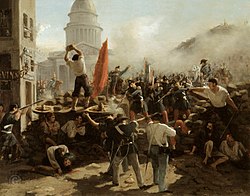
Feb 1848
% complete
The Communist Manifesto was written by Karl Marx and Friedrich Engels in 1847–48 just before the Revolutions of 1848 swept Europe, expressing what they termed scientific socialism.
Image source: The Communist Manifesto
1870 - 1900
% complete
In the last third of the 19th century parties dedicated to Democratic socialism arose in Europe, drawing mainly from Marxism and seeking socialist change through democratic means.
Image source: Democratic socialism
1871
% complete
The major characteristics of socialism (particularly as conceived by Marx and Engels after the Paris Commune of 1871) are that the proletariat would control the means of production through a workers' state erected by the workers in their interests.
Image source: Paris Commune
1872
% complete
The authoritarian–libertarian struggles within the socialist movement go back to the First International and the expulsion in 1872 of the anarchists, who went on to lead the Anti-authoritarian International and then founded their own libertarian international.
Image source: International Workingmen's Association
1879
% complete
August Bebel's Woman under Socialism (1879) is the 'single work dealing with sexuality most widely read by rank-and-file members of the Social Democratic Party of Germany (SPD)', laying groundwork for socialist perspectives on women's emancipation.
1884
% complete
Marxist feminism's foundation was laid by Engels in The Origin of the Family, Private Property, and the State (1884), linking women's oppression to private property and class society.
Image source: Marxist feminism
1888
% complete
In 1888, the individualist anarchist Benjamin Tucker, who proclaimed himself to be an anarchistic socialist and libertarian socialist in opposition to authoritarian state socialism, included the full text of a 'Socialistic Letter' by Ernest Lesigne in his essay on 'State Socialism and Anarchism'.
Image source: Benjamin Tucker
1888
% complete
By 1888, Marxists employed socialism in place of communism as the latter had come to be considered an old-fashioned synonym for socialism.
Dec 1899
% complete
For a duration of one week in December 1899, the Australian Labor Party formed the first socialist government in the world when it was elected into power in the Colony of Queensland with Premier Anderson Dawson as its leader.
Image source: Anderson Dawson
1900 - 1950
% complete
In the first half of the 20th century, the Soviet Union and the communist parties of the Third International came to represent socialism in terms of the Soviet model of centrally planned economies directed by a state owning all means of production, though other trends condemned the lack of democracy.
Image source: Soviet Union
1917 - 1925
% complete
Influenced by Lenin, the Central Committee of the Bolshevik Party stated that the development of the socialist workers' culture should not be 'hamstrung from above' and opposed the Proletkult (1917–1925) organisational control of the national culture.
Image source: Proletkult
1918
% complete
The distinction between communism and socialism became salient in 1918 after the Russian Social Democratic Labour Party renamed itself to the All-Russian Communist Party, interpreting communism specifically to mean socialists who supported Bolshevism, Leninism and later Marxism–Leninism.
Image source: Russian Social Democratic Labour Party
1920
% complete
By the early 1920s, communism and social democracy had become the two dominant political tendencies within the international socialist movement, with socialism itself becoming the most influential secular movement of the 20th century.
1923
% complete
Trotsky's writings on literature such as his 1923 survey which advocated tolerance, limited censorship and respect for literary tradition had strong appeal to the New York Intellectuals.
Image source: Leon Trotsky
1924
% complete
In his Dictionary of Socialism (1924), Angelo S. Rappoport documented the evolving definitions and varieties of socialist thought in the early 20th century.
1938
% complete
Trotsky would later co-author the 1938 Manifesto for an Independent Revolutionary Art with the endorsement of prominent artists Andre Breton and Diego Rivera.
1949
% complete
The establishment of the People's Republic of China in 1949 saw socialism introduced, eventually developing into a system combining a large state sector controlling the commanding heights of the economy with a growing private sector.
Image source: China
1953
% complete
This system substituted Yugoslavia's Soviet-type central planning with a decentralised, self-managed system after reforms in 1953, creating a distinctive model of workers' self-management.
Image source: Socialist self-management
1945 - 1951
% complete
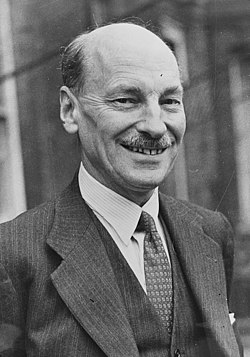
This ideology influenced the policies of the British Labour Party during Clement Attlee's 1945 administration, including nationalisation of coal mines in 1947 and the creation of British Shipbuilders combining major shipbuilding companies.
Image source: Attlee ministry
1968
% complete
By 1968, the prolonged Vietnam War gave rise to the New Left, socialists who tended to be critical of the Soviet Union and social democracy, energized by events like the May 1968 insurrection in France and the Stonewall riots of 1969.
Image source: New Left
1972
% complete
In 1972, the Chicago Women's Liberation Union published 'Socialist Feminism: A Strategy for the Women's Movement', which is believed to be the first published use of the term 'socialist feminism'.
1975
% complete
In The Concepts of Socialism (1975), Bhikhu Parekh identifies four core principles of socialism and particularly socialist society, namely sociality, social responsibility, cooperation and planning.
Image source: Bhikhu Parekh
1989 - 1991
% complete
In 1989, the Soviet Union saw the end of communism, marked by the Revolutions of 1989 across Eastern Europe, culminating in the dissolution of the Soviet Union in 1991. Many countries moved away from socialism as a neoliberal consensus replaced the social democratic consensus in the advanced capitalist world.
Image source: Revolutions of 1989
1992
% complete
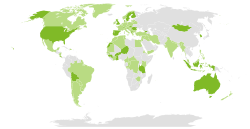
Mainstream social democratic and socialist parties are networked in Europe in the Party of European Socialists formed in 1992, coordinating center-left politics at the European level.
Image source: Party of European Socialists
1996
% complete
In his study Ideologies and Political Theory (1996), Michael Freeden states that all socialists share five themes: society is more than a collection of individuals; human welfare is desirable; humans are active and productive; human equality; and progressive history creating positive change through human effort.
Image source: Michael Freeden
2009 - 2015
% complete
Many mainstream socialist parties lost large parts of their electoral base in the early 21st century. This phenomenon is known as Pasokification from the Greek party PASOK, which declined from 43.9% in 2009 to 4.7% in 2015 due to its poor handling of the Greek government-debt crisis and austerity measures.
Image source: Pasokification
1990
% complete
In 1990, the São Paulo Forum was launched by the Workers' Party (Brazil), linking left-wing socialist parties in Latin America. Its members were associated with the pink tide of left-wing governments on the continent in the early 21st century.
Image source: São Paulo Forum
1999 - 2013
% complete
Member parties ruling countries included the Front for Victory in Argentina, the PAIS Alliance in Ecuador, Farabundo Martí National Liberation Front in El Salvador, Peru Wins in Peru, and the United Socialist Party of Venezuela, whose leader Hugo Chávez initiated what he called 'Socialism of the 21st century'.
Image source: United Socialist Party of Venezuela
2010 - 2019
% complete
Socialism experienced a resurgence in popularity in the 2010s due to the 2008 global financial crisis, which discredited neoliberal orthodoxy and renewed interest in socialist ideas among younger generations.
2013
% complete
On the right of the socialist movement, the Progressive Alliance was founded in 2013 by current or former members of the Socialist International, offering an alternative network for social democratic parties.
Image source: Progressive Alliance
2014 - 2019
% complete
The decline of mainstream parties opened space for more radical and populist left parties, such as Spain's Podemos, Greece's Syriza (in government, 2015–19), Germany's Die Linke, and France's La France Insoumise. In Europe, the share of votes for socialist parties was at its 70-year lowest in 2015.
2018 - 2023
% complete
A 2018 IPSOS poll found 50% of respondents globally agreed socialist values were valuable for societal progress. A 2019 Axios poll found 70% of US millennials willing to vote for a socialist candidate; a 2021 IEA survey found 67% of young Britons wanted a socialist economic system; and a 2023 IPSOS poll found a majority of the British public favoured public ownership of utilities.
Or browse the full history timeline directory, with more than 2,000 topics.
This Socialism timeline was generated with the help of AI, using information found on the internet.
We work hard to keep these timelines accurate, but mistakes do get through. If you spot one, email us at [email protected] and we'll fix it for future visitors.
Generate yours with AI or build it from scratch, for free.
Export your timeline, add your own events, edit or remove AI-generated events, and much more
No credit card required.
Cancel anytime.
Cancel anytime.
You can create an unlimited number of timelines with up to 10 events on each one, customize how they look, export them to PDF, PNG, PowerPoint, CSV, and Excel, and share them with a link. Paid plans raise the event limit and add features like spreadsheet imports and collaborators.
Yes. You can cancel your subscription from your account page at any time, and you will not be charged again. Your subscription stays active for the rest of the period you already paid for.
Yes. We will email you a reminder before the annual renewal, and we will also email you a receipt.
Yes. You can email us within 15 days of any payment, and we will issue you a full refund.
Check out our pricing docs or send us an email anytime: [email protected].