-
Use Cases
-
Resources
-
Pricing
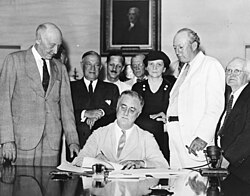
The Social Security Act, signed into law by President Franklin D. Roosevelt on August 14, 1935, established a system of old-age benefits for retired workers, unemployment insurance, and aid to dependent children and the disabled. As a cornerstone of Roosevelt's New Deal, it created the Social Security Board (later the Social Security Administration) and fundamentally reshaped the American social safety net, evolving through numerous amendments over the decades. More Less
1900
% complete
Industrialization and urbanization in the 20th century created many new social problems and transformed ideas about how society and the government should function together, setting the stage for national social insurance debates.
Image source: Social Security Act
1900 - 1930
% complete
During the early twentieth century, over a dozen bills providing for old-age pensions were put forward in Congress, but none of them were passed.
1908
% complete
Congress passed accident insurance bills in 1908, 1912, and 1916, together with an old-age pension bill in 1920, but the benefits provided under these bills only covered employees of the federal government.
1916
% complete
In 1916, House representative Meyer London submitted a resolution calling for a committee to work out details of a scheme for old age, health, and unemployment insurance. Opposed by organized labor and the insurance industry, it failed with 106 abstaining, 138 voting against, and 189 voting in favor.
Image source: Meyer London
Jan 1918
% complete
A similar resolution submitted by Meyer London in January 1918 also failed to win Congressional approval, with 199 House representatives voting in favor of a motion to strike out the enacting clause, while 133 voted against and 95 abstained.
1930
% complete
By 1930, amid the Great Depression, the United States was one of the few industrialized countries without any national social security system.
1931
% complete
By 1931, only 12 states had enacted old-age pension laws, although that year fourteen state governors advocated that their legislatures enact measures related to pensions.
Feb 1934
% complete
Having debated the issue since the Hoover administration, Congress saw a majority favor unemployment compensation by 1934. In February 1934, the Wagner-Lewis bill was introduced, seeking to establish a system of unemployment insurance.
May 1934
% complete
In 1934, the Dill-Connery bill for federal funding of state pension programs passed the House of Representatives and came near passage in the Senate that May.
Jun 1934
% complete
In 1934, Roosevelt charged the Committee on Economic Security, chaired by Secretary of Labor Frances Perkins, with developing an old-age pension program, an unemployment insurance system, and a national health insurance program.
Image source: Cabinet Committee on Security
Jan 1935
% complete
In January 1935, Roosevelt presented his plan for the Social Security Act to Congress, presenting it as a more practical alternative to the Townsend Plan.
Feb 1935 - Aug 1935
% complete
After a series of congressional hearings on Roosevelt's proposal, momentum built toward passage of the Social Security Act during the summer of 1935.
Aug 14, 1935
% complete
The Social Security Act of 1935 was enacted by the 74th United States Congress and signed into law by President Franklin D. Roosevelt on August 14, 1935, establishing old-age benefits funded through a newly created payroll tax.
May 24, 1937
% complete
Helvering v. Davis, 301 U.S. 548 (1937), decided by a 5–4 vote, held that given the exigencies of the Great Depression, using federal money to relieve the unemployed was a use for promoting the general welfare. Justices Butler, McReynolds, and Sutherland argued the act exceeded federal powers.
May 24, 1937
% complete
Decided the same day as Helvering v. Davis, Steward Machine Co. v. Davis upheld the program's payroll tax as constitutional, ruling that its proceeds were paid into the Treasury like internal-revenue taxes generally and were not earmarked in any way—a mere exercise of Congress's general taxation powers.
Image source: Steward Machine Co. v. Davis
1960
% complete
Flemming v. Nestor, 363 U.S. 603 (1960), upheld Section 1104 of the act, allowing Congress itself to amend and revise the schedule of benefits, affirming that Social Security benefits are not contractual property rights.
Mar 19, 1975
% complete
Weinberger v. Wiesenfeld (1975) held that a male widower should be entitled to his deceased wife's benefit just as a female widow was entitled to a deceased husband's, under the equal protection and due process clauses of the Fourteenth Amendment.
1939
% complete
In the amendments of 1939, the tax was removed from the Social Security Act, placed in the Internal Revenue Code, and renamed the Federal Insurance Contributions Act (FICA).
Image source: Federal Insurance Contributions Act
1940
% complete
The amendments accelerated the start of monthly benefit payments, which had originally been scheduled for 1940 but were moved up to begin earlier, transforming the very nature of the Social Security program.
1950
% complete
Many workers who had initially been excluded were covered only later, when Social Security was expanded in 1950, broadening the reach of the program significantly.
Image source: History of Social Security in the United States
1954
% complete
The Social Security Act Amendments of 1954 significantly expanded the system by extending coverage to approximately 10 million additional people, including self-employed farmers, most self-employed professionals, and state or local government employees on a voluntary basis via referendum.
Image source: Social Security Act
Jul 30, 1965
% complete
The law was amended by the Social Security Amendments of 1965, which established two major healthcare programs: Medicare and Medicaid, extending health coverage to elderly and low-income Americans.
1966
% complete
When Medicare was established in 1966, the FICA tax was increased to fund that program as well, linking the healthcare program's financing to the existing payroll tax structure.
1970 - 1975
% complete
Major changes included a 13% general increase in monthly benefits, a rise in the maximum annual earnings base from $3,600 to $4,200, and a scheduled tax rate increase to 4.0% by 1975.
1940
% complete
In 1940, Social Security benefits paid totaled $35 million, marking the early years of the program's benefit distributions to retired workers.
1950
% complete
By 1950, annual Social Security benefits paid had risen dramatically to $961 million, reflecting both inflation and the growing number of beneficiaries covered by the program.
1960
% complete
By 1960, annual Social Security benefits paid totaled $11.2 billion in nominal dollars, reflecting the program's rapid growth over two decades.
1980
% complete
By 1980, annual Social Security benefits paid had reached $120.5 billion in nominal dollars, demonstrating the program's massive growth since its inception.
2004
% complete
In 2004, $492 billion of benefits were paid to 47.5 million beneficiaries, showing the scale at which the program operated in the early 21st century.
2009
% complete
In 2009, nearly 51 million Americans received $650 billion in Social Security benefits, underscoring the program's central role in supporting retirees, disabled persons, and survivors during the Great Recession.
Or browse the full history timeline directory, with more than 2,000 topics.
This Social Security Act timeline was generated with the help of AI, using information found on the internet.
We work hard to keep these timelines accurate, but mistakes do get through. If you spot one, email us at [email protected] and we'll fix it for future visitors.
Generate yours with AI or build it from scratch, for free.
Export your timeline, add your own events, edit or remove AI-generated events, and much more
No credit card required.
Cancel anytime.
Cancel anytime.
You can create an unlimited number of timelines with up to 10 events on each one, customize how they look, export them to PDF, PNG, PowerPoint, CSV, and Excel, and share them with a link. Paid plans raise the event limit and add features like spreadsheet imports and collaborators.
Yes. You can cancel your subscription from your account page at any time, and you will not be charged again. Your subscription stays active for the rest of the period you already paid for.
Yes. We will email you a reminder before the annual renewal, and we will also email you a receipt.
Yes. You can email us within 15 days of any payment, and we will issue you a full refund.
Check out our pricing docs or send us an email anytime: [email protected].