-
Use Cases
-
Resources
-
Pricing
The Supermarine Spitfire was a British single-seat fighter aircraft designed by R.J. Mitchell and used by the Royal Air Force and Allied countries throughout World War II. Famous for its elliptical wings and Rolls-Royce Merlin engine, the Spitfire became an enduring symbol of British air power, playing a decisive role in the Battle of Britain and serving in numerous variants until after the war. More Less
1934
% complete
Undeterred by the Type 224's failure, R.J. Mitchell privately developed a new design with retractable undercarriage, enclosed cockpit, and eight machine guns. With backing from Vickers-Armstrongs chairman Robert McLean, the design matured into the Type 300 after the Rolls-Royce PV-12 engine (later the Merlin) became available.
Image source: Supermarine Spitfire
Feb 1934
% complete
R.J. Mitchell's team at Supermarine built the Type 224 in response to Air Ministry Specification F.7/30. Powered by a goshawk evaporative-cooled engine, it proved underpowered and disappointing, prompting Mitchell to begin an entirely new design that would evolve into the Spitfire.
Image source: Supermarine Type 224
Jan 3, 1935
% complete
The Air Ministry issued contract for a single prototype of Mitchell's refined design, designated F.37/34 and given serial K5054. The elliptical wing design gave the aircraft its distinctive shape and excellent aerodynamic efficiency.
Mar 5, 1936
% complete
Chief test pilot Captain Joseph 'Mutt' Summers took the prototype K5054 on its maiden flight at Eastleigh Aerodrome near Southampton. The flight lasted only about eight minutes, but Summers was reportedly delighted, saying not to touch anything, marking the birth of one of history's most famous fighters.
Image source: Supermarine Spiteful
Jun 1936
% complete
The Air Ministry approved the name 'Spitfire' for the new fighter, a word Sir Robert McLean said described his daughter as 'a little spitfire.' The evocative name would become synonymous with British resistance during World War II.
Jun 11, 1937
% complete
Reginald Joseph Mitchell died at age 42 after a long battle with cancer, just over a year after his masterpiece first flew. His colleague Joseph Smith took over as chief designer and guided the Spitfire through numerous wartime developments.
Image source: R. J. Mitchell
Jun 3, 1936
% complete
Before the prototype had even flown, the Air Ministry placed an order for 310 production Spitfire Mk I aircraft, reflecting confidence in the design. The order was the largest placed for a British fighter since World War I.
1938 - 1948
% complete
Total Spitfire production exceeded 20,000 aircraft across more than two dozen major marks, making it the most-produced British combat aircraft. Continuous refinement throughout the war kept it competitive from 1939 until 1945.
Jul 12, 1938
% complete
A shadow factory was established at Castle Bromwich, Birmingham, to mass-produce Spitfires alongside Supermarine's Southampton works. After early management troubles, Vickers-Armstrongs took over and the plant eventually built over half of all Spitfires.
Image source: Castle Bromwich
Sep 26, 1940
% complete
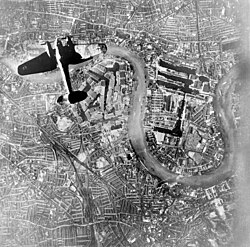
German bombers attacked the Supermarine factory at Woolston, Southampton, killing dozens of workers and halting production. Manufacturing was dispersed to garages, bus depots, and other sites across the region until new facilities could be organized.
Image source: Supermarine
1941
% complete
A navalized version of the Spitfire, the Seafire, was adapted with an arrester hook and folding wings for carrier operations. Though tricky to land aboard carriers, it provided the Royal Navy with a capable fleet fighter throughout the war.
Image source: Supermarine Seafire
Feb 1941
% complete
The Mk V, essentially a Mk I or II fitted with the improved Merlin 45 engine, became the most numerous Spitfire variant with nearly 6,500 built. It served on every front and formed the backbone of Fighter Command through 1941-42.
Image source: Supermarine Spitfire (late Merlin-powered variants)
Jul 1942
% complete
Responding to the superior Fw 190, Supermarine hastily married the two-stage Merlin 61 to the Mk V airframe, creating the Mk IX. It restored parity with German fighters and became one of the most successful and beloved Spitfire marks.
Image source: Supermarine Spitfire (Griffon-powered variants)
Feb 1943
% complete
The Mk XII, powered by the Rolls-Royce Griffon, entered service with low-level squadrons in early 1943. It offered exceptional speed at low altitude and paved the way for more powerful Griffon marks like the Mk XIV and F.24.
Jan 1944
% complete
The Griffon-powered Mk XIV proved one of the fastest Allied piston-engine fighters of the war, reaching around 446 mph. It scored the first victory over a Messerschmitt Me 262 jet when Flying Officer Dean shot one down in October 1944.
Aug 4, 1938
% complete
No. 19 Squadron based at Duxford received the first operational Spitfire Mk Is, becoming the first unit equipped with the type. Delivery had been delayed by production difficulties, but the fighter quickly won the admiration of its pilots.
Image source: No. 19 Squadron RAF
Oct 16, 1939
% complete
Spitfires of Nos. 602 and 603 Squadrons shot down a Junkers Ju 88 over the Firth of Forth, scoring the type's first aerial victory of the war. The engagement came during German raids on Royal Navy ships in Scottish waters.
Image source: Battle of the Heligoland Bight (1939)
Jul 10, 1940 - Oct 31, 1940
% complete
The Spitfire played its most celebrated role during the Battle of Britain, flying alongside Hawker Hurricanes against the Luftwaffe. While Hurricanes engaged bombers, Spitfires often took on German fighters, and their performance in the summer of 1940 made them enduring symbols of Britain's defiance.
Image source: Battle of Britain
Aug 20, 1940
% complete
Winston Churchill immortalized RAF Fighter Command in his speech to Parliament: 'Never was so much owed by so many to so few.' The Spitfire became forever linked with this tribute to the pilots who defended Britain.
Image source: Never was so much owed by so many to so few
Nov 1940
% complete
Unarmed, stripped-down Spitfires excelled as high-altitude photo-reconnaissance aircraft, with cameras replacing guns. Their speed and ceiling allowed them to photograph targets deep in Europe, including preparations for Operation Sea Lion and later V-weapons sites.
Jan 1941
% complete
Fighter Command switched to the offensive, sending Spitfires on sweeps ('Circuses' and 'Rhubarbs') over occupied France to draw the Luftwaffe into battle. These operations honed pilots' skills but brought heavy losses against experienced German units.
Image source: Circus offensive
May 9, 1942
% complete
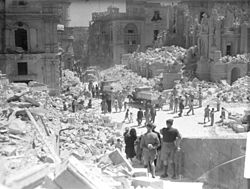
Spitfires delivered to Malta by aircraft carriers, including USS Wasp, turned the tide of the island siege. From Maltese airfields they contested Axis air supremacy, protecting supply convoys critical to keeping the strategic island alive.
Image source: Siege of Malta (World War II)
Aug 19, 1942
% complete
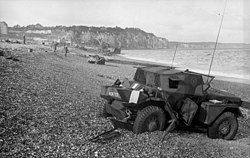
Dozens of Spitfire squadrons provided cover for the ill-fated amphibious raid on Dieppe. The massive air battle that day was among the largest single-day air engagements of the war, testing Spitfire squadrons against the full strength of Luftflotte 3.
Image source: Dieppe Raid
Nov 1942
% complete
Tropicalized Spitfires deployed to North Africa following Operation Torch, supporting Allied ground forces from Algeria to Tunisia. They went on to serve in Sicily, Italy, and southern France as the Mediterranean campaign progressed.
Image source: North African campaign
1943 - 1945
% complete
Spitfires of the RAF and other Commonwealth squadrons fought Japanese forces over Burma and Ceylon, defending India and supporting the reconquest of Southeast Asia, proving adaptable even in harsh tropical conditions.
Image source: Burma campaign
Jun 1944 - Aug 1944
% complete
When Germany launched V-1 flying bombs at London, fast Spitfire marks such as the Mk XIV were among the best interceptors. Spitfire pilots destroyed hundreds of the missiles, sometimes by tipping them off balance with a wingtip.
Image source: Operation Crossbow
Jun 6, 1944
% complete
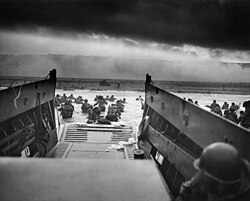
On D-Day, Spitfires flew patrols over the invasion beaches, shielding the armada and troops from Luftwaffe attack. Low-altitude marks like the LF IX operated from forward strips in Normandy within weeks of the landings.
Image source: Normandy landings
Apr 1945
% complete
In the final days of the European war, Spitfires continued ground-attack and reconnaissance missions over Germany. The type had grown from a defensive interceptor into a versatile multi-role aircraft by war's end.
1946
% complete
The Spitfire F.24 represented the ultimate development of the original design, with four cannon and a more powerful Griffon engine. By this time, however, jets such as the Meteor and Vampire were rendering piston fighters obsolete.
1951
% complete
The RAF withdrew the Spitfire from front-line fighter service in 1951, though photo-reconnaissance versions soldiered on until 1954. Some foreign air forces kept Spitfires operational into the late 1950s.
Or browse the full history timeline directory, with more than 2,000 topics.
This Spitfire timeline was generated with the help of AI, using information found on the internet.
We work hard to keep these timelines accurate, but mistakes do get through. If you spot one, email us at [email protected] and we'll fix it for future visitors.
Generate yours with AI or build it from scratch, for free.
Export your timeline, add your own events, edit or remove AI-generated events, and much more
No credit card required.
Cancel anytime.
Cancel anytime.
You can create an unlimited number of timelines with up to 10 events on each one, customize how they look, export them to PDF, PNG, PowerPoint, CSV, and Excel, and share them with a link. Paid plans raise the event limit and add features like spreadsheet imports and collaborators.
Yes. You can cancel your subscription from your account page at any time, and you will not be charged again. Your subscription stays active for the rest of the period you already paid for.
Yes. We will email you a reminder before the annual renewal, and we will also email you a receipt.
Yes. You can email us within 15 days of any payment, and we will issue you a full refund.
Check out our pricing docs or send us an email anytime: [email protected].