-
Use Cases
-
Resources
-
Pricing
The Sunni and Shia split is one of the most significant divisions in Islam, originating from a dispute over who should succeed Prophet Muhammad after his death in 632 CE. Sunnis believed leadership should pass to the community's chosen caliph, while Shias held that Ali, Muhammad's cousin and son-in-law, and his descendants were the rightful leaders. This theological and political disagreement shaped centuries of Islamic history, culture, and geopolitics. More Less
632
% complete
Fatimah, daughter of Muhammad and wife of Ali, disputed the caliphate's seizure of the estate of Fadak, which she claimed was her inheritance. Her death later in 632, following a reported confrontation, deepened resentment among Ali's supporters.
Image source: Fadak
Jun 8, 632
% complete
The death of Prophet Muhammad in Medina in 632 CE created a crisis of succession. Without a designated heir, the Muslim community faced the question of who should lead, setting the stage for the division between those who supported Abu Bakr and those who believed Ali ibn Abi Talib was the rightful successor.
Image source: Muhammad
634 - 644
% complete
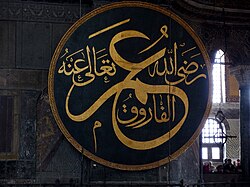
Umar became the second caliph after Abu Bakr's death, dramatically expanding the Islamic empire. His decade-long rule saw further marginalization of Ali's faction, though Ali later served as an advisor to Umar.
Image source: Umar
644
% complete
The shura council chose Uthman ibn Affan as the third caliph. His reign was marked by accusations of nepotism favoring his Umayyad relatives, fueling growing discontent that would eventually erupt into open rebellion.
Image source: Uthman
650
% complete
Uthman commissioned a standardized version of the Quran to unify the rapidly expanding empire's recitations. This codex remains central to both Sunni and Shia traditions, though Shia views on its compilation differ in emphasis.
656 - 661
% complete
The First Fitna erupted over Uthman's assassination and Ali's contested authority. Ali faced opposition from Aisha at the Battle of the Camel and from Mu'awiya, governor of Syria, fragmenting the Muslim community into rival camps.
Image source: First Fitna
656
% complete
Ali, cousin and son-in-law of Muhammad, was finally proclaimed caliph in Medina. Shias regard this as the restoration of rightful leadership, while Sunnis count him as the last of the Rashidun (rightly guided) caliphs.
Image source: Ali
658
% complete
Followers of Ali who rejected the arbitration with Mu'awiya broke away to form the Kharijite movement, declaring both Ali and Mu'awiya illegitimate. They became a third sect alongside the proto-Sunni and proto-Shia factions.
661
% complete
Mu'awiya founded the Umayyad dynasty, moving the capital to Damascus and establishing hereditary rule. Sunni Muslims largely accept Umayyad legitimacy, while Shias viewed the dynasty as usurpers of Ali's rights.
Image source: Umayyad Caliphate
661
% complete
After Ali's death, Hasan was acclaimed caliph in Kufa but abdicated within months in a peace treaty with Mu'awiya to avoid further bloodshed. Shias revere him as their second Imam; Sunnis view his concession pragmatically.
Image source: Hasan ibn Ali
680 - 692
% complete
The Second Fitna saw renewed civil war involving Husayn's revolt, Ibn al-Zubayr's counter-caliphate, and Mukhtar's pro-Alid uprising in Kufa. The Marwanid branch of the Umayyads ultimately crushed all rivals by 692.
Image source: Second Fitna
Oct 10, 680
% complete
Husayn, grandson of Muhammad and third Shia Imam, was killed along with his small band of followers by Umayyad forces at Karbala on Ashura. The tragedy became the defining event of Shia identity, commemorated every year during Muharram.
Image source: Battle of Karbala
685 - 687
% complete
Mukhtar led an uprising in Kufa avenging Karbala, killing those responsible for Husayn's death and championing Muhammad ibn al-Hanafiyya. Though defeated, his movement shaped early Shia political thought and the concept of the mahdi.
Image source: Mukhtar al-Thaqafi
740
% complete
Zayd, grandson of Husayn, rose against Umayyad rule in Kufa and was killed. His followers founded Zaydiyyah, a moderate Shia school still dominant in Yemen, illustrating the branching of Shia thought.
Image source: Zayd ibn Ali
750 - 765
% complete
The sixth Shia Imam, Ja'far al-Sadiq, taught in Medina and systematized Shia law and theology. His teachings form the basis of Twelver (Ja'fari) jurisprudence, and he also influenced early Sunni scholars like Abu Hanifa.
Image source: Ja'far al-Sadiq
750
% complete
The Abbasids seized power with crucial support from Shia and other dissident groups, promising rule by the Prophet's family. Once established, they sidelined the Alids, disillusioning many Shia supporters.
Image source: Abbasid Revolution
765
% complete
Ja'far al-Sadiq's death triggered a major split: Ismailis recognized his son Isma'il (or his descendants) as Imam, while Twelvers followed Musa al-Kadhim. This schism produced distinct Shia branches that endure today.
Image source: Ismailism
874
% complete
With the death of the eleventh Imam, Twelver Shias believe his young son, Muhammad al-Mahdi, entered a state of occultation (ghayba). Belief in his eventual return as the Mahdi became a cornerstone of Twelver doctrine.
Image source: Muhammad al-Mahdi
899
% complete
The Qarmatians, a radical Ismaili sect, established a state in eastern Arabia and famously raided Mecca in 930, carrying off the Black Stone. Their millenarian movement demonstrated the political reach of Shia offshoots.
Image source: Qarmatians
945
% complete
The Shia Buyids captured Baghdad and reduced the Abbasid caliphs to figureheads. For over a century they promoted Shia observances such as Ashura mourning and Ghadir Khumm celebrations across Iraq and Iran.
Image source: Buyid dynasty
969
% complete
The Ismaili Fatimids conquered Egypt and founded Cairo, ruling a vast empire from North Africa to the Levant. Their rival Shia caliphate competed with the Abbasids for religious authority until their fall in 1171.
Image source: Fatimid Caliphate
1055
% complete
The Sunni Seljuks took Baghdad from the Buyids and championed Sunni Islam, patronizing scholars like al-Ghazali. Their rise reversed Shia political dominance in the heartlands and strengthened Sunni institutions.
Image source: Seljuk Empire
1171
% complete
Saladin ended the Ismaili Fatimid regime in Egypt, restoring Sunni allegiance to the Abbasid caliph and founding the Ayyubid dynasty. Egypt returned firmly to the Sunni fold, reshaping the sectarian map of the region.
Image source: Saladin
Feb 13, 1258
% complete
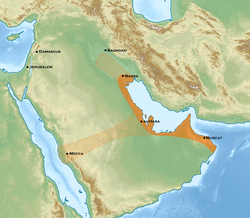
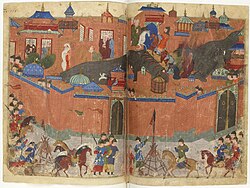
Hulagu Khan's Mongol army destroyed Baghdad and executed the last Abbasid caliph. The catastrophe shifted the centers of Islamic scholarship and power, eventually enabling new dynasties like the Ottomans, Safavids, and Mughals.
Image source: Siege of Baghdad (1258)
1501
% complete
Shah Ismail I declared Twelver Shiism the official religion of the Safavid Empire, converting largely Sunni Iran through coercion and clerical importation. This created the enduring Sunni-Shia geopolitical divide between Safavid Iran and the Ottoman Empire.
Image source: Safavid conversion of Iran to Shia Islam
Aug 23, 1514
% complete
Selim I's Ottoman army defeated Shah Ismail's Safavid forces at Chaldiran, fixing the border between the Sunni Ottoman and Shia Safavid empires. The battle entrenched sectarian rivalry in Middle Eastern geopolitics.
Image source: Battle of Chaldiran
1517
% complete
Following the conquest of Egypt and the end of the Abbasid line in Cairo, Selim I assumed the caliphal title. The Ottoman caliphate became the preeminent symbol of Sunni authority for four centuries.
Image source: Ottoman Caliphate
1744
% complete
Muhammad ibn Abd al-Wahhab allied with Muhammad ibn Saud, launching a puritanical Sunni reform movement that condemned Shia practices as innovations. Wahhabi-Saudi ideology has remained a major source of anti-Shia polemic.
Image source: Wahhabism
Apr 1802
% complete
Saudi-Wahhabi forces stormed Karbala, destroyed the dome of Husayn's shrine, and killed thousands of pilgrims. The attack exemplified militant Sunni hostility toward Shia holy sites and practices.
Image source: Wahhabi sack of Karbala
Mar 3, 1924
% complete
Ataturk's new Turkish republic abolished the caliphate, removing the institution that had symbolized Sunni unity for centuries. The vacuum spurred competing claims to Islamic leadership across the Sunni world.
Image source: Abolition of the Caliphate
Feb 11, 1979
% complete
Ayatollah Khomeini's revolution toppled the Shah and created a Shia theocracy based on velayat-e faqih (rule of the jurist). It energized Shia movements worldwide and alarmed Sunni-majority states, intensifying sectarian competition.
Image source: Iranian Revolution
Sep 22, 1980 - Aug 20, 1988
% complete
Saddam Hussein's Sunni-led Iraq invaded revolutionary Iran, framing the war as an Arab defense against Persian Shia expansion. The eight-year conflict entrenched regional Sunni-Shia polarization.
Image source: Iran–Iraq War
Sep 11, 2001
% complete
The September 11 attacks drew the United States into Afghanistan and later Iraq, destabilizing the region. The ensuing conflicts empowered sectarian militias and extremist groups on both sides of the divide.
Image source: September 11 attacks
Mar 20, 2003
% complete
The US-led invasion toppled Saddam Hussein, ending Sunni minority dominance in Iraq. Elections brought Shia parties to power, transforming Iraq into a key arena of Sunni-Shia competition and fueling insurgent backlash.
Image source: Iraq War
Feb 22, 2006
% complete
The bombing of the golden dome of the Al-Askari Shrine in Samarra, burial place of two Shia Imams, triggered waves of retaliatory sectarian violence that pushed Iraq to the brink of full-scale civil war.
Image source: 2006 al-Askari mosque bombing
Mar 15, 2011
% complete
The uprising against Bashar al-Assad's Alawite-led (Shia-offshoot) regime evolved into a proxy war drawing in Sunni Gulf states and Shia Iran and Hezbollah, making Syria a focal point of the regional Sunni-Shia struggle.
Image source: Syrian civil war
Jun 29, 2014
% complete
ISIS proclaimed a caliphate over territory in Iraq and Syria, systematically massacring Shia Muslims and destroying their shrines. Its extreme anti-Shia ideology represented one of the most violent chapters of the ancient split.
Image source: Islamic State
Or browse the full history timeline directory, with more than 2,000 topics.
This Sunni and Shia Split timeline was generated with the help of AI, using information found on the internet.
We work hard to keep these timelines accurate, but mistakes do get through. If you spot one, email us at [email protected] and we'll fix it for future visitors.
Generate yours with AI or build it from scratch, for free.
Export your timeline, add your own events, edit or remove AI-generated events, and much more
No credit card required.
Cancel anytime.
Cancel anytime.
You can create an unlimited number of timelines with up to 10 events on each one, customize how they look, export them to PDF, PNG, PowerPoint, CSV, and Excel, and share them with a link. Paid plans raise the event limit and add features like spreadsheet imports and collaborators.
Yes. You can cancel your subscription from your account page at any time, and you will not be charged again. Your subscription stays active for the rest of the period you already paid for.
Yes. We will email you a reminder before the annual renewal, and we will also email you a receipt.
Yes. You can email us within 15 days of any payment, and we will issue you a full refund.
Check out our pricing docs or send us an email anytime: [email protected].