-
Use Cases
-
Resources
-
Pricing
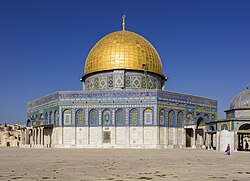
The Dome of the Rock is an iconic Islamic shrine located on the Temple Mount (Haram al-Sharif) in Jerusalem. Completed in 691/692 CE under the Umayyad Caliph Abd al-Malik, it is one of the oldest surviving works of Islamic architecture. The octagonal structure, crowned by a golden dome, enshrines the Foundation Stone, a site sacred in Judaism, Christianity, and Islam. More Less
100 BC - 099 BC
% complete
The Dome of the Rock is situated in the center of the Temple Mount, the site of Solomon's Temple and the Second Jewish Temple, which had been greatly expanded under Herod the Great in the 1st century BCE.
Image source: Dome of the Rock
300 - 599
% complete
Jerusalem was ruled by the Byzantine Empire throughout the 4th to 6th centuries, before the Muslim conquest of the city.
700 - 799
% complete
At the beginning of the 8th century, Ibn Ishaq codified the earliest Arabic source pertaining to the Jerusalem Rock as part of his Sirat al-Nabi, introducing the notion that Muhammad set off from the Rock in his Ascension (mi'raj) to Heaven following his Night Journey.
685 - 688
% complete
According to Sibt ibn al-Jawzi, construction started in 685/6, while al-Suyuti holds that its commencement year was 688. The inscriptions inside the dome attribute the building to Caliph 'Abd al-Malik in the year 691/2.
691
% complete
The interior of the dome is lavishly decorated with mosaic, faience and marble. Much of it still dates from the Umayyad period or retains the original Umayyad designs, though it has undergone multiple restorations over the centuries.
1015
% complete
The upper part of the original dome collapsed in an earthquake in 1015 and had to be rebuilt.
1022 - 1023
% complete
The collapsed dome was rebuilt in 1022–23 during the reign of the Fatimid caliph Al-Zahir (r. 1021–1036), who also rebuilt the Qibli (Al-Aqsa) Mosque. A mosaic epitaph on the inner dome dated 413 AH (1022–23) records this restoration.
1027 - 1028
% complete
The mosaics on the drum were repaired in 1027–1028 under Fatimid patronage. A rectangular inscription panel added into the mosaics records the restoration by caliph al-Zahir with the date 413 AH (1027/8 CE).
1033
% complete
The earthquake of 1033 resulted in the introduction of wooden beams to reinforce the dome structure.
1099
% complete
Jerusalem was captured by Crusaders in 1099 at the end of the First Crusade, beginning Christian rule over the city.
Image source: Siege of Jerusalem (1099)
1099 - 1187
% complete
The Dome of the Rock was given to the Augustinians, who turned it into a church, while the nearby Al-Aqsa main prayer hall became first a royal palace and then the headquarters of the Knights Templar for much of the 12th century.
1119
% complete
The Knights Templar, active from c. 1119, identified the Dome of the Rock as the site of the Temple of Solomon, calling it Templum Domini.
Image source: Knights Templar
Oct 2, 1187 - 1190
% complete
Saladin recaptured Jerusalem on 2 October 1187, requested a complete restoration of Al-Aqsa, and ordered the marble cover of the rock added by the crusaders to be removed. His restoration is recorded in a later Ottoman inscription dated 586 AH (1190 CE).
Image source: Saladin
1199
% complete
Another inscription on a wooden screen inside the building, no longer present, recorded the name of one of Saladin's sons and a date corresponding to 1199 CE.
1260 - 1277
% complete
During the Mamluk period (1260–1516), the Temple Mount received extensive royal patronage. Sultan Baybars restored the exterior decoration of the Dome of the Rock.
Image source: Baybars
1299 - 1309
% complete
The Mamluk sultan al-Nasir Muhammad re-gilded the dome during his second reign (1299–1309) as part of his extensive patronage of the Temple Mount.
Image source: Al-Nasir Muhammad
1327 - 1328
% complete
The current wooden ceiling of the outer ambulatory and its gilded decoration likely dates to another restoration by al-Nasir Muhammad during his third reign, around 1327–1328, in the Mamluk period.
1447
% complete
The dome was severely damaged in 1447, possibly by lightning, and its western side had to be rebuilt.
1520 - 1566
% complete
In the second major renovation phase, Ottoman sultan Suleiman the Magnificent renovated the building and replaced what remained of the exterior mosaics with brightly coloured, mainly blue-and-white Iznik-style Ottoman tile decoration.
Image source: Suleiman the Magnificent
1545 - 1552
% complete
Inscriptions on the tiles provide the dates 952 AH (1545–6 CE) and 959 AH (1552 CE), but work continued until the end of Suleiman's reign, if not later. Surah Ya-Sin was commissioned across the top of the tile work.
1561 - 1562
% complete
The Dome of the Chain, a free-standing structure next to the Dome of the Rock, was renovated as part of Suleiman's project in 1561–2.
Image source: Dome of the Chain
1574 - 1595
% complete
Documents show repairs were still incomplete by the time of Murad III, who can probably be credited with finishing Suleiman's work, including repairs to the lead of the dome.
Image source: Murad III
1780
% complete
An Ottoman inscription from 1780 and an eyewitness account from the 1860s record that the small domelets in the inner ambulatory ceiling were at one time filled with Chinese porcelain bowls inserted during the 1780 restoration.
1874 - 1875
% complete
In a major restoration project during the reign of Ottoman Sultan Abdülaziz, all tiles on the west and southwest walls of the octagonal part of the building were removed and replaced by copies made in Turkey. The Throne Verse band around the apex of the dome also dates to 1874–75.
Image source: Abdulaziz
1864
% complete
The alteration of the original inscription inside the dome was first noted by Melchior de Vogüé in 1864.
Image source: Eugène-Melchior de Vogüé
1917
% complete
Haj Amin al-Husseini, appointed Grand Mufti by the British in 1917, along with Yaqub al-Ghusayn, implemented the restoration of the Dome of the Rock and the Jami Al-Aqsa in Jerusalem.
Image source: Amin al-Husseini
Jul 11, 1927
% complete
Parts of the Dome of the Rock collapsed during the 11 July 1927 earthquake, and the walls were left badly cracked, damaging many of the repairs that had taken place over previous years.
Image source: 1927 Jericho earthquake
1959 - 1964
% complete
Between 1959 and 1964, an extensive program of renovation was undertaken by the government of Jordan, with funds supplied by Arab governments and Turkey. Before 1959, the dome was covered in blackened lead.
1959 - 1962
% complete
In the course of substantial restoration carried out from 1959 to 1962, the lead covering was replaced by aluminum-bronze plates covered with gold leaf made in Italy. In 1961 the golden appearance was also restored using copper, and the original tiles were replaced between 1960 and 1962 with copies produced in Italy.
1960 - 1963
% complete
The Mamluk painted decoration of the outer ambulatory ceiling was restored faithfully in 1960–61 and the Ottoman decoration of the inner ambulatory underwent restoration in 1963, with some minor changes.
1967
% complete
A few hours after the Israeli flag was hoisted over the Dome of the Rock in 1967 during the Six-Day War, Israelis lowered it on the orders of Moshe Dayan and invested the Muslim waqf with the authority to manage the Al-Aqsa compound in order to 'keep the peace'. Since then, non-Muslims have been permitted limited access.
1993 - 1995
% complete
In 1993, the golden dome covering was refurbished following a donation of US$8.25 million by King Hussein of Jordan, who sold one of his houses in London to fund the 80 kilograms of gold required. In 1995, the dome was covered again with real gold-plated segments of aluminum and copper.
Image source: Hussein of Jordan
Or browse the full history timeline directory, with more than 2,000 topics.
This Dome of the Rock timeline was generated with the help of AI, using information found on the internet.
We work hard to keep these timelines accurate, but mistakes do get through. If you spot one, email us at [email protected] and we'll fix it for future visitors.
Generate yours with AI or build it from scratch, for free.
Export your timeline, add your own events, edit or remove AI-generated events, and much more
No credit card required.
Cancel anytime.
Cancel anytime.
You can create an unlimited number of timelines with up to 10 events on each one, customize how they look, export them to PDF, PNG, PowerPoint, CSV, and Excel, and share them with a link. Paid plans raise the event limit and add features like spreadsheet imports and collaborators.
Yes. You can cancel your subscription from your account page at any time, and you will not be charged again. Your subscription stays active for the rest of the period you already paid for.
Yes. We will email you a reminder before the annual renewal, and we will also email you a receipt.
Yes. You can email us within 15 days of any payment, and we will issue you a full refund.
Check out our pricing docs or send us an email anytime: [email protected].