-
Use Cases
-
Resources
-
Pricing
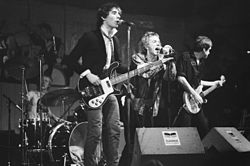
Punk rock is a raw, fast-paced genre of rock music that emerged in the mid-1970s as a rebellious reaction against mainstream rock's excesses. Characterized by short songs, stripped-down instrumentation, anti-establishment lyrics, and DIY ethics, punk became both a musical movement and a cultural phenomenon. From underground clubs in New York to the streets of London, punk rock challenged social norms, inspired countless subgenres, and left an enduring mark on music, fashion, and politics worldwide. More Less
1970
% complete
The history of punk plays an important part in the history of subcultures in the 20th century, shaping fashion, music, politics and youth identity far beyond the boundaries of rock music itself.
Image source: Punk subculture
Apr 1971
% complete
The earliest known example of a rock journalist using the term 'punk' was Greg Shaw, who used it to describe music by The Guess Who in the April 1971 issue of Rolling Stone as 'good, not too imaginative, punk rock and roll'.
Image source: Punk rock
May 1971
% complete
In May 1971, Dave Marsh used the term 'punk' in Creem magazine in reference to the music of ? and the Mysterians, further spreading the label in American music criticism.
Image source: Dave Marsh
1972
% complete
John Waters' 1972 underground classic, Pink Flamingos, is considered an important precursor of punk culture, with its deliberately shocking aesthetic and celebration of the taboo anticipating punk's confrontational spirit.
Image source: Pink Flamingos
1972
% complete
In the liner notes of the 1972 anthology album Nuggets, critic and guitarist Lenny Kaye uses the term 'punk-rock' to refer to the mid-60s garage rock groups, as well as some darker and more primitive practitioners of 1960s psychedelic rock.
Image source: Nuggets: Original Artyfacts from the First Psychedelic Era, 1965–1968
1974 - 1976
% complete
A less celebrated but highly influential scene appeared in Ohio, including the Electric Eels, Devo and Rocket from the Tombs, who in 1975 split into Pere Ubu and the Dead Boys.
1991
% complete
In 1991, Observer journalist John Windsor wrote about artist Frankie Stein – Precursor to Punk, noting she wore a safety pin as an earring years before her Sex Pistols friends adopted it, experimenting alongside Sassoon artistic director Flint Whincop with hairstyles copied by people such as Toya, Steve Strange and what became the Sex Pistols.
1991
% complete
In 1991 Observer journalist John Windsor wrote a story about artist Frankie Stein titled 'Precursor to Punk', documenting how her safety-pin earring and hairstyles prefigured the look later popularized by the Sex Pistols and their circle.
1971 - 1973
% complete
A mini underground rock scene at New York's Mercer Arts Center picked up from the demise of the Velvet Underground starting in 1971, featuring the New York Dolls and Suicide. It helped pave the way but came to an abrupt end in 1973 when the building collapsed.
Image source: The Kitchen (art institution)
1974 - 1976
% complete
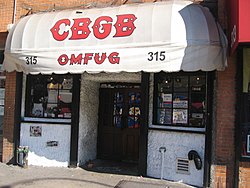
The first ongoing music scene assigned the 'punk' label appeared in New York in 1974–1976, centered around bands that played regularly at the clubs Max's Kansas City and CBGB.
Image source: CBGB
1975
% complete
Smith's group, and her first album Horses released in 1975, directly inspired many of the mid-1970s punk rockers, suggesting one path by which the term 'punk' migrated to the music we now know as punk rock.
Image source: Horses (album)
1975
% complete
The title of The Boy Looked at Johnny echoed a lyric from the title track of Patti Smith's 1975 album Horses, underscoring her influence on punk's literary and cultural imagination.
Jan 1976
% complete
By early 1976 the 'punk' title was applied to these groups when Punk Magazine first appeared, featuring the bands alongside immediate role models such as Lou Reed on the cover of its first issue and Patti Smith on the second.
Image source: Punk (magazine)
1975
% complete
Even after Franco died in 1975, Spain went through a volatile political period, having to relearn democratic values and install a constitution after forty years of fascist dictatorship melding state repression with fundamentalist Catholic moralism.
Image source: Spanish transition to democracy
1977
% complete
Notable Yugoslav artists included pioneers Pankrti and Paraf (both formed in 1977) and Pekinška patka (formed in 1978), followed later by 1980s hardcore punk acts such as KUD Idijoti, Niet, KBO! and many others.
Image source: Pankrti
1978
% complete
Formed in 1978, Pekinška patka joined Pankrti and Paraf among the pioneering acts of the Yugoslav punk rock scene, which grew into a vibrant regional movement through the following decade.
Image source: Pekinška Patka
1978
% complete
In Spain, the punk rock scene emerged in 1978, when the country had just emerged from forty years of fascist dictatorship under General Franco and was navigating its turbulent democratic transition.
1978
% complete
The early Spanish punk records, most emerging in the 1978 explosion of punk, often reached back to old-fashioned 50s rock'n'roll, glam, early metal and Detroit's hard proto-punk, creating an aggressive mix of fuzz guitar, jagged sounds and crude Spanish slang lyrics.
1979
% complete
The first independently released Spanish punk disc was a 45 RPM record by Almen TNT in 1979, marking a milestone in Spain's DIY punk underground.
1980 - 1989
% complete
Through the 1980s the Yugoslav punk movement produced notable hardcore punk acts including KUD Idijoti, Niet, KBO! and many others, building on the foundations laid by the late-1970s pioneers.
Image source: KUD Idijoti
May 1975
% complete
After a brief stint managing the New York Dolls at the end of their career in the US, Englishman Malcolm McLaren returned to London in May 1975, where he would soon guide the Sex Pistols and ignite the UK punk explosion.
Image source: Malcolm McLaren
Jul 4, 1976
% complete
An oft-cited moment in punk rock's history is the 4 July 1976 concert by the Ramones at the Roundhouse in London, with the Stranglers also on the bill. The show inspired many young British musicians to start their own bands.
Image source: Ramones
Dec 1976
% complete
By the end of 1976, many fans of the Sex Pistols had formed their own bands, including the Clash, Siouxsie and the Banshees, the Adverts, Generation X, the Slits and X-Ray Spex.
Image source: Sex Pistols
Dec 1976
% complete
In December 1976, the Sex Pistols, the Clash, the Damned and Johnny Thunders & the Heartbreakers united for the Anarchy Tour, a series of gigs throughout the UK that spread punk's notoriety nationwide.
Image source: Sex Pistols
1977
% complete
In 1977, a second wave of bands emerged, influenced by the first generation of punk acts, broadening the movement's reach and diversifying its sound.
Image source: New wave music
Dec 1977
% complete
One of the first books about punk rock, The Boy Looked at Johnny by Julie Burchill and Tony Parsons (December 1977), declared the punk movement to be already over; its subtitle was The Obituary of Rock and Roll.
Image source: Johnny Borrell
1991
% complete
In 1991, Nirvana achieved huge commercial success with their album Nevermind, bringing punk-derived alternative rock to mainstream audiences worldwide.
Image source: Nevermind
1991
% complete
The subsequent shift in taste among listeners of rock music was chronicled in a film entitled 1991: The Year Punk Broke, which featured Nirvana, Dinosaur Jr and Sonic Youth.
Image source: 1991: The Year Punk Broke
1991
% complete
The documentary 1991: The Year Punk Broke captured Nirvana, Dinosaur Jr and Sonic Youth at the moment alternative and punk-inflected rock broke into the mainstream, cementing the year as a turning point.
1996
% complete
Nirvana also featured in the film Hype!, which chronicled the Seattle grunge scene whose commercial breakthrough in 1991 transformed the landscape of rock music and carried punk's spirit to new generations.
Or browse the full history timeline directory, with more than 2,000 topics.
This History of Punk Rock timeline was generated with the help of AI, using information found on the internet.
We work hard to keep these timelines accurate, but mistakes do get through. If you spot one, email us at [email protected] and we'll fix it for future visitors.
Generate yours with AI or build it from scratch, for free.
Export your timeline, add your own events, edit or remove AI-generated events, and much more
No credit card required.
Cancel anytime.
Cancel anytime.
You can create an unlimited number of timelines with up to 10 events on each one, customize how they look, export them to PDF, PNG, PowerPoint, CSV, and Excel, and share them with a link. Paid plans raise the event limit and add features like spreadsheet imports and collaborators.
Yes. You can cancel your subscription from your account page at any time, and you will not be charged again. Your subscription stays active for the rest of the period you already paid for.
Yes. We will email you a reminder before the annual renewal, and we will also email you a receipt.
Yes. You can email us within 15 days of any payment, and we will issue you a full refund.
Check out our pricing docs or send us an email anytime: [email protected].