-
Resources
-
Pricing
Texas Annexation was the process by which the independent Republic of Texas joined the United States as the 28th state. More Less
Build a timeline like this one in minutes, for free. Start Yours →
1675 - 1699
Spanish and Indigenous immigrants, particularly people from the northeastern provinces of New Spain, began settling Texas in the late seventeenth century.
Image source: History of Texas
1718
The city of San Antonio, then known as San Fernando de Bexar, was founded in 1718 during the period of Spanish settlement in Texas.
Image source: History of San Antonio
1817 - 1819
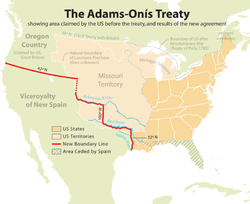
Secretary of State John Quincy Adams and Spanish ambassador Luis de Onís negotiated the United States–Spain border along the northern frontier of Texas.
Image source: Adams–Onís Treaty
Feb 22, 1819
The Florida Purchase Treaty established the Sabine and Red Rivers as southern boundary markers and legally extinguished American claims to Texas, while excluding Spain from the lower Columbia River drainage basin.
1821
When Mexico gained independence from Spain in 1821, the United States did not contest Mexico’s claims to Texas. Presidents John Quincy Adams and Andrew Jackson nevertheless sought to purchase all or part of the province through official and unofficial channels.
Image source: Mexican War of Independence

1826
The unsuccessful Fredonian Rebellion contributed to Mexican fears that control over Texas was weakening and helped prompt a shift away from Mexico’s earlier policy of relatively benign rule.
Image source: Fredonian Rebellion
1829 - 1830
Mexican authorities imposed new restrictions in 1829–1830, outlawing slavery throughout the nation and ending further American immigration to Texas.
1832 - 1833
Texas conventions held in 1832 and 1833 submitted petitions seeking redress of grievances and the reversal of Mexican restrictions, but achieved only limited success.
Image source: Convention of 1833
1835
In 1835, an army under Mexican President Antonio López de Santa Anna entered Texas and abolished its self-government, intensifying the conflict between Mexican authorities and Texian settlers.
Image source: Texas Revolution
Mar 2, 1836
Texians declared their independence from Mexico on March 2, 1836, establishing the political basis for the Republic of Texas.
Image source: Texas Declaration of Independence
Jun 1836
While held prisoner by Texians, Santa Anna signed an agreement recognizing Texas independence. The Mexican government refused to ratify the agreement because it had been made under duress.
Image source: Treaties of Velasco
1819 - 1821
The Missouri crisis sharpened expansionist commitments among slaveholding interests. The Thomas proviso established the 36°30′ parallel and imposed free-soil and slave-soil futures in lands acquired through the Louisiana Purchase.
Image source: Missouri Compromise
1820
Richmond Enquirer editor Thomas Ritchie argued that if the South were constrained in the north, it would need western room and would ultimately require Texas.
Image source: Texas annexation
1824
Representative John Floyd of Virginia accused Secretary of State Adams of conceding Texas to Spain in 1819 to satisfy Northern antislavery interests, thereby depriving the South of potential slave states.
Mar 3, 1837
Although Andrew Jackson strongly supported Texas independence, he delayed recognizing the new republic until the last day of his presidency to avoid raising the issue during the 1836 general election.
Aug 1837
Texas minister Memucan Hunt Jr. presented a formal annexation proposal to President Martin Van Buren in August 1837. Van Buren summarily rejected it.
1838
After repeated failures to secure annexation, Texas president Mirabeau B. Lamar withdrew the republic’s offer in 1838.
Image source: Mirabeau B. Lamar
1840
Whig presidential nominee William Henry Harrison defeated President Martin Van Buren in the 1840 general election, preceding John Tyler’s arrival in the White House.
Image source: 1840 United States presidential election
1841
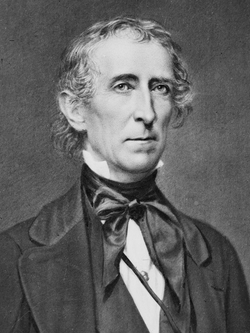
John Tyler entered the White House in 1841. He was expelled from the Whig Party after repeatedly vetoing its domestic finance legislation, leaving him politically unaligned while Texas annexation became a possible source of support.
Image source: John Tyler
Jun 1, 1841
In his first address to Congress during a special session, Tyler announced an expansionist agenda intended to preserve the balance between state and national authority and protect American institutions, including slavery, from sectional conflict.
1843
After the Webster–Ashburton Treaty was ratified, Tyler decided independently to pursue Texas annexation as his top political priority and as a potential base of support for another four years in office.
1843 - Jul 1843
The Tyler administration sent executive agent Duff Green to Europe to gather intelligence and arrange treaty discussions concerning Oregon. Green also worked with minister Lewis Cass against efforts by European powers to suppress the maritime slave trade and later reported an alleged abolitionist loan plot involving Texas.
1843
Sam Houston’s administration resumed discussions with Mexico about a rapprochement that might preserve Texas self-government, potentially as a Mexican state, with Great Britain serving as mediator.
Jun 23, 1843
Tyler arranged the resignation of the anti-annexation Secretary of State Daniel Webster and appointed Abel P. Upshur, a Virginia states’ rights advocate and ardent supporter of Texas annexation.
Image source: Abel P. Upshur
Sep 18, 1843
After consulting Upshur, Tyler ordered secret negotiations with Isaac Van Zandt, the Texas minister to the United States, to discuss annexing Texas.
Sep 20, 1843 - Sep 30, 1843
Secretary Upshur wrote to American minister Edward Everett expressing opposition to Britain’s global antislavery posture and warning that British involvement in Texas would be treated as interference with established United States institutions.
Oct 16, 1843
Face-to-face negotiations between United States and Texas representatives over annexation commenced on October 16, 1843.
Jan 1, 1844 - Mar 31, 1844
Upshur assured Texas officials that 40 of the 52 senators supported ratifying the Tyler–Texas treaty, a number exceeding the two-thirds majority then required.
Jan 1844
With the 1844 election approaching and both major parties opposed to annexation, Secretary Upshur urged Texas diplomats to begin talks and sent an appeal to President Sam Houston. After receiving assurances of military defense, Houston authorized negotiations to reopen.
Feb 28, 1844
Secretary of State Abel P. Upshur and Secretary of the Navy Thomas W. Gilmer died in an accident aboard USS Princeton, one day after reaching a preliminary treaty draft agreement with the Republic of Texas.
Image source: USS Princeton (1843)
Mar 29, 1844
After becoming secretary of state, John C. Calhoun sent British minister Richard Pakenham a letter denouncing alleged British antislavery interference in Texas.
Image source: John C. Calhoun
Apr 12, 1844
The Tyler–Texas treaty was signed on April 12, 1844. It proposed bringing Texas into the Union as a territory through constitutional treaty procedures.
Apr 22, 1844
Tyler submitted the treaty to the Senate on April 22, 1844, where ratification required a two-thirds majority.
Jun 8, 1844
The Whig-majority Senate rejected the Tyler–Calhoun annexation treaty by a vote of 16–35, decisively blocking ratification.
1844
Texas annexation and the reoccupation of Oregon became central issues in the 1844 presidential campaign after the treaty’s terms became public.
Image source: 1844 United States presidential election
May 1844
At the Democratic convention in May 1844, pro-annexation southern delegates denied anti-annexation leader Martin Van Buren the presidential nomination.
Image source: 1844 Democratic National Convention
Aug 1844
Tyler withdrew from the presidential race in August 1844 while the campaign increasingly focused on Texas annexation.
Nov 5, 1844
Pro-annexation Democrat James K. Polk narrowly defeated anti-annexation Whig Henry Clay in the 1844 presidential election. Clay’s support collapsed in the Deep South amid pro-annexation excitement.
Dec 1844
During the lame-duck session in December 1844, Tyler called on Congress to pass Texas annexation by simple majorities in both houses, seeking to avoid another overwhelming Senate treaty rejection.
Jan 13, 1845
Representatives Milton Brown and Alexander Stephens and Senator Ephraim Foster introduced an amendment recognizing Texas as a slave state, retaining its public lands, and preserving its bonded debt accrued since 1836.
Jan 25, 1845
The House of Representatives approved the amended Texas annexation measure by a vote of 120–98.
Feb 5, 1845
Senator Thomas Hart Benton proposed an alternative resolution that avoided specifying the future free-or-slave status of Texas and called for bipartisan commissioners to settle border disputes and establish acquisition conditions.
Image source: Thomas Hart Benton (painter)
Feb 27, 1845
Less than a week before Polk’s inauguration, the Senate voted 27–25 to admit Texas under the Tyler protocols allowing passage by simple majorities.
Mar 1, 1845
President Tyler signed the Joint Resolution for annexing Texas to the United States on March 1, 1845. The law was enacted as J.Res. 8, 5 Stat. 797.
Image source: Secession in the United States
Mar 3, 1845
On his last full day in office, Tyler dispatched an offer of annexation to the Republic of Texas under the Brown–Foster option of the joint resolution.
May 5, 1845
Texas President Anson Jones called for a convention to meet on July 4, 1845, to consider annexation and draft a state constitution.
Jun 23, 1845
The Texan Congress accepted the United States Congress’s joint resolution of March 1, 1845, and consented to convening a convention.
Aug 27, 1845 - Aug 28, 1845
The Texas convention remained in session through August 28 and adopted the Constitution of Texas on August 27, 1845.
Oct 13, 1845
Texas citizens approved both the annexation ordinance and the new constitution on October 13, 1845.
Nov 1845
President Polk sent John Slidell as a secret representative to Mexico City with a monetary offer for disputed land and other Mexican territories.
Image source: John Slidell
Dec 29, 1845
President James K. Polk signed the legislation admitting the former Republic of Texas to the Union as the 28th state on December 29, 1845. The measure was J.Res. 1, 9 Stat. 108.
Image source: List of U.S. states by date of admission to the Union
Feb 19, 1846
Texas relinquished its sovereignty to the United States at the inauguration of Governor James Henderson on February 19, 1846, formally completing its integration into the Union.
Apr 1846
Texas’s formal admission and the dispute over its southern boundary contributed to the Mexican–American War, which began in April 1846. Polk subsequently ordered General Zachary Taylor to garrison the border claimed by the former republic.
Image source: Mexican–American War
1897 - Jul 1898
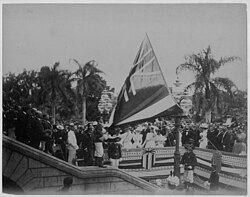
The joint-resolution method used for Texas became a precedent for annexing Hawaii. After President Benjamin Harrison’s treaty effort failed to secure Senate support, President William McKinley revived the proposal, and Congress approved Hawaii’s annexation by joint resolution in July 1898.
Image source: Newlands Resolution
Build a timeline like this one in minutes, for free. Start Yours →
Or browse the full history timeline directory, with more than 2,500 topics.
This Texas Annexation timeline was generated with the help of AI, using information found on the internet.
We work hard to keep these timelines accurate, but mistakes do get through. If you spot one, email us at [email protected] and we'll fix it for future visitors.
Generate yours with AI or build it from scratch, for free.
Export your timeline, add your own events, edit or remove AI-generated events, and much more
No credit card required.
15-day money-back guarantee.
You can create an unlimited number of timelines with up to 10 events on each one, customize how they look, export them to PDF, PNG, PowerPoint, CSV, and Excel, and share them with a link. Timelines made with Timeline Maker AI keep every event the generator created, and you can add up to 5 events of your own. Paid plans remove the event limit, add spreadsheet imports and hide Preceden's branding, and the higher-priced plan also adds collaborators, a custom logo and a custom domain.
Yes. You can cancel your subscription from your account page at any time, and you will not be charged again. Your subscription stays active for the rest of the period you already paid for.
Yes. We email you a reminder 15 days before your annual renewal, and we email you a receipt after every payment.
Yes. You can email us within 15 days of any payment, and we will issue you a full refund.
Check out our pricing docs or send us an email anytime: [email protected].