-
Use Cases
-
Resources
-
Pricing
The Texas Revolution was the armed conflict between the colonists of Mexican Texas and the centralist government of Mexico from 1835 to 1836. Sparked by growing tensions over immigration, autonomy, and political control, the revolution culminated in iconic events such as the Battle of the Alamo and the decisive Battle of San Jacinto, resulting in Texas gaining independence as the Republic of Texas. More Less
1803
% complete
Following the Louisiana Purchase of 1803, the United States claimed the land west of the Sabine River all the way to the Rio Grande, fueling disputes with Spain over the boundaries of Texas.
Image source: Louisiana Purchase
1812 - 1813
% complete
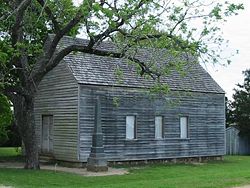
From 1812 to 1813, anti-Spanish republicans and U.S. volunteers launched an expedition into Texas. They won early battles, captured several Texas cities from the Spanish, and on April 17, 1813 declared the independence of the state of Texas as part of the Mexican Republic.
Image source: Gutiérrez–Magee Expedition
Apr 17, 1813
% complete
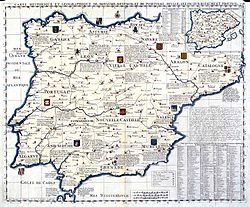
Republican forces proclaimed the independence of the state of Texas as part of the Mexican Republic. Future signers of the Texas Declaration of Independence José Antonio Navarro and José Francisco Ruiz took part in this Gutiérrez–Magee Expedition.
Aug 1813
% complete
The new Texas government and army met their doom at the Battle of Medina, 20 miles south of San Antonio, where 1,300 of the 1,400 rebel soldiers were killed or executed shortly afterward by royalist troops.
Image source: Battle of Medina Ridge
1819
% complete
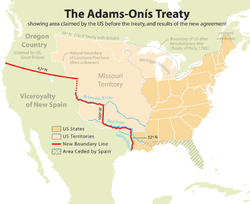
The United States officially renounced its claim to Texas as part of the Transcontinental Treaty with Spain, but many Americans continued to believe Texas should belong to their nation, and over the next decade the U.S. made several offers to purchase the region.
Image source: Adams–Onís Treaty
1824
% complete
Under the Constitution of 1824, which defined Mexico as a federal republic, the provinces of Texas and Coahuila were combined to become the state of Coahuila y Tejas.
Image source: 1824 Constitution of Mexico
1829
% complete
Mexico officially abolished slavery in 1829 but made an exemption for Texas. Because the exemption was not constitutionalized, many slave owners in Texas remained unsatisfied, and the colonies teetered at the brink of revolt.
Image source: History of slavery in Texas
Apr 6, 1830
% complete
In response to growing unrest, President Anastasio Bustamante implemented the Laws of April 6, 1830, which prohibited further immigration to Texas from the United States, increased taxes, and reiterated the ban on slavery.
1832
% complete
In 1832, Antonio López de Santa Anna led a revolt that overthrew President Anastasio Bustamante. Buoyed by their success, Texians held two political conventions to persuade Mexican authorities to weaken the Laws of April 6, 1830.
Image source: Antonio López de Santa Anna
Nov 1833
% complete
In November 1833, the Mexican government attempted to address Texian concerns by repealing some sections of the Laws of April 6, 1830 and granting further concessions, including increased representation in the state legislature.
Image source: Texas Revolution
1834
% complete
By 1834, an estimated 30,000 Anglos lived in Coahuila y Tejas, compared to only 7,800 Mexican-born residents, shifting the demographic balance of the region dramatically toward American settlers.
Apr 1834
% complete
Santa Anna overthrew Valentín Gómez Farías in April 1834 and soon revealed himself to be a centralist, inaugurating the Centralist Republic of Mexico and abandoning federalism.
Image source: Centralist Republic of Mexico
1835
% complete
In 1835, the 1824 Constitution was overturned; state legislatures were dismissed and militias disbanded, alarming Texans who had pledged loyalty to the federal constitution.
Image source: Siete Leyes
Apr 1835
% complete
As early as April 1835, military commanders in Texas began requesting reinforcements from Mexico City, fearing that the increasingly restless citizens would rise in revolt.
Sep 10, 1835
% complete
After a Mexican soldier bludgeoned a Gonzales resident on September 10, 1835, tensions rose even further, and Mexican authorities felt it unwise to leave the settlers with a weapon, setting the stage for confrontation.
Image source: Battle of Gonzales
Oct 1835 - Nov 1835
% complete
Of the 1,300 men who volunteered to fight for the Texian army in October and November 1835, only 150–200 arrived from the United States after October 2; most were residents of Texas with an average immigration date of 1830.
Oct 2, 1835
% complete
The Texas Revolution began on October 2, 1835, when Texians resisted Mexican attempts to reclaim a cannon at Gonzales. The rebellion was waged by Anglo-American immigrants (Texians) and Hispanic Texans (Tejanos) against the centralist government of Mexico in the state of Coahuila y Tejas.
Nov 1835
% complete
While delegates at the Consultation debated whether the goal was independence or a return to the Constitution of 1824, Texians and volunteers from the United States defeated small Mexican garrisons across Texas.
Image source: Consultation (Texas)
Nov 13, 1835
% complete
After days of bitter debate, the delegates voted to create a provisional government based on the principles of the Constitution of 1824 rather than declaring outright independence.
Dec 1835
% complete
By mid-December 1835, Texians and volunteers from the United States had defeated the small garrisons of Mexican soldiers in Texas. Under the terms of surrender, General Martín Perfecto de Cos and his men agreed to leave Texas and no longer fight against supporters of the Constitution of 1824.
Image source: Siege of Béxar
Dec 30, 1835
% complete
At Santa Anna's behest, the Mexican Congress passed the Tornel Decree in late December, declaring that any foreigners fighting against Mexican troops would be deemed pirates and dealt with as such — meaning execution upon capture, as captured pirates were executed immediately in the early nineteenth century.
Image source: José María Tornel
1836 - Dec 31, 1836
% complete
Out of caution following the revolutionary upheaval, the town of Béxar (San Antonio) remained under martial law throughout 1836.
Image source: San Antonio
Jan 9, 1836
% complete
Petty bickering between Governor Henry Smith and the Council members increased dramatically, and on January 9, 1836, Smith threatened to dismiss the Council unless they revoked their approval of the ill-fated Matamoros Expedition.
Feb 1836
% complete
By December 1835, 6,019 soldiers had begun their march towards Texas under Santa Anna. His Army of Operations entered Texas in mid-February 1836 and found the Texians completely unprepared for the invasion.
Mar 1, 1836
% complete
On March 1, 1836, Mexican President Miguel Barragán died in the midst of the war from typhus while attending to matters related to the conflict with the rebel colonists.
Image source: Miguel Barragán
Apr 21, 1836
% complete
From October 1835 through April 1836, approximately 1,000 Mexican and 600 Texian soldiers died, while wounded numbered roughly 400 Mexican and 350 Texian — unusual for 19th-century warfare, where the wounded typically outnumbered those killed.
Mar 1836
% complete
In March 1836, a second political convention declared independence from Mexico and appointed leadership for the new Republic of Texas, fulfilling one side of the debate between independence and return to the Constitution of 1824.
Image source: Texas Declaration of Independence
Mar 1, 1836
% complete
The Convention of 1836 opened at Washington-on-the-Brazos on March 1, attracting 45 delegates representing 21 municipalities. Travis had succeeded in buying time for the convention to meet despite the ongoing siege of the Alamo.
Image source: Convention of 1836
Jun 1, 1836
% complete
On June 1, 1836, after his defeat and capture by Texian forces, Santa Anna boarded a ship to travel back to Mexico, ending his direct involvement in the revolution's military campaign.
Sep 1836
% complete
Voters overwhelmingly chose Sam Houston as the first president of the Republic of Texas, ratified the constitution drawn up by the Convention of 1836, and approved a resolution requesting annexation to the United States.
Image source: Sam Houston
Mar 1837
% complete
The United States agreed to recognize the Republic of Texas in March 1837 but declined to annex the territory, leaving the young republic diplomatically isolated.
Image source: Republic of Texas
May 1837
% complete
In May 1837, Santa Anna requested an official inquiry into his conduct of the Texas campaign and his surrender after the Battle of San Jacinto.
1839 - 1840
% complete
The northern Mexican states, which had been the focus of the Matamoros Expedition, briefly launched an independent Republic of the Rio Grande in 1839, echoing the federalist resistance that fueled the Texas Revolution.
Image source: Republic of the Rio Grande
1839
% complete
In late 1839 France recognized the Republic of Texas after being convinced it would make a fine trading partner, giving the republic valuable international legitimacy.
Image source: France–Mexico relations
1840
% complete
In 1840, after years in which the Republic of Texas was neither annexed by the United States nor reabsorbed into Mexico, Britain signed a treaty recognizing the nation and acting as mediator to help Texas gain recognition from Mexico.
Jun 1843
% complete
In June 1843, leaders of the Republic of Texas and Mexico declared an armistice, easing hostilities between the two nations though Mexico still refused to recognize Texan independence.
1838 - 1950
% complete
From the first novel depicting events of the revolution, 1838's 'Mexico versus Texas,' through the mid-20th century, most works contained themes of anticlericalism and racism, depicting the battle as a fight for freedom between good (Anglo Texian) and evil (Mexican).
Mar 1845
% complete
The United States voted to annex Texas as the 28th state in March 1845. Some rights were restored in 1845 when Texas added them to the new state constitution, and the annexation led directly to the Mexican–American War.
Image source: Texas annexation
Jul 4, 1845
% complete
On July 4, 1845, Texians voted overwhelmingly in favor of annexation to the United States, completing the process of joining the Union as the 28th state.
1873 - 1901
% complete
The Texas Veterans Association, composed solely of revolutionary veterans living in Texas, was active from 1873 through 1901 and played a key role in convincing the legislature to create a monument honoring the San Jacinto veterans.
1879
% complete
Veterans were guaranteed land bounties; in 1879, surviving Texian veterans who served more than three months from October 1, 1835, through January 1, 1837, were guaranteed an additional 1,280 acres in public lands.
1883
% complete
In the late 19th century, the Texas Legislature purchased the San Jacinto battlesite, which is now home to the San Jacinto Monument, the tallest stone column monument in the world.
Image source: San Jacinto Monument
1905
% complete
In the early 20th century, the Texas Legislature purchased the Alamo Mission, preserving it as an official state shrine commemorating the defenders of the Alamo.
Image source: Alamo Mission
Or browse the full history timeline directory, with more than 2,000 topics.
This Texas Revolution timeline was generated with the help of AI, using information found on the internet.
We work hard to keep these timelines accurate, but mistakes do get through. If you spot one, email us at [email protected] and we'll fix it for future visitors.
Generate yours with AI or build it from scratch, for free.
Export your timeline, add your own events, edit or remove AI-generated events, and much more
No credit card required.
Cancel anytime.
Cancel anytime.
You can create an unlimited number of timelines with up to 10 events on each one, customize how they look, export them to PDF, PNG, PowerPoint, CSV, and Excel, and share them with a link. Paid plans raise the event limit and add features like spreadsheet imports and collaborators.
Yes. You can cancel your subscription from your account page at any time, and you will not be charged again. Your subscription stays active for the rest of the period you already paid for.
Yes. We will email you a reminder before the annual renewal, and we will also email you a receipt.
Yes. You can email us within 15 days of any payment, and we will issue you a full refund.
Check out our pricing docs or send us an email anytime: [email protected].