-
Use Cases
-
Resources
-
Pricing
The Republic of Texas was an independent sovereign nation in North America that existed from 1836 to 1845, after Texas won independence from Mexico at the Battle of San Jacinto. Governed by leaders such as Sam Houston and Mirabeau B. Lamar, the republic faced challenges including debt, border disputes, and relations with Native American tribes before joining the United States as the 28th state in 1845. More Less
1799 - 1803
% complete
During the years 1799 to 1803, at the height of the Napoleonic Empire in France, Spain returned Louisiana to France, leaving the status of Texas during these transfers unclear.
Image source: Louisiana Purchase
1810 - 1821
% complete
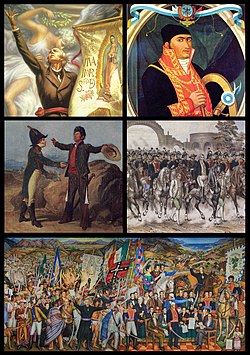
Starting in 1810 with the outbreak of the Mexican War of Independence, New Spain sought a different relationship with the Spanish crown. Mexico's independence from Spain in 1821 brought Texas into the newly formed Mexican state.
Image source: Mexican War of Independence
Apr 1, 1813
% complete
Bolstered by new recruits and led by Samuel Kemper, who succeeded Magee after his death in battle in 1813, the expedition gained victories against soldiers led by Spanish governor Manuel María de Salcedo. Their victory convinced Salcedo to surrender on April 1, 1813; he was executed two days later.
Apr 6, 1813 - Aug 18, 1813
% complete
On April 6, 1813, the victorious Republican Army of the North drafted a constitution and declared the independent Republic of Texas, with Gutiérrez as its president. The ephemeral republic came to an end on August 18, 1813, when the Spanish Army crushed the Republican Army of the North at the Battle of Medina.
Image source: Republic of Texas
1819
% complete
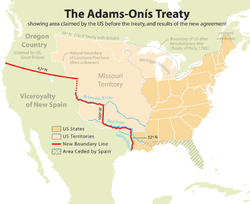
The Adams–Onís Treaty between Spain and the United States ceded Spanish Florida to the United States and established a clear boundary between Texas and Louisiana, resolving the ambiguous status of Texas after the transfers of Louisiana.
Image source: Adams–Onís Treaty
1820
% complete
Undeterred by earlier defeat, James Long returned to Texas again in 1820, joining refugees at Bolivar Peninsula on April 6, 1820 with more reinforcements. By December 1820 he commanded only 50 men.
Image source: James Long (filibuster)
Sep 19, 1821
% complete
The expedition led an uncertain existence until September 19, 1821, when Long and 52 men marched inland to capture Presidio La Bahía, marking the final failure of the filibustering effort for a Republic of Texas.
1824
% complete
The First Mexican Empire was short-lived, being replaced by a republican form of government in 1823. In 1824, the sparsely populated territories of Texas and Coahuila were joined to form the state of Coahuila y Tejas.
Image source: Coahuila y Tejas
Apr 6, 1830
% complete
Mexican President Anastasio Bustamante outlawed American immigration to Texas following several conflicts with the Empresarios over the status of slavery, which had been abolished in Mexico in 1829 but which the Texians refused to end.
1832
% complete
Angered at the interference of the Mexican government, the Empresarios held the Convention of 1832, which was the first formal step in what became the Texas Revolution.
Image source: Convention of 1832
1834
% complete
By 1834, American immigrants in the area greatly outnumbered Mexicans. Following a series of minor skirmishes between Mexican authorities and the immigrants, the Mexican government increased its military presence in Texas throughout 1834 and early 1835.
Image source: Texas Revolution
1835
% complete
In 1835, the central government split Coahuila y Tejas into two separate departments, escalating tensions between Texas settlers and the centralist Mexican regime.
Oct 2, 1835
% complete
Hostilities broke out on October 2, 1835, shortly before Santa Anna's Siete Leyes abolished state authority under the federal republic. The Texian leadership under Austin organized its own military, and the Battle of Gonzales became the first engagement of the Texas Revolution.
Image source: Battle of Gonzales
Nov 1835
% complete
In November 1835, a provisional government known as the Consultation was established to oppose the Santa Anna regime, though it stopped short of declaring independence from Mexico.
Image source: Consultation (Texas)
Mar 2, 1836
% complete
Delegates in convention proclaimed the Texas Declaration of Independence on March 2, 1836, formally establishing the Republic of Texas. The Convention of 1836 had come to order on March 1, and declared independence from Mexico the next day.
Image source: Texas Declaration of Independence
Apr 21, 1836
% complete
Major fighting ended on April 21, 1836, with the Treaties of Velasco that ended the fighting and secured Texas' independence from Mexico.
Image source: Treaties of Velasco
Sep 5, 1836
% complete
After interim President David G. Burnet declined to run for reelection, Sam Houston was elected as the new President of the Republic of Texas on September 5, 1836, with Burnet resigning. In September 1836 Texas also elected a Congress of 14 senators and 29 representatives.
Image source: Sam Houston
Oct 1836
% complete
The first Congress of the Republic of Texas convened in October 1836 at Columbia (now West Columbia), one of five temporary capitals that year alongside Washington-on-the-Brazos, Harrisburg, Galveston and Velasco.
Image source: Congress of the Republic of Texas
Dec 27, 1836
% complete
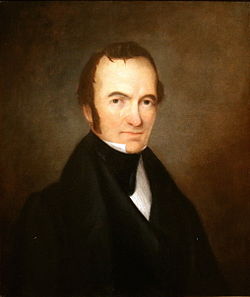
Austin, known as the Father of Texas, died December 27, 1836, after serving just two months as Secretary of State for the new Republic.
Image source: Stephen F. Austin
1837
% complete
After serving as capitals in 1836 at Washington-on-the-Brazos, Harrisburg, Galveston, Velasco and Columbia, President Sam Houston moved the capital to the new city of Houston in 1837.
Image source: History of Houston
1839
% complete
President Mirabeau B. Lamar moved the capital to the new town of Austin in 1839, a small pioneer settlement on the Colorado River chosen as the republic's seventh and final capital.
Image source: Austin, Texas
1839
% complete
The first flag of the republic was the Burnet Flag, a single gold star on an azure field, followed in 1839 by official adoption of the Lone Star Flag, which remains the flag of Texas today.
Image source: Flag of Texas
1839
% complete
In 1839, Texas became the first nation in the world to enact a homestead exemption, under which creditors cannot seize a person's primary residence.
Image source: Republic of Texas
1839 - 1844
% complete
The Regulator–Moderator War involved a land feud in Harrison and Shelby Counties in East Texas from 1839 to 1844, a violent internal conflict that ended only with intervention by the Republic's authorities.
Image source: Regulator–Moderator War
1841
% complete
Houston became president again in 1841 and, with both Texians and Comanches exhausted by war, a new peace was established with Native American tribes.
1844
% complete
The 1844 Republic of Texas presidential election split the electorate dramatically: the newer western regions preferred nationalist Edward Burleson, while the cotton country east of the Trinity River went for Anson Jones, who won.
Image source: Anson Jones
1845
% complete
President Anson Jones signed the charter for Baylor University in the fall of 1845. The University of Mary Hardin-Baylor was also chartered by the Republic in 1845, receiving lands in Belton, Texas.
Image source: Baylor University
Mar 3, 1837
% complete
On March 3, 1837, the United States granted official recognition to the Republic of Texas, an important diplomatic milestone for the young nation.
Image source: Texas annexation
1838
% complete
When Mirabeau Lamar ascended to the presidency in 1838, he reversed the Houston administration's policy towards the Native Americans, pursuing a more hostile stance toward the Comanches and other tribes.
Image source: Mirabeau B. Lamar
1840
% complete
After peace talks in 1840 ended with the massacre of 34 Comanche leaders in San Antonio, the Comanches launched a major attack deep into Texas, known as the Great Raid of 1840.
Image source: Great Raid of 1840
1841
% complete
In 1841, President Lamar unofficially supported the Santa Fe Expedition, seeking to extend Texian influence and trade into New Mexico.
Mar 5, 1842
% complete
On March 5, 1842, a Mexican force of over 500 men, led by Ráfael Vásquez, invaded Texas for the first time since the revolution, briefly occupying San Antonio.
Sep 11, 1842
% complete
About 1,400 Mexican troops, led by the French mercenary general Adrián Woll, launched a second attack and captured San Antonio on September 11, 1842.
Image source: Adrián Woll
1843
% complete
In 1843, Texans, with the support of their government, conducted two large raids on New Mexico and commercial traffic on the Santa Fe Trail.
Image source: Texan Santa Fe Expedition
Apr 30, 1843 - May 16, 1843
% complete
The Naval Battle of Campeche took place in two engagements on April 30, 1843, and May 16, 1843. A scene from this battle is engraved on the cylinder of every Colt 1851 Navy, 1860 Army, and 1861 Navy revolver.
Image source: Naval Battle of Campeche
1844
% complete
The negotiated treaty with the Comanches, known as the Treaty of Tehuacana Creek, was signed in 1844, cementing peace between Texans and the Comanche people.
Feb 28, 1845
% complete
On February 28, 1845, the U.S. Congress passed a resolution offering annexation to Texas, setting the stage for the republic to join the Union.
Oct 13, 1845
% complete
On October 13, 1845, a large majority of voters in the republic approved both the American offer and the proposed constitution that specifically endorsed slavery and emigrants bringing slaves to Texas.
Dec 29, 1845
% complete
Texas was annexed by the United States on December 29, 1845, and admitted to the Union as the 28th state on that same day, thereby bypassing a territorial phase.
Feb 19, 1846
% complete
The transfer of power from the Republic of Texas to the new U.S. state formally took place on February 19, 1846, ending the Republic's existence that had begun on March 2, 1836.
Or browse the full history timeline directory, with more than 2,000 topics.
This Republic of Texas timeline was generated with the help of AI, using information found on the internet.
We work hard to keep these timelines accurate, but mistakes do get through. If you spot one, email us at [email protected] and we'll fix it for future visitors.
Generate yours with AI or build it from scratch, for free.
Export your timeline, add your own events, edit or remove AI-generated events, and much more
No credit card required.
Cancel anytime.
Cancel anytime.
You can create an unlimited number of timelines with up to 10 events on each one, customize how they look, export them to PDF, PNG, PowerPoint, CSV, and Excel, and share them with a link. Paid plans raise the event limit and add features like spreadsheet imports and collaborators.
Yes. You can cancel your subscription from your account page at any time, and you will not be charged again. Your subscription stays active for the rest of the period you already paid for.
Yes. We will email you a reminder before the annual renewal, and we will also email you a receipt.
Yes. You can email us within 15 days of any payment, and we will issue you a full refund.
Check out our pricing docs or send us an email anytime: [email protected].