-
Use Cases
-
Resources
-
Pricing
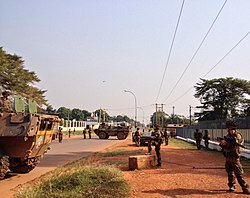
The Central African Republic (CAR) is a landlocked nation in central Africa whose history spans ancient settlement by indigenous peoples, French colonial rule as Ubangi-Shari, independence in 1960, decades of political instability marked by coups and dictatorships—including Jean-Bédel Bokassa's self-proclaimed empire—and recent civil conflicts involving armed groups that have shaped its turbulent path toward peace. More Less
700
% complete
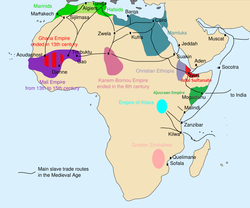
From at least the 7th century onward, the territory of modern Central African Republic was settled by overlapping empires including the Kanem-Bornu, Ouaddai, Baguirmi, and Dafour groups based around Lake Chad and along the Upper Nile.
Image source: Kanem–Bornu Empire
1500 - 1700
% complete
During the 16th and 17th centuries, Muslim slave traders began to raid the region, shipping captives to the Mediterranean coast, Europe, Arabia, the Western Hemisphere, or slave ports and factories along the West African coast.
Image source: Slavery in Africa
1700
% complete
During the 18th century, the Bandia-Nzakara peoples established the Bangassou Kingdom along the Ubangi river.
Image source: Bangassou
1800 - 1900
% complete
Population migration in the 18th and 19th centuries brought new migrants into the area, including the Zande, Banda, and Baya-Mandjia peoples.
Image source: Azande people
1830 - 1900
% complete
The slave state of Dar al-Kuti was located on the northern extreme of the modern border, existing until it was brought under French colonial rule in the late 19th century.
Image source: Dar al Kuti
1875
% complete
In 1875, the Sudanese sultan Rabih az-Zubayr governed Upper-Oubangui, which included present-day Central African Republic.
Image source: Rabih az-Zubayr
1885
% complete
The European occupation of Central African territory began in the late 19th century during the Scramble for Africa. Europeans, primarily the French, German, and Belgians, arrived in the area in 1885.
Image source: Scramble for Africa
1887
% complete
France asserted its legal claim to the area through an 1887 convention with the Congo Free State, privately owned by Leopold II of Belgium, which accepted French possession of the right bank of the Oubangui River.
Image source: Ubangi-Shari
1889
% complete
In 1889, the French established a trading post on the Ubangi River at Bangui, which would later grow into the capital of the Central African Republic.
Image source: Bangui
1890 - 1891
% complete
De Brazza sent expeditions up the Sangha River in south-western CAR, up the center of the Ubangi basin toward Lake Chad, and eastward toward the Nile, intending to expand the borders of the French Congo to link up other French territories in Africa.
Image source: Pierre Savorgnan de Brazza
1894
% complete
In 1894, the French Congo's borders with Leopold II's Congo Free State and German Cameroon were fixed by diplomatic agreements, and France declared Ubangi-Shari to be a French territory.
1899
% complete
In 1899, the French Congo's border with Sudan was fixed along the Congo-Nile divide, completing the delineation of colonial boundaries in the region.
Image source: French Equatorial Africa
1900
% complete
In 1900, the French defeated the forces of Rabih az-Zubayr at the Battle of Kousséri, but they did not consolidate control over Ubangi-Shari until 1903, when they established colonial administration throughout the territory.
Image source: Battle of Kousséri
1900 - 1910
% complete
During the first decade of French colonial rule, from about 1900 to 1910, the rulers of the Ubangi-Shari region increased both their slave-raiding activities and the selling of local produce to Europe.
1906
% complete
In 1906, the Ubangi-Shari territory was united with the Chad colony; in 1910 it became one of the four territories of the Federation of French Equatorial Africa (AEF), along with Chad, Middle Congo, and Gabon.
1911
% complete
In 1911, the Sangha and Lobaye basins were ceded to Germany as part of an agreement that gave France a free hand in Morocco.
Image source: Neukamerun
1920 - 1930
% complete
From 1920 to 1930, a network of roads was built, cash crops were promoted, and mobile health services were formed to combat sleeping sickness across Ubangi-Shari.
1925
% complete
In 1925, the French writer André Gide published Voyage au Congo, describing the alarming consequences of conscription for the Congo-Ocean railroad.
1928 - 1931
% complete
In 1928, a major insurrection known as the Kongo-Wara rebellion or 'war of the hoe handle' broke out in Western Ubangi-Shari. Although its leader Karnou was killed in December 1928, the rebellion was not fully suppressed until 1931.
1928
% complete
Peaceful opposition to railway recruitment and rubber tapping, and mistreatment by European concessionary companies began in the mid-1920s, descending into violence in 1928 when over 350,000 natives rebelled against the colonial administration.
Aug 1940
% complete
In August 1940, Ubangi-Shari responded, with the rest of the AEF, to the call from General Charles de Gaulle to fight for Free France; in September, pro-Gaullist French officers took control of the territory.
Image source: Free France
1946
% complete
After World War II, the French Constitution of 1946 inaugurated reforms leading eventually to complete independence. In 1946, all AEF inhabitants were granted French citizenship and allowed to establish local assemblies.
Image source: French Fourth Republic
1956
% complete
In 1956, French legislation eliminated certain voting inequalities and provided for the creation of some organs of self-government in each territory.
Image source: Gaston Defferre
Dec 1, 1958
% complete
The French constitutional referendum of September 1958 dissolved the AEF, and on 1 December 1958 the Assembly declared the birth of the autonomous Central African Republic with Barthélemy Boganda as head of government.
Image source: Central African Republic
Mar 29, 1959
% complete
Boganda, the founding father of the nation, ruled until his death in a plane crash on 29 March 1959, leaving a leadership void on the eve of independence.
Image source: Barthélemy Boganda
Aug 13, 1960
% complete
On 12 July 1960 France agreed to the Central African Republic becoming fully independent, and on 13 August 1960 it became an independent country with David Dacko as its first president.
Jan 5, 1964
% complete
David Dacko began consolidating his power soon after taking office in 1960. On 5 January 1964 he was elected in an election in which he ran alone, but by 1965 he had lost most support and may have been planning to resign.
Image source: David Dacko
Jan 1, 1966
% complete
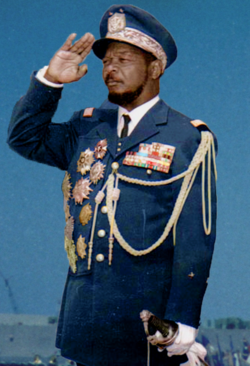
On 1 January 1966, following a swift and almost bloodless overnight coup, Colonel Jean-Bédel Bokassa assumed power as president, abolished the constitution of 1959, dissolved the National Assembly, and placed all legislative and executive powers in his own hands.
Mar 4, 1972
% complete
On 4 March 1972, Bokassa's presidency was extended to a life term, cementing his personal rule over the country.
Image source: Jean-Bédel Bokassa
Dec 4, 1976 - Sep 20, 1979
% complete
On 4 December 1976, the republic became a monarchy – the Central African Empire – with the promulgation of the imperial constitution and the coronation of the president as Emperor Bokassa I.
Image source: Central African Empire
Sep 20, 1979
% complete
On 20 September 1979, David Dacko overthrew Emperor Bokassa in a bloodless coup, restoring the republic.
Sep 20, 1981
% complete
After Dacko's economic and political reform efforts proved ineffectual, he was overthrown on 20 September 1981 in a bloodless coup by General André Kolingba.
1985 - 1988
% complete
In 1985 the CMRN was dissolved and Kolingba named a new cabinet with increased civilian participation. Democratization quickened in 1986 with the creation of the RDC party and a new constitution ratified by referendum. Kolingba was sworn in as constitutional president on 29 November 1986, a National Assembly of 52 deputies was elected in July 1987, and municipal elections followed in 1988.
May 1990
% complete
By 1990, inspired by the fall of the Berlin Wall, a pro-democracy movement became very active. In May 1990, a letter signed by 253 prominent citizens asked for the convocation of a National Conference.
Oct 1992
% complete
Pressure from GIBAFOR — locally represented countries and agencies including the United States, France, Japan, Germany, EU, World Bank and the UN — finally led André Kolingba to agree, in principle, to hold free elections in October 1992.
Image source: 1992 Central African general election
1993
% complete
When elections were finally held in 1993 with international help and the UN Electoral Assistance Unit, Ange-Félix Patassé led in the first round while Kolingba came in fourth behind Abel Goumba and David Dacko.
Dec 28, 1994 - Jan 14, 1995
% complete
Patassé relieved former president Kolingba of his military rank in March 1994 and charged former ministers with crimes. A new constitution was approved on 28 December 1994 and promulgated on 14 January 1995, though like earlier constitutions it had little impact on politics.
1996 - 1997
% complete
In 1996–1997, reflecting decreasing public confidence in the government, three mutinies against Patassé's administration occurred, accompanied by widespread destruction of property and heightened ethnic tension.
Jan 25, 1997
% complete
On 25 January 1997, the Bangui Agreements, providing for deployment of the inter-African military mission MISAB, were signed. Mali's former president Amadou Touré served as chief mediator, brokering the entry of ex-mutineers into government on 7 April 1997.
Image source: Bangui Agreements
1999
% complete
In 1998 parliamentary elections, Kolingba's RDC won 20 of 109 seats in a significant comeback, but in 1999 Patassé won free elections to become president for a second term despite widespread public anger in urban centres.
May 28, 2001
% complete
On 28 May 2001, rebels stormed strategic buildings in Bangui in an unsuccessful coup attempt against President Patassé.
Image source: 2001 Central African Republic coup attempt
Mar 15, 2003
% complete
In March 2003, François Bozizé launched a surprise attack against Patassé, who was out of the country. On 15 March 2003 rebels moved into Bangui and installed Bozizé as president.
2004 - Apr 13, 2007
% complete
After Bozizé seized power in 2003, the Bush War began with a rebellion by the Union of Democratic Forces for Unity (UFDR) led by Michel Djotodia, escalating into major fighting during 2004. On 13 April 2007, a peace agreement between the government and UFDR was signed in Birao.
Image source: Central African Bush War
2005
% complete
Bozizé won the 2005 presidential election, and his coalition led the 2005 legislative election, consolidating his grip on power after seizing the presidency.
Jan 2009
% complete
Further negotiations resulted in a 2008 agreement for reconciliation, a unity government, local elections in 2009, and parliamentary and presidential elections in 2010. The new unity government was formed in January 2009.
Dec 2012
% complete
In late 2012, a coalition of old rebel groups under the new name Séléka renewed fighting. On 27 December 2012, President Bozizé requested international assistance, particularly from France and the United States.
Image source: Séléka
Jan 11, 2013
% complete
On 11 January 2013, a ceasefire agreement was signed in Libreville, Gabon. The rebels dropped their demand for Bozizé to resign, but he had to appoint a new prime minister from the opposition party by 18 January 2013.
Image source: Libreville
Mar 24, 2013 - Mar 28, 2013
% complete
On 24 March 2013, rebel forces heavily attacked Bangui and took major structures including the presidential palace, ousting Bozizé. Tiangaye was reappointed prime minister on 27 March, and top military and police officers recognized Michel Djotodia as president on 28 March 2013.
Image source: Michel Djotodia
Dec 2013
% complete
Peacekeeping largely transitioned from the ECCAS-led MICOPAX to the African Union-led MISCA, which was deployed in December 2013 amid escalating sectarian violence.
Image source: MISCA
Jan 23, 2014
% complete
Catherine Samba-Panza assumed the office of interim president on 23 January 2014, tasked with guiding the country through a transitional period toward elections.
Image source: Catherine Samba-Panza
Sep 2014
% complete
In September 2014, MISCA transferred its authority to the UN-led MINUSCA, while the French peacekeeping mission operated as Operation Sangaris.
Image source: MINUSCA
Dec 14, 2015
% complete
By 2015 there was little government control outside Bangui. Noureddine Adam, leader of the rebel group Popular Front for the Rebirth of Central African Republic (FRPC), declared the autonomous Republic of Logone on 14 December 2015.
Image source: Popular Front for the Rebirth of Central African Republic
Feb 2016
% complete
In February 2016, after a peaceful election, former prime minister Faustin-Archange Touadéra was elected president of the Central African Republic.
Image source: Faustin-Archange Touadéra
Oct 2016
% complete
In October 2016, France announced that Operation Sangaris, its peacekeeping mission in the country, had been a success, and largely withdrew its troops.
Image source: Operation Sangaris
Nov 2016
% complete
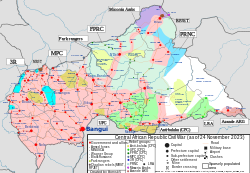
Tensions erupted between ex-Séléka militias over control of a goldmine in November 2016, where a coalition formed by the MPC and FPRC (incorporating elements of their former enemy, the Anti-balaka) attacked the UPC.
Image source: Central African Republic Civil War
Nov 2016
% complete
A new rebel group, Return, Reclamation, Rehabilitation (3R), formed in 2015 with no known links to Séléka or Anti-balaka, displaced 17,000 people in November 2016 and at least 30,000 in Ouham-Pendé in December 2016. Around Paoua, fighting between Revolution and Justice (RJ) and the MNLC erupted after RJ leader Clément Bélanga was killed in November 2017, displacing 60,000 people since December 2017. The MNLC was founded in October 2017 and led by Ahamat Bahar, allegedly backed by Fulani fighters from Chad, while the Christian militant group RJ had been formed in 2013 mostly by members of Patassé's presidential guard, mainly ethnic Sara-Kaba.
Image source: Return, Reclamation, Rehabilitation
Feb 2017
% complete
The fight for Bambari in early 2017 displaced 20,000 people. In February 2017, Joseph Zoundeiko, chief of staff of the FPRC, was killed by MINUSCA after crossing one of the red lines.
Image source: Bambari
Apr 2017 - Oct 2017
% complete
The thinly spread MINUSCA relied on Ugandan and American special forces in the southeast as part of a campaign to eliminate the Lord's Resistance Army, but that mission ended in April 2017. By late 2017, fighting largely shifted to the Southeast where the UPC was pursued by the FPRC and Anti-balaka. Ceasefires were signed in Rome in June and again in October 2017, though fighting continued.
Image source: Lord's Resistance Army insurgency
Jul 2018
% complete
By July 2018, the FPRC, now headed by Abdoulaye Hissène and based in Ndélé, had troops threatening to move onto Bangui. Further clashes between the UPC and MINUSCA/government forces occurred in early 2019.
Dec 2020
% complete
In December 2020, President Faustin Archange Touadéra was reelected in the first round of the presidential election, extending his tenure amid continuing instability.
Image source: 2020–21 Central African general election
Or browse the full history timeline directory, with more than 2,000 topics.
This History of Central African Republic timeline was generated with the help of AI, using information found on the internet.
We work hard to keep these timelines accurate, but mistakes do get through. If you spot one, email us at [email protected] and we'll fix it for future visitors.
Generate yours with AI or build it from scratch, for free.
Export your timeline, add your own events, edit or remove AI-generated events, and much more
No credit card required.
Cancel anytime.
Cancel anytime.
You can create an unlimited number of timelines with up to 10 events on each one, customize how they look, export them to PDF, PNG, PowerPoint, CSV, and Excel, and share them with a link. Paid plans raise the event limit and add features like spreadsheet imports and collaborators.
Yes. You can cancel your subscription from your account page at any time, and you will not be charged again. Your subscription stays active for the rest of the period you already paid for.
Yes. We will email you a reminder before the annual renewal, and we will also email you a receipt.
Yes. You can email us within 15 days of any payment, and we will issue you a full refund.
Check out our pricing docs or send us an email anytime: [email protected].