-
Use Cases
-
Resources
-
Pricing
The Democratic Republic of the Congo (DRC), formerly Zaire, has a complex history spanning pre-colonial kingdoms such as Kongo and Luba, brutal Belgian colonial rule under King Leopold II, independence in 1960, decades of dictatorship under Mobutu Sese Seko, devastating regional wars from 1996 to 2003, and ongoing political and economic challenges. More Less
1585
% complete
The Luba Empire emerged in the Upemba Depression region, developing a complex system of government based on sacred kingship. It became a major power in central Africa, influencing neighboring peoples and controlling trade routes for salt, iron, and other goods.
Image source: Luba Empire
1876 - 1877
% complete
Welsh-American explorer Henry Morton Stanley journeyed down the Congo River from its upper reaches to the Atlantic Ocean, mapping the river and establishing contacts with local chiefs. His expedition opened the interior of the Congo basin to European interest and paved the way for King Leopold II's colonial ambitions.
Image source: Henry Morton Stanley
Nov 15, 1884 - Feb 26, 1885
% complete
European powers met in Berlin to formalize rules for the colonization of Africa. The conference recognized King Leopold II of Belgium's claims to the Congo basin, granting him personal control over a territory 76 times the size of Belgium itself, with no African representation present.
Image source: Berlin Conference
1885
% complete
The Congo Free State was created as the private possession of King Leopold II rather than a Belgian colony. Leopold exploited the territory ruthlessly through forced labor to harvest rubber and ivory, resulting in millions of deaths from violence, starvation, and disease.
Image source: Congo Free State
1895 - 1908
% complete
Reports by missionaries, journalists like E.D. Morel, and investigators such as Roger Casement exposed horrific abuses including mutilations, hostage-taking, and mass killings in the Congo Free State. A global humanitarian campaign pressured Belgium to take action against Leopold's regime.
Image source: Congo Free State propaganda war
1906
% complete
The Union Minière du Haut Katanga was established to exploit the vast mineral wealth of Katanga province, particularly copper, cobalt, and uranium. The company became enormously profitable and dominated the colonial economy, with its uranium later used in the atomic bombs dropped on Japan.
Image source: Union Minière du Haut-Katanga
Nov 15, 1908
% complete
Under international pressure following revelations of atrocities, the Belgian parliament voted to annex the Congo Free State, transforming it into the Belgian Congo. While some reforms followed, the colonial administration continued exploitative practices and denied Congolese people meaningful political rights.
Apr 6, 1921
% complete
Simon Kimbangu began preaching as a prophet in the lower Congo, attracting massive followings among the colonized population. The Belgian authorities arrested him and sentenced him to life imprisonment, but his religious movement survived underground and became one of Africa's largest independent churches.
Image source: Kimbanguism
1940 - 1945
% complete
The Force Publique, the colonial army of the Belgian Congo, participated in campaigns against Italian forces in Abyssinia (Ethiopia) during World War II. Thousands of Congolese soldiers served overseas, gaining experiences that would later fuel demands for independence.
Image source: Force Publique
Jan 4, 1959
% complete
Violent riots erupted in Léopoldville (now Kinshasa) when authorities banned a meeting of the Congolese National Movement led by Patrice Lumumba. The unrest killed dozens and convinced Belgium that decolonization was imminent and inevitable, accelerating plans for independence.
Image source: Léopoldville riots
Jan 20, 1960 - Feb 20, 1960
% complete
Congolese leaders and Belgian officials met in Brussels to negotiate independence. They agreed on a June 30, 1960 independence date and a federal structure, though critical questions about the future role of institutions were left unresolved, sowing seeds of later crises.
Jun 30, 1960
% complete
The Republic of the Congo achieved independence from Belgium with Patrice Lumumba as prime minister and Joseph Kasavubu as president. Celebrations turned tense when King Baudouin's paternalistic speech provoked Lumumba's famous defiant reply about the humiliations of colonial rule.
Image source: Democratic Republic of the Congo
Jul 5, 1960
% complete
Days after independence, Congolese soldiers mutinied against their white Belgian officers over unfulfilled promises of advancement. The widespread disorder endangered Europeans and prompted Belgian military intervention without Lumumba's consent, deepening the crisis of the new state.
Jul 11, 1960 - Jan 1963
% complete
Katanga, the mineral-rich southern province, declared secession under Moise Tshombe with covert Belgian support. The breakaway lasted two and a half years and became the focus of international attention, involving UN peacekeeping operations and Cold War rivalries before being forcibly reintegrated in January 1963.
Image source: State of Katanga
Jul 14, 1960 - Jun 30, 1964
% complete
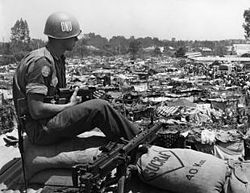
The UN deployed a large peacekeeping mission to restore order after the mutiny and secessions. The operation grew into one of the UN's most ambitious early missions, ultimately using force to end the Katangese secession but drawing criticism for failing to prevent political instability.
Image source: United Nations Operation in the Congo
Sep 5, 1960 - Jan 17, 1961
% complete
President Kasavubu dismissed Prime Minister Lumumba in a constitutional struggle, and Colonel Mobutu seized power briefly. In January 1961, Lumumba was handed to Katangese authorities and executed, an assassination implicating Belgian officials and Western intelligence agencies that shocked the world.
Image source: Patrice Lumumba
Jan 1964 - Nov 1965
% complete
Leftist rebels inspired partly by Lumumba's legacy launched a major insurgency across eastern and northern Congo, capturing large areas including Kisangani. Che Guevara personally joined the fight briefly. Government forces, aided by Western mercenaries, gradually crushed the uprising by late 1965.
Image source: Simba rebellion
Nov 24, 1965
% complete
Army commander Joseph-Désiré Mobutu took power in a bloodless coup, initially claiming emergency authority. He consolidated control rapidly, establishing himself as head of state and beginning a rule that would last more than three decades, characterized by authoritarianism and patronage politics.
Image source: Mobutu Sese Seko
Oct 27, 1971
% complete
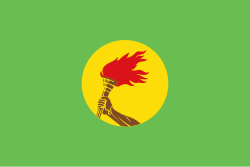
As part of his Authenticité program of cultural nationalism, Mobutu renamed the country Zaire, changed his own name to Mobutu Sese Seko Nkuku Ngbendu wa Za Banga, and ordered citizens to abandon Christian names and Western clothing in favor of African traditions.
Image source: Zaire
Oct 30, 1974
% complete
Muhammad Ali defeated George Foreman in Kinshasa in one of the most famous sporting events in history, using his 'rope-a-dope' strategy. Mobutu hosted the fight at enormous expense to showcase Zaire internationally, bringing global attention to his regime.
Image source: The Rumble in the Jungle
Mar 8, 1977 - May 26, 1977
% complete
Exiled Katangan gendarmes known as the Front for the National Liberation of the Congo invaded Shaba (Katanga) province from Angola, threatening the copper-mining heartland. Mobutu was saved largely by Moroccan troops airlifted in with French and American logistical support.
Image source: Shaba I
May 11, 1978 - Jun 1978
% complete
A second FLNC offensive captured Kolwezi, prompting a rapid French Foreign Legion intervention supported by Belgian paratroopers that recaptured the city. The invasions exposed Mobutu's weakness despite decades in power and accelerated the decline of his once-strong Western patronage.
1989 - 1992
% complete
Falling copper prices, massive corruption, and unsustainable debt devastated Zaire's economy. Hyperinflation destroyed savings, civil servants went unpaid, and infrastructure crumbled. The IMF imposed austerity measures while Mobutu amassed one of history's great personal fortunes abroad.
Aug 1991 - Dec 1992
% complete
Facing pro-democracy pressure, Mobutu allowed a Sovereign National Conference that declared itself sovereign and appointed Étienne Tshisekedi as prime minister. Mobutu resisted the conference's decisions, creating a dual-power crisis that paralyzed governance amid growing chaos.
Image source: First Congo War
Apr 1994 - Jul 1994
% complete
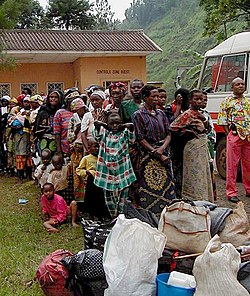
The Rwandan genocide sent nearly two million refugees fleeing into eastern Zaire, including Interahamwe militia and ex-FAR génocidaires who regrouped in camps near Goma. The militarized camps destabilized the region and became the pretext for Rwanda's eventual intervention.
Image source: Great Lakes refugee crisis
Oct 1996 - May 1997
% complete
Rwanda and Uganda backed Laurent-Désiré Kabila's Alliance of Democratic Forces for the Liberation of Congo in an invasion of eastern Zaire. The coalition swept across the country with remarkable speed, attacking refugee camps and defeating Mobutu's demoralized army.
Aug 2, 1998 - Jul 2003
% complete
After Kabila turned against his former Rwandan and Ugandan allies, they invaded again, backing rebel groups while Zimbabwe, Angola, Namibia, and others intervened on the government side. The conflict drew in nine countries and numerous militias, causing millions of deaths primarily from disease and starvation.
Image source: Second Congo War
May 17, 1997
% complete
Laurent-Désiré Kabila entered Kinshasa triumphantly as Mobutu fled into exile in Morocco, where he died months later. Kabila renamed the country the Democratic Republic of the Congo, ending 32 years of Mobutu's kleptocratic rule and raising hopes for renewal.
Jan 16, 2001
% complete
Laurent-Désiré Kabila was shot by one of his own bodyguards during a cabinet meeting at his Kinshasa residence. His son Joseph Kabila succeeded him within days, inheriting a fractured nation mired in continental-scale warfare.
Image source: Assassination of Laurent-Désiré Kabila
Apr 19, 2002
% complete
Negotiated in South Africa, the Sun City Agreement established a transitional framework between the government and various rebel factions. Though incomplete, it laid groundwork for the comprehensive peace process that would formally end the war.
Dec 17, 2002
% complete
The Global and All-Inclusive Agreement signed in Pretoria created a transitional government uniting Kabila with former rebel leaders as vice-presidents. Foreign troops began withdrawing, and the deadliest conflict since World War II officially concluded, though violence persisted in the east.
Jul 30, 2006 - Oct 2006
% complete
The first multiparty elections since independence in 1960 saw Joseph Kabila defeat Jean-Pierre Bemba in a runoff, confirmed by the Supreme Court after violent clashes in Kinshasa. The vote marked a milestone toward democracy despite ongoing instability.
Image source: 2006 Democratic Republic of the Congo general election
Nov 28, 2011 - Dec 2011
% complete
Kabila narrowly defeated Étienne Tshisekedi in elections marred by irregularities, violence, and disputed tallies. International observers questioned the results' credibility, and Tshisekedi rejected the outcome, deepening political tensions.
Image source: 2011 Democratic Republic of the Congo general election
Apr 2012 - Nov 2013
% complete
Former CNDP fighters mutinied and formed the March 23 Movement, capturing Goma in November 2012 with alleged Rwandan support. A joint UN-FarDC offensive defeated M23 by November 2013, forcing its leaders to surrender or flee.
Image source: M23 rebellion
Dec 2016 - 2018
% complete
When Kabila's second term expired in December 2016, authorities delayed elections indefinitely, citing logistical problems and a flawed voter census. Protesters were killed in demonstrations, raising fears of prolonged dictatorship and regional instability.
Image source: Congo Crisis
Dec 30, 2018 - Jan 2019
% complete
Félix Tshisekedi was declared winner of long-delayed elections, succeeding Joseph Kabila in the first peaceful transfer of power since independence. Opposition leader Martin Fayulu claimed victory had been stolen, but the Catholic Church's observers endorsed Tshisekedi's win, and he was inaugurated in January 2019.
Image source: 2018 Democratic Republic of the Congo general election
Or browse the full history timeline directory, with more than 2,000 topics.
This History of Democratic Republic of the Congo timeline was generated with the help of AI, using information found on the internet.
We work hard to keep these timelines accurate, but mistakes do get through. If you spot one, email us at [email protected] and we'll fix it for future visitors.
Generate yours with AI or build it from scratch, for free.
Export your timeline, add your own events, edit or remove AI-generated events, and much more
No credit card required.
Cancel anytime.
Cancel anytime.
You can create an unlimited number of timelines with up to 10 events on each one, customize how they look, export them to PDF, PNG, PowerPoint, CSV, and Excel, and share them with a link. Paid plans raise the event limit and add features like spreadsheet imports and collaborators.
Yes. You can cancel your subscription from your account page at any time, and you will not be charged again. Your subscription stays active for the rest of the period you already paid for.
Yes. We will email you a reminder before the annual renewal, and we will also email you a receipt.
Yes. You can email us within 15 days of any payment, and we will issue you a full refund.
Check out our pricing docs or send us an email anytime: [email protected].