-
Use Cases
-
Resources
-
Pricing
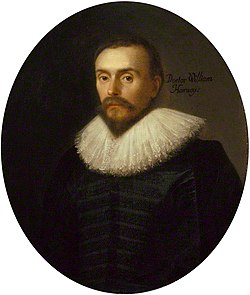
William Harvey (1578–1657) was an English physician whose revolutionary work demonstrated that blood circulates continuously through the body, pumped by the heart. His 1628 treatise 'De Motu Cordis' challenged centuries of Galenic medicine and laid the foundation for modern physiology and cardiovascular science. More Less
1242
% complete
Arabic scholar Ibn al-Nafis had disputed aspects of Galen's views, providing a model that seems to imply a form of pulmonary circulation in his Commentary on Anatomy in Avicenna's Canon (1242), centuries before Harvey's work.
Image source: Ibn al-Nafis
1546 - 1553
% complete
Independently of Ibn al-Nafis, Michael Servetus identified pulmonary circulation, but this discovery did not reach the public because it was written down first in the Manuscript of Paris in 1546 and only published in Christianismi Restitutio (1553), which caused his execution; almost all copies were destroyed. He wrote that blood is passed through the pulmonary artery to the pulmonary vein through the lungs, becoming red and ridding itself of sooty fumes by exhalation.
Image source: Michael Servetus
1546
% complete
Ideas on circulation of blood were also proposed by the Spanish veterinarian-farrier Francisco de la Reyna in 1546, another precursor to Harvey's demonstration of the circulation of the blood.
1600 - 1657
% complete
As early as the 17th century, William Harvey had already discerned the existence of the Ductus arteriosus and explained its relative function, adding to understanding of fetal circulation.
Image source: Ductus arteriosus
1628
% complete
In 1628 Harvey published in Frankfurt his completed treatise on the circulation of the blood, De Motu Cordis. The 72-page Exercitatio Anatomica de Motu Cordis et Sanguinis in Animalibus contains the mature account of the circulation of the blood; Frankfurt hosted an annual book fair that Harvey knew would allow immediate dispersion of his work.
Image source: Exercitatio Anatomica de Motu Cordis et Sanguinis in Animalibus
1651
% complete
Harvey's other major work was Exercitationes de generatione animalium (On Animal Generation), published in 1651, which made foundational contributions to the study of embryology and reproduction.
Image source: William Harvey
Apr 1, 1578
% complete
William Harvey was born on 1 April 1578. He would grow up to become an English physician who made influential contributions to anatomy and physiology.
1593
% complete
After staying at the King's School for five years, Harvey matriculated at Gonville and Caius College, Cambridge in 1593 to continue his education.
Image source: Gonville and Caius College, Cambridge
1597
% complete
Harvey graduated as a Bachelor of Arts from Caius College in 1597, completing his undergraduate studies in Cambridge.
1599
% complete
Harvey travelled through France and Germany to Italy, where he entered the University of Padua in 1599, one of Europe's leading centers of medical learning.
Image source: University of Padua
1600
% complete
William's father, Thomas Harvey, was a jurat of Folkestone where he served as mayor in 1600, reflecting the family's standing in the town.
Image source: William Harvey
Apr 25, 1602
% complete
Harvey graduated as a Doctor of Medicine at the age of 24 from the University of Padua on 25 April 1602, completing his formal medical training.
1582
% complete
The Lumleian lectureship, established by Richard Caldwell in 1582, consisted in giving lectures for a period of seven years with the purpose of spreading light and increasing the general knowledge of anatomy throughout England.
Image source: Lumleian Lectures
Oct 5, 1604
% complete
Following his return from Italy, Harvey established himself in London, joining the Royal College of Physicians on 5 October 1604, beginning his professional career in England.
Image source: Royal College of Physicians
Jun 5, 1607
% complete
Harvey was elected a Fellow of the Royal College of Physicians on 5 June 1607, which earned him the post-nominal letters FRCP and greater professional standing.
Oct 14, 1609
% complete
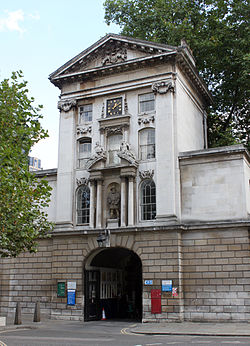
Succeeding Dr Wilkinson on 14 October 1609, Harvey became the Physician in charge at St Bartholomew's Hospital, where he was charged to do his best for the poor patients sent to him.
Image source: St Bartholomew's Hospital
1613
% complete
Harvey served as Censor of the Royal College of Physicians for the first time in 1613, a role he would hold again in later years.
Aug 4, 1615
% complete
The next important phase of Harvey's life began with his appointment to the office of Lumleian lecturer on 4 August 1615, a role involving lectures on anatomy over seven years with the purpose of spreading light and increasing general knowledge of anatomy throughout England.
Apr 1616
% complete
Harvey began his Lumleian lectures in April 1616, and also compiled his lecture notes in a notebook that preserved his developing anatomical ideas.
Feb 3, 1618
% complete
While continuing the Lumleian lectures and caring for his patients at St Bartholomew's Hospital, Harvey attained an important and lucrative practice, culminating in his appointment as Physician Extraordinary to King James I on 3 February 1618.
Image source: James VI and I
1625
% complete
Harvey was re-elected Censor of the College of Physicians several times, having been elected for the first time in 1613 and the second time in 1625.
1629
% complete
Following the publication of De Motu Cordis, Harvey was re-elected Censor of the College of Physicians in 1629, continuing his active role in the medical establishment.
1632
% complete
Earlier, in 1632, while travelling with the King to Newmarket, Harvey had been sent to investigate a woman accused of being a witch, demonstrating the scientific skepticism he applied to such accusations.
Image source: Witch-hunt
1632
% complete
Having returned to England in 1632, Harvey resumed his duties serving the King and the Royal College of Physicians.
1634
% complete
Harvey was one of the examiners of four women from Lancashire accused of witchcraft in 1634. As a consequence of his report, all of them were acquitted.
Image source: Witch trials in England
Oct 1636
% complete
Harvey returned to Italy in October 1636, dining at the English College, Rome, as a guest of the Jesuits there during his travels with the Earl of Arundel's embassy.
Image source: English College, Rome
1642
% complete
The conflicts of the Civil War soon led King Charles to Oxford, with Harvey attending, where the physician was made Doctor of Physic in 1642.
Image source: University of Oxford
1645
% complete
During the Civil War years in Oxford, Harvey was made Warden of Merton College in 1645, a position of academic leadership at the university.
Image source: Merton College, Oxford
1645
% complete
The surrender of Oxford in 1645 marks the beginning of Harvey's gradual retirement from public life and duties, as the Civil War drew to a close for the royalist stronghold.
Image source: Siege of Oxford
1656
% complete
The Royal College of Physicians of London holds an annual lecture established by William Harvey in 1656 called the Harveian Oration, which continues to this day.
Jun 3, 1657
% complete
Harvey died at Roehampton in the house of his brother Eliab on 3 June 1657, at the age of 79.
Jun 26, 1657 - Jun 30, 1657
% complete
The funeral procession started on 26 June 1657, leading Harvey to be placed in the Harvey Chapel built by Eliab. His body, lapt in lead and simply soldered, was laid without shell or enclosure of any kind in the Harvey vault of the Church of Hempstead, Essex, in June 1657.
1782
% complete
The Harveian Society of Edinburgh was founded in 1782 by Dr Andrew Duncan, honoring William Harvey's legacy in medicine.
Image source: Harveian Society of Edinburgh
1831
% complete
The Harveian Society of London is a medical society founded in 1831 based in the Medical Society of London, Chandos Street, in Cavendish Square.
Image source: Harveian Society of London
1882 - 1883
% complete
The Royal College of Physicians, of which corporate body Harvey was a munificent benefactor, undertook a memorial duty in the years 1882–1883 by permission of the representatives of the Harvey family.
1889
% complete
A work titled Harvey, William (1889) was published, contributing to the historical record and scholarship about Harvey's life and contributions to medicine.
1993
% complete
A work titled Harvey, William (1993) was published, continuing scholarly attention to Harvey's life and enduring influence on anatomy and physiology.
Or browse the full history timeline directory, with more than 2,000 topics.
This William Harvey timeline was generated with the help of AI, using information found on the internet.
We work hard to keep these timelines accurate, but mistakes do get through. If you spot one, email us at [email protected] and we'll fix it for future visitors.
Generate yours with AI or build it from scratch, for free.
Export your timeline, add your own events, edit or remove AI-generated events, and much more
No credit card required.
Cancel anytime.
Cancel anytime.
You can create an unlimited number of timelines with up to 10 events on each one, customize how they look, export them to PDF, PNG, PowerPoint, CSV, and Excel, and share them with a link. Paid plans raise the event limit and add features like spreadsheet imports and collaborators.
Yes. You can cancel your subscription from your account page at any time, and you will not be charged again. Your subscription stays active for the rest of the period you already paid for.
Yes. We will email you a reminder before the annual renewal, and we will also email you a receipt.
Yes. You can email us within 15 days of any payment, and we will issue you a full refund.
Check out our pricing docs or send us an email anytime: [email protected].