-
Use Cases
-
Resources
-
Pricing
William Shakespeare (1564–1616) was an English playwright, poet, and actor, widely regarded as the greatest writer in the English language. Born in Stratford-upon-Avon, he wrote at least 39 plays and 154 sonnets, including masterpieces like Hamlet, Romeo and Juliet, Macbeth, and A Midsummer Night's Dream, while working with the Lord Chamberlain's Men (later the King's Men) in London. More Less
Apr 23, 1564
% complete
William Shakespeare, the English playwright, poet and actor, is traditionally said to have been born on 23 April 1564 in Stratford-upon-Avon. This date, which can be traced to William Oldys and George Steevens, has appealed to biographers because Shakespeare died on the same date in 1616.
Image source: William Shakespeare
Apr 26, 1564
% complete
Shakespeare was born in Stratford-upon-Avon, where he was baptised on 26 April 1564.
Jan 1, 1571
% complete
Although no attendance records for the period survive, most biographers agree that Shakespeare was probably educated at the King's New School in Stratford, a free school chartered in 1553, based about a quarter-mile (400 m) from his home in Stratford's guildhall.
Nov 27, 1582
% complete
The consistory court of the Diocese of Worcester issued a marriage licence on 27 November 1582 for Shakespeare's marriage to Anne Hathaway.
May 26, 1583
% complete
Six months after the marriage, Anne gave birth to a daughter, Susanna, baptised 26 May 1583. Susanna was the first of their three children.
Jan 1, 1585 - Dec 31, 1592
% complete
Scholars refer to the years between 1585 and 1592 as Shakespeare's 'lost years'. Various stories attempt to fill this gap: one 18th-century tale has him starting his theatrical career minding the horses of theatre patrons in London, while some 20th-century scholars suggested he may have been employed as a schoolmaster by Alexander Hoghton of Lancashire, who named a certain 'William Shakeshafte' in his will.
Feb 2, 1585
% complete
Twins, son Hamnet and daughter Judith, followed almost two years later and were baptised 2 February 1585. After the birth of the twins, Shakespeare left few historical traces until he is mentioned as part of the London theatre scene in 1592, and scholars refer to these as his 'lost years'.
Oct 9, 1589
% complete
The exception to the sparse records of this period is the appearance of his name in the 'complaints bill' of a law case before the Queen's Bench court at Westminster dated Michaelmas Term 1588 and 9 October 1589.
Aug 11, 1596
% complete
Hamnet died of unknown causes at the age of 11 and was buried 11 August 1596.
Jan 1, 1607
% complete
Susanna had married a physician, John Hall, in 1607. The Halls had one child, Elizabeth, who married twice but died without children in 1670, ending Shakespeare's direct line.
Jan 1, 1592
% complete
It is not known definitively when Shakespeare began writing, but contemporary allusions and records of performances show that several of his plays were on the London stage by 1592. Sometime between 1585 and 1592 he began a successful career in London as an actor, writer, and part-owner of the Lord Chamberlain's Men.
Jan 1, 1594
% complete
After 1594 Shakespeare's plays were performed at The Theatre, in Shoreditch, only by the Lord Chamberlain's Men, a company owned by a group of players including Shakespeare that soon became the leading playing company in London. After the plagues of 1592–93, his plays were performed there and at the Curtain in Shoreditch, north of the Thames.
Jan 1, 1596
% complete
In 1596, the year before he bought New Place as his family home in Stratford, Shakespeare was living in the parish of St Helen's, Bishopsgate, north of the River Thames. He moved across the river to Southwark by 1599.
Jan 1, 1597
% complete
Extant records of Shakespeare's property purchases and investments indicate that his association with the company made him a wealthy man. In 1597 he bought New Place, the second-largest house in Stratford, and in 1605 invested in a share of the parish tithes in Stratford.
Jan 1, 1599
% complete
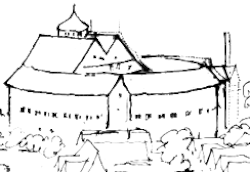
In 1599 a partnership of members of the company built their own theatre on the south bank of the River Thames, which they named the Globe. It opened in autumn 1599, with Julius Caesar one of the first plays staged. Most of Shakespeare's greatest post-1599 plays were written for the Globe, including Hamlet, Othello, and King Lear.
Image source: Globe Theatre
Jan 1, 1603
% complete
After the death of Queen Elizabeth in 1603, the company was awarded a royal patent by the new king James I and changed its name to the King's Men. They entered a special relationship with the new king, performing seven of Shakespeare's plays at court between 1 November 1604 and 31 October 1605, including two performances of The Merchant of Venice.
Image source: All the King's Men
Jan 1, 1604
% complete
By 1604 Shakespeare had moved north of the river again, to an area north of St Paul's Cathedral with many fine houses.
Jan 1, 1608
% complete
In 1608 the partnership also took over the Blackfriars indoor theatre. After 1608, the King's Men performed at the indoor Blackfriars Theatre during the winter and the Globe during the summer. Shakespeare was still working as an actor in London in 1608, as Cuthbert Burbage later stated in an answer to the sharers' petition in 1635.
Image source: Blackfriars Theatre
Jan 1, 1593 - Dec 31, 1594
% complete
In 1593 and 1594, when the theatres were closed because of plague, Shakespeare published two narrative poems on sexual themes, Venus and Adonis and The Rape of Lucrece.
Jan 1, 1594 - Dec 31, 1598
% complete
Some of Shakespeare's plays were published in quarto editions, beginning in 1594, and by 1598 his name had become a selling point and began to appear on the title pages.
Jan 1, 1599
% complete
In 1599, two early drafts of sonnets 138 and 144 appeared in The Passionate Pilgrim, published under Shakespeare's name but without his permission.
Image source: The Passionate Pilgrim
Jan 1, 1600 - Dec 31, 1608
% complete
He then wrote mainly tragedies until 1608, among them Hamlet, Othello, King Lear and Macbeth, which are considered to be among the finest works in English. In the early-17th century he also wrote the so-called 'problem plays' Measure for Measure, Troilus and Cressida, and All's Well That Ends Well.
Image source: Shakespearean tragedy
Jan 1, 1601
% complete
The Phoenix and the Turtle, printed in Robert Chester's 1601 Love's Martyr, mourns the deaths of the legendary phoenix and his lover, the faithful turtle dove.
Image source: The Phoenix and the Turtle
Jan 1, 1609
% complete
Published in 1609, the Sonnets were the last of Shakespeare's non-dramatic works to be printed. A third narrative poem, A Lover's Complaint, was printed in the first edition of the Sonnets in 1609. Over the centuries, some readers have posited that the sonnets are autobiographical, pointing to them as evidence of his love for a young man.
Image source: Shakespeare's sonnets
Jan 1, 1623
% complete
In 1623 John Heminges and Henry Condell, two fellow actors and friends of Shakespeare's from the King's Men, published a more definitive text known as the First Folio, a posthumous collected edition of Shakespeare's dramatic works that includes 36 of his plays. Alfred Pollard termed some of the pre-1623 versions as 'bad quartos', and in the case of King Lear, the folio version is so different from the 1608 quarto that some editions print them both.
Image source: First Folio
Jan 1, 1598
% complete
In 1598 the cleric and author Francis Meres singled Shakespeare out from a group of English playwrights as 'the most excellent' in both comedy and tragedy, and referred to his 'sugred Sonnets among his private friends'.
Jan 1, 1623
% complete
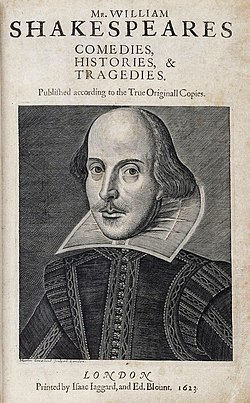
Some time before 1623 a funerary monument was erected in his memory on the north wall of the church, with a half-effigy of him in the act of writing. Also in 1623, in conjunction with the publication of the First Folio, the Droeshout engraving was published.
Image source: Shakespeare's funerary monument
Jan 1, 1612
% complete
In 1612 Shakespeare was called as a witness in Bellott v Mountjoy, a court case concerning the marriage settlement of Mountjoy's daughter, Mary. He continued to visit London during the years 1611–1614.
Jun 29, 1613
% complete
Shakespeare retired in 1613, before the Globe Theatre burned down during a performance of Henry VIII on 29 June. Sir Henry Wotton recorded that Henry VIII 'was set forth with many extraordinary circumstances of pomp and ceremony'. After 1610 Shakespeare wrote fewer plays, and none are attributed to him after 1613.
Mar 25, 1616
% complete
Shakespeare signed his last will and testament on 25 March 1616. The following day, Thomas Quiney, his new son-in-law who had married Judith two months before Shakespeare's death, was found guilty of fathering an illegitimate son by Margaret Wheeler, and Margaret and her son both died during childbirth.
Apr 23, 1616
% complete
Shakespeare died on 23 April 1616, at the age of 52. Half a century later, John Ward, the vicar of Stratford, wrote that 'Shakespeare, Drayton, and Ben Jonson had a merry meeting and, it seems, drank too hard, for Shakespeare died of a fever there contracted', not an impossible scenario since Shakespeare knew Jonson and Michael Drayton.
Or browse the full history timeline directory, with more than 2,000 topics.
This William Shakespeare timeline was generated with the help of AI, using information found on the internet.
We work hard to keep these timelines accurate, but mistakes do get through. If you spot one, email us at [email protected] and we'll fix it for future visitors.
Generate yours with AI or build it from scratch, for free.
Export your timeline, add your own events, edit or remove AI-generated events, and much more
No credit card required.
Cancel anytime.
Cancel anytime.
You can create an unlimited number of timelines with up to 10 events on each one, customize how they look, export them to PDF, PNG, PowerPoint, CSV, and Excel, and share them with a link. Paid plans raise the event limit and add features like spreadsheet imports and collaborators.
Yes. You can cancel your subscription from your account page at any time, and you will not be charged again. Your subscription stays active for the rest of the period you already paid for.
Yes. We will email you a reminder before the annual renewal, and we will also email you a receipt.
Yes. You can email us within 15 days of any payment, and we will issue you a full refund.
Check out our pricing docs or send us an email anytime: [email protected].