-
Use Cases
-
Resources
-
Pricing
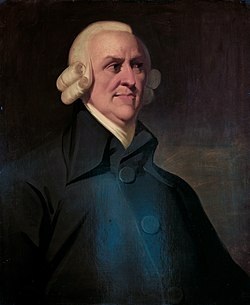
Adam Smith (1723–1790) was a Scottish economist and philosopher widely regarded as the father of modern economics and capitalism. His seminal work, 'The Wealth of Nations' (1776), laid the foundations for classical economics, introducing concepts such as the division of labor, free markets, and the invisible hand. He also authored 'The Theory of Moral Sentiments' (1759), exploring ethics and human behavior. Smith's ideas profoundly shaped economic thought and policy worldwide. More Less
1720
% complete
Smith's mother was born Margaret Douglas, daughter of Robert Douglas of Strathendry in Fife; she married Adam Smith's father in 1720, three years before Smith's baptism.
Image source: Adam Smith
Jun 5, 1723
% complete
Adam Smith was baptized into the Church of Scotland at Kirkcaldy on 5 June 1723. His exact date of birth is unknown, so the baptismal date has often been treated as if it were his date of birth. He was a Scottish economist and philosopher, a pioneer in political economy and a key figure during the Scottish Enlightenment.
1740
% complete
In 1740 Smith became the graduate scholar presented to undertake postgraduate studies at Balliol College of the University of Oxford under the Snell Exhibition.
Image source: Balliol College, Oxford
1746
% complete
Smith left Oxford in 1746, before his Snell Exhibition scholarship had ended, concluding his formal studies at Balliol College.
1748
% complete
Smith began delivering public lectures in 1748 at the University of Edinburgh, sponsored by the Philosophical Society of Edinburgh under the patronage of Lord Kames.
Image source: University of Edinburgh
1750
% complete
In 1750 Smith met the philosopher David Hume, who was his senior by more than a decade. The two formed one of the most significant intellectual friendships of the Scottish Enlightenment.
Image source: David Hume
1751
% complete
In 1751 Smith earned a professorship at Glasgow teaching logic courses, beginning his influential period of university teaching.
Image source: University of Glasgow
1752
% complete
In 1752 Smith was elected a member of the Philosophical Society of Edinburgh, having been introduced to the society by Henry Home, Lord Kames.
Image source: Royal Society of Edinburgh
1762
% complete
In 1762, the University of Glasgow conferred on Smith the honorary title of Doctor of Laws (LL.D.), recognizing his scholarly contributions.
Dec 31, 1763
% complete
At the end of 1763, Smith received an offer from chancellor of the exchequer Charles Townshend—who had been introduced to him by David Hume—to tutor his stepson, Henry Scott, the young Duke of Buccleuch, as preparation for a career in international politics.
Image source: Charles Townshend
1764
% complete
Smith resigned from his Glasgow professorship in 1764 to take up the tutoring position with the young Duke of Buccleuch, embarking on a tour of Europe.
1766
% complete
In 1766 Henry Scott's younger brother died in Paris, and Smith's tour as a tutor ended shortly thereafter, freeing him to focus on his own writing.
Image source: Henry Scott, 3rd Duke of Buccleuch
May 1767
% complete
In May 1767 Smith was elected fellow of the Royal Society of London, an honor reflecting his growing scientific and intellectual reputation.
Image source: Royal Society
1775
% complete
In 1775 Smith was elected a member of the Literary Club in London, joining a distinguished circle of writers and thinkers.
1778
% complete
In 1778 Smith was appointed to a post as commissioner of customs in Scotland and went to live with his mother in Panmure House in the Canongate in Edinburgh, where he resided from 1778 to 1790.
1784
% complete
Smith's mother, Margaret Douglas, died in 1784 while living with her son at Panmure House in Edinburgh.
1787 - 1789
% complete
From 1787 to 1789 Smith occupied the honorary position of Lord Rector of the University of Glasgow, returning in honor to the institution where he had once taught.
Jul 17, 1790
% complete
Smith died in the northern wing of Panmure House in Edinburgh on 17 July 1790 after a painful illness, closing the life of the man often called the father of economics and capitalism.
1759
% complete
Smith published The Theory of Moral Sentiments in 1759, embodying some of his Glasgow lectures. It was sold by co-publishers Andrew Millar of London and Alexander Kincaid of Edinburgh. He based his explanation of morality not on a special 'moral sense' or utility, but on mutual sympathy, best captured by the modern concept of empathy.
Image source: The Theory of Moral Sentiments
1763
% complete
Smith's Lectures on Justice, Police, Revenue, and Arms were delivered in 1763, though they were not first published until 1896. They form part of the record of his teaching at Glasgow.
1776
% complete
An Inquiry into the Nature and Causes of the Wealth of Nations was published in 1776 and was an instant success, selling out its first edition in only six months. It is considered one of the foundational works of economics, and Smith used the term 'the invisible hand' within it.
Image source: The Wealth of Nations
1777
% complete
The publication in 1777 of Smith's letter to William Strahan, in which he described David Hume's courage in the face of death despite his irreligiosity, attracted considerable controversy.
1795
% complete
Smith had mentioned an early unpublished History of Astronomy as probably suitable for publication, and it duly appeared in 1795, along with other material such as Essays on Philosophical Subjects.
1846
% complete
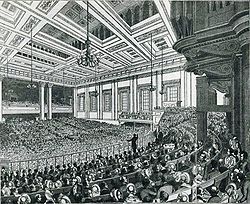
Richard Cobden, Smith's most prominent disciple in 19th-century Britain, preferred Smith's first proposal regarding colonies. Cobden led the Anti-Corn Law League in overturning the Corn Laws in 1846, shifting Britain to a policy of free trade and empire 'on the cheap'.
Image source: Anti–Corn Law League
1867
% complete
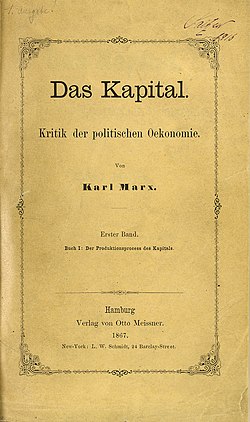
The first volume of Karl Marx's major work, Das Kapital, was published in German in 1867, engaging critically with the classical economic tradition that Smith helped found.
Image source: Das Kapital
1867 - 1870
% complete
Between 1867 and 1870, a statue of Smith was built into the outside wall of 6 Burlington Gardens, then the headquarters of the University of London (now home to the Royal Academy of Arts).
1870 - 1910
% complete
The body of theory later termed 'neoclassical economics' or 'marginalism' formed from about 1870 to 1910. Disagreement exists between classical and neoclassical economists about the central message of The Wealth of Nations.
Image source: Neoclassical economics
1879
% complete
On the death in 1878 of her husband, the Reverend W. Bannerman, Smith-related library materials passed to his widow, and on her death in 1879 her portion of the library went intact to the New College (of the Free Church) in Edinburgh.
Image source: New College, Edinburgh
1972
% complete
In 1972 the collection of Smith-related materials held at New College was transferred to the University of Edinburgh Main Library, preserving his literary legacy.
Image source: Edinburgh University Library
1976
% complete
The bicentennial anniversary of the publication of The Wealth of Nations was celebrated in 1976, resulting in increased interest in The Theory of Moral Sentiments and his other works throughout academia. After 1976, Smith was more likely represented as author of both works and founder of moral philosophy and economics. The Glasgow Edition of his works, including Lectures on Jurisprudence, was also published that year.
1981
% complete
Smith has been commemorated in the UK on banknotes printed by two different banks; his portrait has appeared since 1981 on the £50 notes issued by the Clydesdale Bank in Scotland.
2005
% complete
In 2005 The Wealth of Nations was named among the 100 Best Scottish Books of all time, cementing its place in Scotland's cultural heritage.
Mar 2007
% complete
In March 2007 Smith's image appeared on the new series of £20 notes issued by the Bank of England, making him the first Scotsman to feature on an English banknote. Line engravings for covers of 19th-century reprints of The Wealth of Nations had been based largely on Tassie's medallion of Smith.
Image source: Bank of England £20 note
2008
% complete
In 2008, Panmure House—where Smith resided from 1778 to 1790—was purchased by the Edinburgh Business School at Heriot-Watt University and funds were raised for its restoration.
Image source: Panmure House
Jul 4, 2008
% complete
A large-scale memorial of Smith by sculptor Alexander Stoddart was unveiled on 4 July 2008 in Edinburgh, honoring the economist in his home country.
2013
% complete
Smith appears as the narrator in the 2013 play The Low Road, centred on a proponent of laissez-faire economics in the late 18th century but dealing obliquely with the 2008 financial crisis and the Great Recession; he was portrayed by Bill Paterson in the premiere production at the Royal Court Theatre in London.
2018
% complete
In 2018 Panmure House was formally opened as a study centre in Smith's honour, preserving the residence where he lived and died as a place of scholarship.
Dec 2023
% complete
Five paving stones, displaying quotations from Smith's works, were unveiled in December 2023 on High Street in Glasgow, commemorating his enduring influence in the city where he taught.
Or browse the full history timeline directory, with more than 2,000 topics.
This Adam Smith timeline was generated with the help of AI, using information found on the internet.
We work hard to keep these timelines accurate, but mistakes do get through. If you spot one, email us at [email protected] and we'll fix it for future visitors.
Generate yours with AI or build it from scratch, for free.
Export your timeline, add your own events, edit or remove AI-generated events, and much more
No credit card required.
Cancel anytime.
Cancel anytime.
You can create an unlimited number of timelines with up to 10 events on each one, customize how they look, export them to PDF, PNG, PowerPoint, CSV, and Excel, and share them with a link. Paid plans raise the event limit and add features like spreadsheet imports and collaborators.
Yes. You can cancel your subscription from your account page at any time, and you will not be charged again. Your subscription stays active for the rest of the period you already paid for.
Yes. We will email you a reminder before the annual renewal, and we will also email you a receipt.
Yes. You can email us within 15 days of any payment, and we will issue you a full refund.
Check out our pricing docs or send us an email anytime: [email protected].