-
Use Cases
-
Resources
-
Pricing
Alexis de Tocqueville (1805–1859) was a French political thinker, historian, and diplomat best known for his seminal work 'Democracy in America,' based on his travels through the United States. His insightful analysis of democracy, equality, individualism, and civil society remains profoundly influential in political science and sociology. More Less
Jul 29, 1805
% completado
Alexis Charles Henri Clérel, comte de Tocqueville, was born on 29 July 1805. He would become a French diplomat, political philosopher and historian, best known for his works Democracy in America and The Old Regime and the Revolution.
Image source: Alexis de Tocqueville
1806
% completado
Tocqueville came from an old aristocratic Norman family. He was the great-grandson of the statesman Malesherbes, who was guillotined in 1793. He was the third son of Hervé Louis François Jean Bonaventure Clérel, Count of Tocqueville, an officer of the Constitutional Guard of King Louis XVI, and Louise Madeleine Le Peletier de Rosanbo, who themselves might have faced the guillotine but for the fall of Maximilien Robespierre in 1794.
1836
% completado
Tocqueville married in 1836, beginning his life as a married man while continuing his intellectual and political pursuits.
1842
% completado
In 1842, Tocqueville was elected as a member of the American Philosophical Society, recognition of his celebrated study of American democracy.
Image source: American Philosophical Society
1831
% completado
In 1831, Tocqueville obtained from the July Monarchy a mission to examine prisons and penitentiaries in the United States, which he undertook with his lifelong friend Gustave de Beaumont.
1831 - 1832
% completado
During his visit to America, Tocqueville kept a travel diary documenting his observations. This journal was later translated into English by George Lawrence and edited by J.-P. Mayer, published by Yale University Press in 1960.
Image source: The Motorcycle Diaries (book)
Feb 1832
% completado
Tocqueville returned to France in February 1832 after roughly nine months in the United States, bringing with him the observations that would shape his most famous works.
1833
% completado
Before putting the finishing touches to his reflections on American democracy, Tocqueville departed for England in 1833.
May 1835
% completado
In May 1835, Tocqueville returned to England and then travelled with Beaumont on to Ireland, then part of the United Kingdom of Great Britain and Ireland. His journeys were later recorded in Journeys to England and Ireland, 1835.
Image source: Charles II of England
1839
% completado
Beaumont produced L'Irlande sociale, politique et religieuse in 1839, drawing on the travels that he and Tocqueville had made together to Ireland in 1835.
Image source: Gustave de Beaumont
1833
% completado
Upon returning from his American tour, Tocqueville published a report on the prison systems he had studied. Together with Beaumont, he also produced 'Du système pénitentiaire aux États-Unis et de son application en France' in 1833.
Image source: Democracy in America
1835
% completado
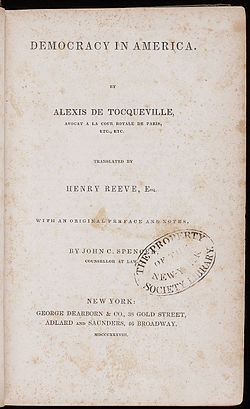
In 1835, Tocqueville published the first volume of Democracy in America, writing of the New World and its burgeoning democratic order. Observing as a detached social scientist, he described his travels through the United States during an era when the Market Revolution, Western expansion and Jacksonian democracy were radically transforming American life.
Image source: Democracy in America
1835
% completado
In 1835, Tocqueville published his 'Mémoire sur le paupérisme', asking whether public charity produces an idle and dependent class in society. It was originally published by Ivan R. Dee.
Image source: Alexis de Tocqueville
1835
% completado
Gustave de Beaumont, Tocqueville's traveling companion, wrote an account of their travels in Jacksonian America: Marie or Slavery in the United States, published in 1835.
1840
% completado
The second volume of Democracy in America appeared in 1840, completing the work that appeared in two volumes, 1835 and 1840. Later editions include translations by Mansfield and Delba Winthrop (University of Chicago Press, 2000) and Arthur Goldhammer (The Library of America, 2004).
1852
% completado
Having retired from political life, Tocqueville began work on The Old Regime and the Revolution. He would spend the days remaining to him fighting the same fight, but conducting it now from libraries, archives, and his own desk, drafting L'Ancien Régime et la Révolution.
Image source: The Old Regime and the Revolution
1855
% completado
In 1855, Tocqueville wrote a text published by Maria Weston Chapman in the Liberty Bell: Testimony against Slavery, stating: 'I do not think it is for me, a foreigner, to indicate to the United States the time, the measures, or the men by whom Slavery shall be abolished.'
Image source: The Liberty Bell (annual)
1856
% completado
In 1856, Tocqueville published the first tome of L'Ancien Régime et la Révolution (The Old Regime and the Revolution), leaving the second one unfinished. The work examined the causes of the French Revolution and its relationship to the old regime.
1837
% completado
In 1837, Tocqueville wrote of his hope for eventual intermarriage between the French and indigenous Arabs and their amalgamation into a distinct whole, reflecting his views on assimilation in France's newest colony.
1841
% completado
In 1841, Tocqueville traveled to Algeria, which France had invaded and colonized from 1830. Having entertained the possibility of settling there as a colonist himself, he studied the colony closely during his visit.
Image source: French conquest of Algeria
1841
% completado
In an 1841 essay concerning the conquest of Algeria, Tocqueville called for a dual program of 'domination' and 'colonization'. In the same year's report on Algeria, he applauded Bugeaud for making war in a way that defeated Abd-el-Kader's resistance, though he had advocated leaving Kabylia undisturbed.
1847
% completado
After modifying his views following his second visit to Algeria in 1846, Tocqueville criticized Bugeaud's desire to invade Kabylia in an 1847 speech to the Assembly. In the debate about the 1846 extraordinary funds, he denounced Bugeaud's conduct of military operations and convinced the Assembly not to vote funds for Bugeaud's military columns.
Image source: Thomas Robert Bugeaud
1847
% completado
In his 1847 'Report on Algeria', Tocqueville declared that Europe should avoid making the same mistake they made with the European colonization of the Americas in order to avoid bloody consequences.
1839
% completado
Tocqueville began his political career in 1839, despite despising the July Monarchy (1830–1848). From 1839 to 1851, he served as member of the lower house of parliament for the Manche department (Valognes), and became seen as the parliament's foremost expert on Algeria.
Image source: Chamber of Deputies (France)
1847
% completado
In 1847, Tocqueville sought to found a Young Left (Jeune Gauche) party which would advocate wage increases, a progressive tax, and other labor concerns in order to undermine the appeal of the socialists.
Feb 1848
% completado
After the fall of the July Monarchy in the Revolution of 1848, Tocqueville was elected a member of the Constituent Assembly of 1848, where he became a member of the commission charged with drafting the new Constitution of the Second Republic (1848–1851). A few days after the February insurrection, he anticipated a violent clash between Parisian workers led by socialists agitating for a 'Democratic and Social Republic' and conservatives including the aristocracy and rural population.
Image source: French Revolution of 1848
Jun 1848
% completado
The social tensions Tocqueville had anticipated eventually exploded in the June Days Uprising of 1848, the violent clash between the socialist-led Parisian workers' population and the conservative forces that he had predicted after the February insurrection.
Image source: June Days uprising
Dec 1848
% completado
Tocqueville had supported Cavaignac against Louis Napoléon Bonaparte for the presidential election of 1848, aligning himself with the Party of Order against Bonaparte's candidacy.
Image source: 1848 French presidential election
Jun 1849
% completado
During the troubled days of June 1849, Tocqueville pleaded with Interior Minister Jules Armand Dufaure for the reestablishment of the state of siege in the capital and approved the arrest of demonstrators. He approved two laws voted immediately after the June days which restricted the liberty of clubs and freedom of the press, having since February 1848 supported laws restricting political freedoms.
Jun 3, 1849 - Oct 31, 1849
% completado
A supporter of Cavaignac and of the Party of Order, Tocqueville accepted an invitation to enter Odilon Barrot's government as Minister of Foreign Affairs from 3 June to 31 October 1849.
Image source: Odilon Barrot
Dec 2, 1851
% completado
Opposed to Louis Napoléon Bonaparte's 2 December 1851 coup, Tocqueville was among the deputies who gathered at the 10th arrondissement of Paris in an attempt to resist the coup and have Napoleon III judged for 'high treason' as he had violated the constitutional limit on terms of office.
Image source: 1851 French coup d'état
Dec 1851
% completado
Detained at Vincennes and then released, Tocqueville, who supported the Restoration of the Bourbons against Napoleon III's Second Empire (1851–1871), quit political life after the coup and retreated to his castle, the Château de Tocqueville.
1855
% completado
While sharing many contemporary views on assimilation and segregation, Tocqueville opposed Arthur de Gobineau's theories as found in An Essay on the Inequality of the Human Races (1853–1855).
Image source: Arthur de Gobineau
Apr 16, 1859
% completado
A longtime sufferer from bouts of tuberculosis, Tocqueville eventually succumbed to the disease on 16 April 1859 and was buried in the Tocqueville cemetery in Normandy.
Or browse the full history timeline directory, with more than 2,000 topics.
This Alexis de Tocqueville timeline was generated with the help of AI, using information found on the internet.
We work hard to keep these timelines accurate, but mistakes do get through. If you spot one, email us at [email protected] and we'll fix it for future visitors.
Generate yours with AI or build it from scratch, for free.
Export your timeline, add your own events, edit or remove AI-generated events, and much more
No credit card required.
Cancel anytime.
Cancel anytime.
You can create an unlimited number of timelines with up to 10 events on each one, customize how they look, export them to PDF, PNG, PowerPoint, CSV, and Excel, and share them with a link. Paid plans raise the event limit and add features like spreadsheet imports and collaborators.
Yes. You can cancel your subscription from your account page at any time, and you will not be charged again. Your subscription stays active for the rest of the period you already paid for.
Yes. We will email you a reminder before the annual renewal, and we will also email you a receipt.
Yes. You can email us within 15 days of any payment, and we will issue you a full refund.
Check out our pricing docs or send us an email anytime: [email protected].