
-
Use Cases
-
Resources
-
Pricing
Artemisia Gentileschi (1593–1656) was one of the most accomplished Italian Baroque painters of the seventeenth century. The daughter of painter Orazio Gentileschi, she trained in her father's workshop in Rome and developed a dramatic, Caravaggio-inspired style. After surviving a notorious rape trial in 1612, she built an international career, working for patrons including the Medici family in Florence and King Charles I of England, and became celebrated for powerful depictions of female heroines from history and mythology. More Less
Jul 8, 1593
% complete
Artemisia Lomi Gentileschi was born in Rome on 8 July 1593, although her birth certificate from the Archivio di Stato indicates she was born in 1590. She would grow up to become one of the most accomplished painters of the Italian Baroque era.
Image source: Artemisia Gentileschi
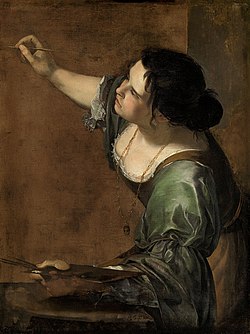
Jul 10, 1593
% complete
Gentileschi was baptised two days after her birth in the church of San Lorenzo in Lucina in Rome. Following the death of her mother in 1605, she was primarily raised by her father, the painter Orazio Gentileschi.
1605
% complete
Artemisia Gentileschi's training in her father Orazio's workshop reflected the typical structure of artistic education in early seventeenth-century Italy, where she learned painting in the style influenced by Caravaggio.
1611
% complete
In 1611, Orazio Gentileschi worked with fellow painter Agostino Tassi to decorate the vaults of the Casino delle Muse inside the Palazzo Pallavicini-Rospigliosi in Rome.
1612
% complete
By 1612, aged around 19, Gentileschi was already known for her exemplary talents, with her father boasting that, despite having only practiced painting for three years, she was peerless.
1615
% complete
In 1615, during her Florentine years, Gentileschi received the attention of Michelangelo Buonarroti the Younger, a great-nephew of Michelangelo, which helped advance her career among Florentine patrons.
Image source: Michelangelo Buonarroti the Younger
1616 - 1620
% complete
A collection of 36 letters dating from about 1616 to 1620 was discovered in 2011 by Francesco Solinas. The letters add startling context to the personal and financial life of the Gentileschi family in Florence, including her acquaintance with Galileo Galilei.
1620
% complete
By 1620, rumours of an affair had begun to spread in the Florentine court, and this, combined with ongoing legal and financial problems, led Gentileschi and her husband to relocate to Rome.
1623
% complete
By 1623, any mention of Gentileschi's husband disappears from any surviving documentation, leaving details of their relationship obscure from that point onward.
1625
% complete
The visiting French artist Pierre Dumonstier II produced a black and red chalk drawing of Gentileschi's right hand in 1625, a tribute celebrating her renowned skill as a painter.
1626 - 1627
% complete
Between 1626 and 1627, Gentileschi moved to Venice, perhaps in search of richer commissions as her career continued to develop across Italy's artistic centres.
1630
% complete
In 1630, Gentileschi moved to Naples, a city rich with workshops and art lovers, in search of new and more lucrative job opportunities. The biographer Bernardo de' Dominici speculated she was already known there before her arrival.
Mar 18, 1634
% complete
On 18 March 1634, the traveller Bullen Reymes recorded in his diary visiting Gentileschi and her daughter Palmira ('who also paints') with a group of fellow Englishmen in Naples.
1638
% complete
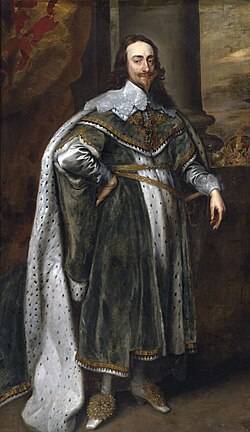
In 1638, Gentileschi joined her father in London at the court of Charles I of England, where Orazio had become court painter, working on the ceiling allegory of Triumph of Peace and the Arts in the Queen's House, Greenwich.
Image source: Charles I of England
1639
% complete
Orazio Gentileschi, Artemisia's father and teacher, died suddenly in 1639 while serving as court painter to Charles I of England.
Image source: Orazio Gentileschi
1642
% complete
It is known that Gentileschi had left England by 1642, when the English Civil War was just starting. She had worked as an expatriate painter at Charles I's court since 1638.
Image source: English Civil War
1610
% complete
Completed at age 17, Susanna and the Elders (1610) is Gentileschi's earliest surviving work, now in the Schönborn collection at Schloss Weißenstein in Pommersfelden. It is considered one of her best-known subjects.
Image source: Susanna and the Elders (Artemisia Gentileschi, Pommersfelden)
1612 - 1613
% complete
Gentileschi's first Judith Beheading Holofernes (1612–13), smaller in size than later versions, is displayed in the Museo di Capodimonte, Naples. It is one of her most celebrated dramatic subjects.
Image source: Judith beheading Holofernes
1614 - 1620
% complete
Between about 1614 and 1620, Gentileschi painted her famous version of Judith Slaying Holofernes, now housed in the Uffizi gallery in Florence. It remains one of her best-known works.
Image source: Judith Slaying Holofernes (Artemisia Gentileschi, Naples)
1622
% complete
Gentileschi's Susanna and the Elders (1622) is often associated with the style introduced by Guercino, reflecting the growing popularity of the Bolognese School during the period of Pope Gregory XV (1621–23).
1625
% complete
In 1625, Gentileschi created Judith and Her Maidservant, now in the Detroit Institute of Arts, one of several treatments of the Judith theme that rank among her best-known subjects.
1630 - 1635
% complete
Corisca and the Satyr, created between 1630 and 1635, is an example of the symbolic content in Gentileschi's work during her early Neapolitan period.
1649
% complete
Works from this period include the Susanna and the Elders (1649) today in Brno, the Virgin and Child with a Rosary in El Escorial, the David and Bathsheba in Columbus, Ohio, and the Bathsheba today in Leipzig.
2020
% complete
Her David with the Head of Goliath, rediscovered in London in 2020, has been attributed by art historian Gianni Papi to Gentileschi's London period.
2023
% complete
Another work by Gentileschi, Susanna and the Elders, previously owned by Charles I, was rediscovered in the Royal Collection in London in 2023.
Image source: Royal Collection
1649
% complete
Historians know that in 1649 Gentileschi was in Naples again, corresponding with Don Antonio Ruffo of Sicily, who became her mentor during this second Neapolitan period.
1650
% complete
The last known letter to her mentor Don Antonio Ruffo is dated 1650 and makes clear that Gentileschi was still fully active as an artist.
Jan 1654
% complete
Although once believed to have died in 1652 or 1653, modern evidence shows Gentileschi was still accepting commissions in January 1654, though she was increasingly dependent upon her assistant Onofrio Palumbo.
1656
% complete
Her exact time of death is disputed, but some have speculated that she died in the devastating plague that swept Naples in 1656 and virtually wiped out an entire generation of Neapolitan artists.
1862 - 1863
% complete
George Eliot may have been the first writer to produce a novel around the figure of Gentileschi in Romola (1862–63), where some aspects of her story, set in Florence in her time, are recognisable but much embroidered.
Image source: Romola
1916
% complete
Italian critic Roberto Longhi's research paper 'Gentileschi, padre e figlia' (1916) described Gentileschi as 'the only woman in Italy who ever knew about painting, coloring, drawing, and other fundamentals', reviving critical attention to her work.
Image source: Roberto Longhi
1947
% complete
Anna Banti, wife of critic Roberto Longhi, published Artemisia in 1947, a fictional account of Gentileschi's life and a landmark literary treatment of the artist.
Image source: Anna Banti
1979
% complete
Gentileschi is one of the women represented in The Dinner Party, an installation artwork by Judy Chicago first exhibited in 1979, honouring significant women throughout history.
Image source: The Dinner Party
1989
% complete
The first full, factual account of Gentileschi's life, The Image of the Female Hero in Italian Baroque Art, was published in 1989 by feminist art historian Mary Garrard, who followed it with Artemisia Gentileschi around 1622: The Shaping and Reshaping of an Artistic Identity in 2001.
1997
% complete
Gentileschi's life and the Judith Slaying Holofernes painting played a pivotal role in the ITV miniseries Painted Lady (1997), starring Helen Mirren.
Image source: Painted Lady (TV series)
1997
% complete
The film Artemisia (1997) by Agnès Merlet tells the story of Gentileschi's entry into being a professional artist, her relationship with Tassi, and the trial. Pollock (2006) interpreted the film as an example of popular culture focusing on one episode rather than her remarkable decades-long career.
Image source: Artemisia (film)
2001
% complete
The exhibition 'Orazio e Artemisia Gentileschi' took place in Rome in 2001 and afterwards in New York, exemplifying the major institutional recognition her talents received in the 20th and 21st centuries.
2002
% complete
Susan Vreeland published The Passion of Artemisia (2002), a biographical novel based on the artist's life, continuing the tradition of literary works inspired by her story.
2004 - 2008
% complete
Gentileschi appears in Eric Flint's Ring of Fire alternate history series, being mentioned in 1634: The Galileo Affair (2004) and figuring prominently in 1635: The Dreeson Incident (2008), as well as appearing in shorter stories in the 1632 universe.
2015
% complete
Gentileschi was the subject of a 2015 BBC documentary, Michael Palin's Quest for Artemisia, exploring her life and art.
Image source: Artemisia Gentileschi
2018
% complete
Breach Theatre's It's True, It's True, It's True (2018) is a play derived from the transcripts of the rape trial, first performed at the Edinburgh Fringe Festival where it won The Stage Edinburgh award and a Fringe First award.
2020
% complete
In 2020, the documentary film Artemisia Gentileschi, Warrior Painter, directed by Jordan River, was produced about her life and artistry.
Feb 9, 2020
% complete
After touring the UK, Breach Theatre's It's True, It's True, It's True, translated from Latin and Italian into conversational English, was broadcast on BBC Four on 9 February 2020.
Image source: The Creator (2023 film)
Apr 13, 2023 - Apr 30, 2023
% complete
Forward Theater in Madison, Wisconsin, along with World Premiere Wisconsin, commissioned and premiered Artemisia, written by Lauren Gunderson, running 13–30 April 2023.
Image source: Lauren Gunderson
Aug 2024
% complete
The Light and The Dark (the life and times of Artemisia Gentileschi), a play by Kate Hamill, premiered at Chautauqua Theater Company in August 2024, directed by Jade King Carroll, and was scheduled for Manhattan performances at Primary Stages at 59E59 Theaters in November 2024.
Jul 2025
% complete
In July 2025, the Paris City Hall named a square after the painter: Place Artemisia-Gentileschi, cementing her enduring legacy in public memory.
Or browse the full history timeline directory, with more than 2,000 topics.
This Artemisia Gentileschi timeline was generated with the help of AI, using information found on the internet.
We work hard to keep these timelines accurate, but mistakes do get through. If you spot one, email us at [email protected] and we'll fix it for future visitors.
Generate yours with AI or build it from scratch, for free.
Export your timeline, add your own events, edit or remove AI-generated events, and much more
No credit card required.
Cancel anytime.
Cancel anytime.
You can create an unlimited number of timelines with up to 10 events on each one, customize how they look, export them to PDF, PNG, PowerPoint, CSV, and Excel, and share them with a link. Paid plans raise the event limit and add features like spreadsheet imports and collaborators.
Yes. You can cancel your subscription from your account page at any time, and you will not be charged again. Your subscription stays active for the rest of the period you already paid for.
Yes. We will email you a reminder before the annual renewal, and we will also email you a receipt.
Yes. You can email us within 15 days of any payment, and we will issue you a full refund.
Check out our pricing docs or send us an email anytime: [email protected].