-
Use Cases
-
Resources
-
Pricing
Vincent van Gogh (1853-1890) was a Dutch Post-Impressionist painter who created some of the most famous and influential works in Western art, including 'Starry Night,' 'Sunflowers,' and 'The Bedroom.' Despite producing around 2,100 artworks in just over a decade, he achieved little commercial success during his lifetime and struggled with mental illness. His bold colors, expressive brushwork, and emotional depth profoundly shaped modern art. More Less
Mar 30, 1853
% complete
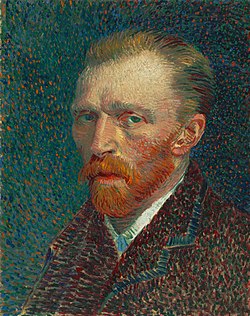
Vincent Willem van Gogh was born on March 30, 1853, in the village of Groot-Zundert in the Netherlands, the eldest surviving son of Theodorus van Gogh, a Protestant pastor, and Anna Carbentus van Gogh.
Image source: Vincent van Gogh
Jul 30, 1869
% complete
At age 16, Van Gogh began an apprenticeship at Goupil & Cie, a major international art dealership, at its Hague branch, where his uncle was a partner. He showed early promise and was later transferred to branches in London and Paris.
Image source: Goupil & Cie
May 1873
% complete
Van Gogh moved to London to work at the firm's branch there. He became enamored with English culture and with Eugénie Loyer, his landlady's daughter; her rejection deepened a period of emotional turmoil and declining professional performance.
Apr 1876
% complete
After years of deteriorating performance and growing disillusionment with the art trade, Van Gogh was dismissed from Goupil & Cie, beginning a restless period of searching for purpose.
Jan 1879 - Jul 1880
% complete
Van Gogh served as a missionary among impoverished coal miners in the Borinage region of Belgium, living in extreme poverty and devoting himself to their welfare before being dismissed for excessive zeal. It was here that he began sketching daily life seriously.
Jul 1880
% complete
At age 27, Van Gogh resolved to pursue art as his vocation, supported financially by his brother Theo, an art dealer whose unwavering support would sustain Vincent throughout his career.
Jan 1886 - Feb 1886
% complete
Van Gogh enrolled at the academy in Antwerp but found its rigid teaching uncongenial and left after little more than a month, having absorbed exposure to Rubens and Japanese prints.
Image source: Royal Academy of Fine Arts (Antwerp)
Apr 1885
% complete
Considered his first masterpiece, this dark, earthy painting of peasant farmers sharing a meal in Nuenen reflected Van Gogh's ambition to depict honest rural life and marked the culmination of his Dutch period.
Image source: The Potato Eaters
Aug 1888 - Jan 1889
% complete
In Arles, Van Gogh created his celebrated series of sunflower paintings in vivid yellows, intended to decorate the Yellow House in anticipation of Paul Gauguin's arrival.
Image source: Sunflowers (Van Gogh series)
Jun 1889
% complete
While at the Saint-Rémy asylum, Van Gogh painted The Starry Night from memory and observation, creating one of the most famous images in Western art with its swirling night sky above the village of Saint-Rémy.
Image source: The Starry Night
Sep 1889
% complete
Theo submitted Vincent's Irises, painted in the asylum garden, to the Salon des Indépendants in Paris, where it received favorable attention—one of the few public acknowledgments during Vincent's lifetime.
Image source: Irises (painting)
Jun 1890
% complete
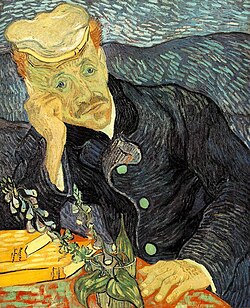
Van Gogh painted two portraits of Dr. Gachet, expressing melancholy through the doctor's weary pose; in 1990 one version sold at auction for $82.5 million, then a world record for a painting.
Image source: Portrait of Dr. Gachet
Jul 1890
% complete
In his final weeks, Van Gogh painted turbulent wheatfields, including the dramatic Wheatfield with Crows, often interpreted—though debated—as a foreboding expression of his inner anguish.
Image source: Wheatfield with Crows
Mar 1886
% complete
Van Gogh moved into Theo's Paris apartment, where he encountered Impressionist and Neo-Impressionist painters including Monet, Pissarro, Signac, Gauguin, and Toulouse-Lautrec, dramatically brightening his palette.
Feb 1888
% complete
Seeking bright light and color, Van Gogh relocated to Arles in Provence, where he entered one of the most productive phases of his life, painting sunflowers, orchards, and vibrant street scenes.
Image source: Bedroom in Arles
Oct 23, 1888
% complete
Paul Gauguin joined Van Gogh at the Yellow House, beginning nine weeks of intense artistic collaboration and increasingly volatile personal tension between the two strong-willed painters.
Image source: The Yellow House
Dec 23, 1888
% complete
After a violent argument with Gauguin, Van Gogh suffered a severe mental crisis in which he cut off part of his left ear and delivered it to a woman at a local brothel. Gauguin departed, and Van Gogh was hospitalized.
May 8, 1889 - May 16, 1890
% complete
Following further breakdowns, Van Gogh committed himself to the Saint-Paul-de-Mausole asylum near Saint-Rémy-de-Provence, where despite recurring illness he painted prolifically, including cypresses, olive trees, and irises.
Image source: Saint-Paul Asylum, Saint-Rémy (Van Gogh series)
May 20, 1890
% complete
Van Gogh moved to the village of Auvers-sur-Oise near Paris to be supervised by homeopathic physician Dr. Paul Gachet, whom Van Gogh famously described as 'sicker than I am.'
Image source: Auvers-sur-Oise
Jul 27, 1890
% complete
Van Gogh shot himself in the chest in a wheatfield near Auvers-sur-Oise and staggered back to his inn, where he died of his wounds two days later, with Theo at his bedside.
Image source: Death of Vincent van Gogh
Jul 29, 1890
% complete
Van Gogh died on July 29, 1890, reportedly saying his last words, 'The sadness will last forever.' His funeral was attended by family and fellow artists including Émile Bernard and Lucien Pissarro.
Jan 25, 1891
% complete
Theo died in January 1891 in Utrecht, weakened by illness and grief. He had sold almost none of Vincent's work during his lifetime but preserved every letter and canvas, enabling his brother's posthumous fame.
Image source: Theo van Gogh (art dealer)
Mar 17, 1901
% complete
A landmark exhibition of 71 Van Gogh paintings at the Salon des Indépendants in Paris brought his genius to wide public attention and deeply influenced emerging Fauvist artists.
Image source: Société des Artistes Indépendants
1905
% complete
The Stedelijk Museum in Amsterdam mounted a retrospective of nearly 500 of Van Gogh's works, a watershed moment that established him as a major figure in modern art.
Image source: Stedelijk Museum Amsterdam
1914
% complete
Johanna van Gogh-Bonger, Theo's widow, published the collected letters between the brothers, providing intimate insight into Vincent's thoughts on art and life and cementing his legend.
Image source: The Letters of Vincent van Gogh
1934
% complete
Irving Stone's biographical novel about Van Gogh became a bestseller, popularizing the mythos of the tormented genius for generations of readers worldwide.
Image source: Lust for Life (novel)
Sep 1956
% complete
Vincente Minnelli's biopic, starring Kirk Douglas as Van Gogh, won Academy Awards and introduced millions to the painter's story and canvases.
Image source: Lust for Life (1956 film)
Jun 2, 1973
% complete
The Van Gogh Museum opened in Amsterdam, housing the largest collection of the artist's paintings and drawings in the world and becoming one of the most visited museums globally.
Image source: Van Gogh Museum
May 15, 1990
% complete
Japanese buyer Ryoei Saito purchased Portrait of Dr. Gachet at Christie's for $82.5 million, setting a record auction price that symbolized Van Gogh's towering market and cultural value.
Oct 2009
% complete
The Van Gogh Museum and Huygens Institute launched an annotated digital edition of all of Vincent's letters, offering scholars and the public free access to his complete correspondence.
Or browse the full history timeline directory, with more than 2,000 topics.
This Vincent van Gogh timeline was generated with the help of AI, using information found on the internet.
We work hard to keep these timelines accurate, but mistakes do get through. If you spot one, email us at [email protected] and we'll fix it for future visitors.
Generate yours with AI or build it from scratch, for free.
Export your timeline, add your own events, edit or remove AI-generated events, and much more
No credit card required.
Cancel anytime.
Cancel anytime.
You can create an unlimited number of timelines with up to 10 events on each one, customize how they look, export them to PDF, PNG, PowerPoint, CSV, and Excel, and share them with a link. Paid plans raise the event limit and add features like spreadsheet imports and collaborators.
Yes. You can cancel your subscription from your account page at any time, and you will not be charged again. Your subscription stays active for the rest of the period you already paid for.
Yes. We will email you a reminder before the annual renewal, and we will also email you a receipt.
Yes. You can email us within 15 days of any payment, and we will issue you a full refund.
Check out our pricing docs or send us an email anytime: [email protected].