-
Use Cases
-
Resources
-
Pricing
Ludwig van Beethoven (1770–1827) was a German composer and pianist, born in Bonn, who became one of the most influential figures in Western classical music. Bridging the Classical and Romantic eras, he created masterpieces such as nine symphonies, five piano concertos, and thirty-two piano sonatas, many composed while battling progressive hearing loss. More Less
Dec 17, 1770
% complete
Ludwig van Beethoven was baptized on December 17, 1770, in Bonn, in the Electorate of Cologne. His exact birth date is unknown but was likely December 16. He was born into a family of musicians; his father Johann was a tenor at the court of the Prince-Archbishop of Cologne.
Image source: Ludwig van Beethoven
Mar 26, 1778
% complete
Beethoven gave his first known public performance in Cologne at age seven. His father promoted him as a child prodigy, falsely stating he was six years old, drawing comparisons to Mozart's early career.
1781
% complete
Beethoven began studying with court organist Christian Gottlob Neefe, who became his most important teacher in Bonn. Under Neefe's guidance, Beethoven learned composition and published his first works, including keyboard variations.
Image source: Christian Gottlob Neefe
1783
% complete
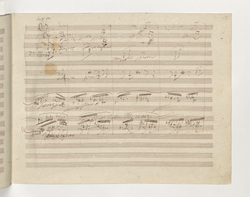
Beethoven published his first composition, a set of nine variations for piano on a march by Ernst Christoph Dressler, along with three piano sonatas later titled 'Kurfürsten' sonatas dedicated to Elector Maximilian Friedrich.
Image source: Piano Trios, Op. 1 (Beethoven)
1784
% complete
Beethoven received his first salaried appointment as assistant court organist under Elector Maximilian Franz. At just 13 years old, he earned an annual salary and became increasingly involved with Bonn's musical life.
Apr 1787 - May 1787
% complete
Beethoven traveled to Vienna, where he may have briefly met and played for Mozart, though evidence is inconclusive. The trip was cut short by news that his mother was dying of tuberculosis, and he returned to Bonn to be at her side.
Nov 1792
% complete
With support from Elector Maximilian Franz, Beethoven moved to Vienna to study with Joseph Haydn. He never returned to his native Bonn, which soon fell under French occupation, and Vienna would remain his home for life.
1795
% complete
Beethoven published his first major opus number, a set of three piano trios dedicated to Prince Karl Lichnowsky, his early patron in Vienna. These trios established his credentials as a serious composer.
Mar 29, 1795
% complete
Beethoven performed publicly in Vienna for the first time, playing one of his own piano concertos at the Burgtheater during a benefit concert. This marked the beginning of his reputation as a leading virtuoso pianist in Vienna.
1798 - 1799
% complete
The Piano Sonata No. 8 in C minor, 'Pathétique', showcased Beethoven's dramatic style and emotional depth. Published in 1799 and dedicated to Prince Lichnowsky, it became one of his most celebrated early works.
1799 - 1800
% complete
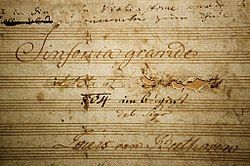
Beethoven composed his Symphony No. 1 in C major, which premiered at his April 1800 academy concert in Vienna. The work announced the arrival of a bold new symphonic voice, though it still showed Haydn's influence.
Image source: Symphony No. 1 (Beethoven)
1803 - 1804
% complete
The Symphony No. 3 in E-flat major, 'Eroica', revolutionized symphonic form with its unprecedented length and emotional scope. Originally dedicated to Napoleon, Beethoven famously tore up the dedication upon Napoleon declaring himself emperor.
Image source: Symphony No. 3 (Beethoven)
Nov 20, 1805
% complete
Beethoven's only opera, Fidelio, premiered at the Theater an der Wien. Set against the backdrop of political imprisonment, the opera tells a story of heroic love and liberation. It underwent several revisions before reaching its final form in 1814.
Image source: Fidelio
1807 - 1808
% complete
Beethoven composed two of his most famous symphonies concurrently: the Fifth, with its iconic four-note opening motif, and the Pastoral Sixth, depicting scenes of country life. Both premiered in a marathon concert on December 22, 1808.
Image source: Symphony No. 5 (Beethoven)
1809
% complete
The Piano Concerto No. 5 in E-flat major, known as the 'Emperor', was composed while Vienna was occupied by Napoleonic forces. It became the last of his piano concertos and one of the grandest works in the genre.
Image source: Piano Concerto No. 5 (Beethoven)
1817 - 1818
% complete
The Piano Sonata No. 29 in B-flat major, 'Hammerklavier', opened Beethoven's late period with its monumental scale, technical demands, and groundbreaking fugue finale. It pushed the boundaries of what piano music could achieve.
Image source: Piano Sonata No. 29 (Beethoven)
1823
% complete
After four years of intense work begun for Archduke Rudolph's enthronement as Archbishop of Olomouc, Beethoven completed the Missa Solemnis, a massive mass setting regarded as one of the supreme achievements of sacred music.
Image source: Missa solemnis (Beethoven)
1824 - 1826
% complete
In his final years, Beethoven composed five profound string quartets commissioned by Prince Golitsyn, including the Grosse Fuge. These works, far ahead of their time, explored unprecedented expressive depths and structural innovation.
Image source: Late string quartets (Beethoven)
May 7, 1824
% complete
The Ninth Symphony, incorporating Schiller's 'Ode to Joy' with its choral finale, premiered at the Kärntnertortheater in Vienna. Completely deaf, Beethoven had to be turned around by contralto Caroline Unger to see the audience's enthusiastic applause.
Image source: Symphony No. 9 (Beethoven)
Oct 30, 1826
% complete
Beethoven finished his String Quartet No. 16 in F major, his final complete work. Its last movement carries the enigmatic inscription 'Muss es sein? Es muss sein!' ('Must it be? It must be!'), often interpreted as a farewell to life.
Image source: String Quartet No. 16 (Beethoven)
Jul 17, 1787
% complete
Maria Magdalena van Beethoven died of tuberculosis when Ludwig was 16. Her death deeply affected him, and with his father's descent into alcoholism, Ludwig took on increasing responsibility for caring for his younger brothers.
1798
% complete
Around this time Beethoven noticed the first signs of progressive hearing loss, initially manifesting as tinnitus. The condition worsened over the following decades, causing him profound distress and eventually near-total deafness.
Oct 6, 1802 - Oct 10, 1802
% complete
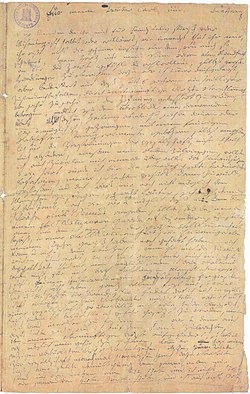
While staying in the village of Heiligenstadt, Beethoven wrote a letter to his brothers expressing despair over his deafness and contemplating suicide, yet resolving to continue living for his art. The document is one of the most moving testaments in music history.
Image source: Heiligenstadt Testament
Mar 1, 1809
% complete
Archduke Rudolph, Prince Lobkowitz, and Prince Kinsky agreed to pay Beethoven an annual stipend to keep him in Vienna. This financial security allowed Beethoven to focus on composing without relying solely on teaching and performances.
Image source: Archduke Rudolf of Austria
Jul 1812 - Sep 1812
% complete
Beethoven met the celebrated German poet Johann Wolfgang von Goethe at the Bohemian spa town of Teplitz. Though mutually respectful, their contrasting temperaments—Beethoven's democratic defiance versus Goethe's courtly deference—limited the friendship.
Image source: Johann Wolfgang von Goethe
Jul 6, 1812 - Jul 7, 1812
% complete
In Teplitz, Beethoven wrote an intensely passionate love letter to an unidentified woman he called his 'Immortal Beloved'. Scholars have debated her identity for two centuries, with Antonie Brentano now considered the most likely candidate.
Image source: Immortal Beloved
1815 - 1820
% complete
After the death of his brother Kaspar Karl, Beethoven fought a bitter five-year legal battle with his sister-in-law Johanna for custody of his nephew Karl. The struggle consumed enormous energy and ultimately ended in mutual unhappiness.
Image source: Karl van Beethoven
1818
% complete
By this point Beethoven's hearing had deteriorated so severely that conversation books were introduced, through which visitors wrote down their side of conversations. He could no longer perform publicly as a pianist or reliably hear music.
Mar 26, 1827
% complete
Beethoven died in Vienna at age 56 after months of liver illness, likely compounded by lead poisoning and other ailments. Legend holds that thunder crashed as he passed. Some 20,000 people attended his funeral procession days later.
Image source: Death of Ludwig van Beethoven
Mar 29, 1827
% complete
Beethoven's funeral drew an estimated 10,000 to 30,000 mourners through Vienna's streets. The poet Franz Grillparzer delivered a moving eulogy, hailing Beethoven as the heir to Handel, Bach, Haydn, and Mozart who had carried music to new heights.
Or browse the full history timeline directory, with more than 2,000 topics.
This Ludwig van Beethoven timeline was generated with the help of AI, using information found on the internet.
We work hard to keep these timelines accurate, but mistakes do get through. If you spot one, email us at [email protected] and we'll fix it for future visitors.
Generate yours with AI or build it from scratch, for free.
Export your timeline, add your own events, edit or remove AI-generated events, and much more
No credit card required.
Cancel anytime.
Cancel anytime.
You can create an unlimited number of timelines with up to 10 events on each one, customize how they look, export them to PDF, PNG, PowerPoint, CSV, and Excel, and share them with a link. Paid plans raise the event limit and add features like spreadsheet imports and collaborators.
Yes. You can cancel your subscription from your account page at any time, and you will not be charged again. Your subscription stays active for the rest of the period you already paid for.
Yes. We will email you a reminder before the annual renewal, and we will also email you a receipt.
Yes. You can email us within 15 days of any payment, and we will issue you a full refund.
Check out our pricing docs or send us an email anytime: [email protected].