-
Use Cases
-
Resources
-
Pricing
Feb 23, 1685
% complete
George Frideric Handel was born in Halle to Georg Händel, a barber-surgeon, and his second wife Dorothea Taust. His father initially opposed a musical career for his son, hoping he would study law instead.
Image source: George Frideric Handel
1692 - 1702
% complete
Handel received his principal musical training from Friedrich Wilhelm Zachow, organist at the Liebfrauenkirche in Halle, learning composition, organ, harpsichord, oboe, and violin.
Image source: Friedrich Wilhelm Zachow
1702 - 1703
% complete
At age 17, Handel was appointed organist at the Calvinist cathedral in Halle, his first professional position, while also briefly studying law at the University of Halle.
1703
% complete
Handel moved to Hamburg, then Germany's leading opera center, where he played violin and harpsichord in the orchestra of the Gänsemarkt opera house and befriended composer Johann Mattheson.
1706 - 1710
% complete
Handel traveled to Italy, spending time in Florence, Rome, Naples, and Venice, meeting Corelli, Alessandro Scarlatti, and Domenico Scarlatti, and absorbing Italian operatic and sacred styles.
Jun 1710
% complete
Handel accepted the post of Kapellmeister to Georg, Elector of Hanover, who would later become King George I of Great Britain, though Handel quickly sought leave to visit London.
1712
% complete
After a second leave of absence from Hanover, Handel settled in England, receiving an annual income from Queen Anne and eventually becoming a naturalized British subject in 1727.
1717 - 1718
% complete
Handel served as resident composer at Cannons, the estate of James Brydges, Duke of Chandos, composing the eleven Chandos Anthems and other works including Acis and Galatea.
Image source: Chandos Anthems
Jan 8, 1705
% complete
Handel's first opera, Almira, premiered successfully at the Gänsemarkt opera in Hamburg. His second opera there, Nero, was a failure and is now lost.
Image source: Almira
1707
% complete
Handel's Rodrigo premiered in Florence, earning him recognition in Italian operatic circles and an invitation from Prince Ferdinando de' Medici.
Image source: Rodrigo (opera)
Dec 26, 1709
% complete
Handel's opera Agrippina premiered at the Teatro San Giovanni Grisostomo in Venice to sensational acclaim, running for 27 consecutive nights and establishing his international reputation.
Image source: Agrippina (opera)
Feb 24, 1711
% complete
Handel's Rinaldo became the first Italian opera written specifically for London, premiering at the Queen's Theatre in the Haymarket to great success.
Image source: Rinaldo (opera)
1719
% complete
Handel was appointed Master of the Orchestra at the newly founded Royal Academy of Music, a company formed to present Italian opera in London, recruiting star singers such as Senesino from continental Europe.
Image source: Royal Academy of Music (company)
Feb 20, 1724
% complete
Giulio Cesare in Egitto, one of Handel's greatest operas, premiered at the King's Theatre with the celebrated castrato Senesino and soprano Francesca Cuzzoni, becoming a landmark of Baroque opera.
Image source: Giulio Cesare
1726 - 1727
% complete
The engagement of rival prima donnas Francesca Cuzzoni and Faustina Bordoni led to public feuding among London opera audiences, culminating in a notorious on-stage brawl in June 1727 during Astianatte.
Image source: Faustina Bordoni
1733
% complete
A rival opera company backed by aristocrats hostile to Handel was founded, poaching his star singer Senesino and intensifying competition that strained both companies financially.
1737
% complete
Both Handel's opera company and the Opera of the Nobility collapsed under financial strain in 1737, prompting Handel to shift his focus increasingly toward English oratorios.
Apr 8, 1708
% complete
Handel's oratorio La resurrezione was performed at the Palazzo Bonelli in Rome with great success, financed by the Marquis Ruspoli, featuring Arcangelo Corelli as concertmaster.
Image source: La resurrezione
Jul 17, 1717
% complete
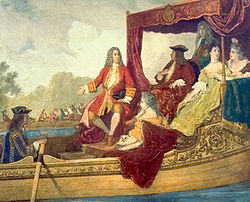
The Water Music was famously performed on a barge on the River Thames for King George I and his court, reportedly helping restore Handel's standing with the king after his prolonged absence from Hanover.
Image source: Water Music
Oct 11, 1727
% complete
Handel composed four coronation anthems for the coronation of George II, including Zadok the Priest, which has been performed at every British coronation since.
Image source: Zadok the Priest
Jul 10, 1733
% complete
Handel's third English oratorio, Athalia, premiered at the Sheldonian Theatre in Oxford to enthusiastic audiences, marking a growing public appetite for his choral works.
Image source: Athalia (Handel)
1739 - 1740
% complete
Handel published his Op. 3 concerti grossi and composed the twelve grand concertos of Op. 6, among the finest examples of the Baroque concerto grosso genre.
Image source: Concerti grossi, Op. 6 (Handel)
Jan 16, 1739 - Apr 4, 1739
% complete
Handel premiered Saul in January 1739 and Israel in Egypt in April 1739, the latter notable for its monumental double chorus and vivid musical depictions of the plagues of Egypt.
Image source: Egypt–Israel peace treaty
Apr 13, 1742
% complete
Messiah premiered at the Music Hall on Fishamble Street in Dublin to tremendous acclaim, benefiting local charities. It became Handel's most famous work, with its Hallelujah Chorus achieving enduring popularity.
Image source: Messiah (Handel)
Mar 23, 1743
% complete
Messiah received its London premiere at Covent Garden Theatre. Tradition holds that King George II stood during the Hallelujah Chorus, beginning a custom still observed today.
Apr 27, 1749
% complete
Handel's Music for the Royal Fireworks accompanied celebrations in Green Park marking the Treaty of Aix-la-Chapelle, performed before an audience reported at over 12,000 people.
Image source: Music for the Royal Fireworks
Apr 1737 - Sep 1737
% complete
In spring 1737 Handel suffered what appears to have been a stroke or rheumatic illness affecting his right arm; he traveled to Aachen, Germany, where hot baths restored his health remarkably quickly.
1751 - 1752
% complete
Handel's eyesight deteriorated badly, and unsuccessful cataract surgery by the charlatan John Taylor left him completely blind by 1752, though he continued performing and composing from memory.
Apr 6, 1759
% complete
Despite failing health, Handel attended and conducted a performance of Messiah at Covent Garden, appearing for the last time in public just days before his death.
Apr 14, 1759
% complete
Handel died at his home in Brook Street, London, aged 74. He was buried with full state honors in Westminster Abbey, and over 3,000 mourners attended his funeral.
Or browse the full history timeline directory, with more than 2,000 topics.
This George Frideric Handel timeline was generated with the help of AI, using information found on the internet.
We work hard to keep these timelines accurate, but mistakes do get through. If you spot one, email us at [email protected] and we'll fix it for future visitors.
Generate yours with AI or build it from scratch, for free.
Export your timeline, add your own events, edit or remove AI-generated events, and much more
No credit card required.
Cancel anytime.
Cancel anytime.
You can create an unlimited number of timelines with up to 10 events on each one, customize how they look, export them to PDF, PNG, PowerPoint, CSV, and Excel, and share them with a link. Paid plans raise the event limit and add features like spreadsheet imports and collaborators.
Yes. You can cancel your subscription from your account page at any time, and you will not be charged again. Your subscription stays active for the rest of the period you already paid for.
Yes. We will email you a reminder before the annual renewal, and we will also email you a receipt.
Yes. You can email us within 15 days of any payment, and we will issue you a full refund.
Check out our pricing docs or send us an email anytime: [email protected].