-
Use Cases
-
Resources
-
Pricing
Feb 22, 1810
% complete
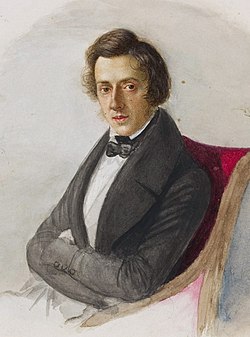
Frédéric Chopin was born in Żelazowa Wola, a village near Warsaw, Poland. His birth certificate records February 22, 1810, though the family later celebrated March 1 as his birthday. He was the second of four children of Nicolas Chopin, a French émigré tutor, and Justyna Krzyżanowska.
Image source: Frédéric Chopin
Oct 1810
% complete
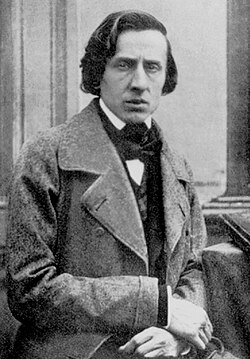
The Chopin family moved to Warsaw, where Nicolas Chopin accepted a position teaching French at the Warsaw Lyceum. Growing up in an intellectual household surrounded by music and literature, young Frédéric was immersed in Polish culture from an early age.
Image source: Frédéric Chopin
1816 - 1822
% complete
At age six, Chopin began professional piano lessons with the Bohemian musician Wojciech Żywny, a violinist who had studied with classical masters. Żywny gave him a solid grounding in Bach, Mozart, and Beethoven while allowing his pupil's original talent to flourish freely.
Image source: Wojciech Żywny
1817
% complete
At only seven years old, Chopin composed his Polonaise in G minor, one of his earliest surviving works. His father's employer, Prince Antoni Radziwiłł, encouraged the boy's composing, and the piece was published in 1817, marking the beginning of his catalog.
Image source: Polonaises, Op. posth. (Chopin)
Feb 24, 1818
% complete
Chopin made his public debut at a charity concert at the Radziwiłł Palace in Warsaw, performing Adalbert Gyrowetz's Piano Concerto in E-flat major. The Warsaw press hailed him as a child prodigy compared to Mozart.
1823 - 1829
% complete
Chopin began private composition studies with Józef Elsner, director of the Warsaw Conservatory, and formally enrolled at the institution in 1826. Elsner recognized and nurtured Chopin's unique voice, famously advising him to follow his own path rather than conventional rules.
Image source: Józef Elsner
Jul 1829
% complete
Chopin completed his studies at the Warsaw Conservatory under Józef Elsner, receiving a diploma that praised him as a 'musical genius.' His graduation report noted his exceptional abilities in both composition and performance.
1827
% complete
Chopin composed his Variations on 'Là ci darem la mano' from Mozart's Don Giovanni for piano and orchestra. Published in 1830, the work earned Robert Schumann's famous review declaring 'Hats off, gentlemen—a genius!'
Image source: Variations on "Là ci darem la mano"
1828 - 1829
% complete
Chopin traveled to Berlin in 1828 and Vienna in 1829, where he performed his own works to critical acclaim. The Viennese concerts established his reputation abroad and convinced him that he could succeed as an international concert artist.
Mar 17, 1830
% complete
Chopin premiered his Piano Concerto No. 2 in F minor at the National Theatre in Warsaw, playing to an enthusiastic audience. The concerto, composed largely during his infatuation with singer Konstancja Gładkowska, remains among his most beloved works.
Oct 11, 1830
% complete
Chopin premiered his Piano Concerto No. 1 in E minor at the National Theatre in Warsaw, with Konstancja Gładkowska singing on the same program. Days later he left Warsaw forever, carrying letters from friends and a silver goblet filled with Polish soil.
Image source: Piano Concerto No. 1 (Chopin)
Nov 2, 1830
% complete
Chopin departed Warsaw intending to tour Western Europe. Weeks after his departure, the November Uprising against Russian rule broke out in Poland; he never returned to his homeland, spending the rest of his life in exile.
Nov 29, 1830 - Oct 5, 1831
% complete
An armed rebellion against Russian domination erupted in Warsaw shortly after Chopin's departure. Its suppression deeply affected Chopin, who was stranded far from home and eventually chose Paris over returning to Russian-controlled Poland.
Image source: November Uprising
Sep 1831
% complete
While in Stuttgart, Chopin learned that Warsaw had fallen to Russian forces. In anguished diary entries he poured out his despair, and scholars link this emotional crisis to works like the Étude Op. 10 No. 12, the 'Revolutionary' Étude.
Sep 1831
% complete
Chopin arrived in Paris, which would remain his home until his death. The city's vibrant artistic scene, including Liszt, Berlioz, Bellini, Delacroix, and Heine, provided fertile ground for his career, and he soon became a sought-after teacher and performer in aristocratic salons.
Feb 26, 1832
% complete
Chopin made his Parisian debut at Salle Pleyel, premiering his Piano Concerto No. 2 and other works. Though attendance was modest due to competition from other concerts, critics praised him lavishly, cementing his standing among Parisian elites.
Image source: Salle Pleyel
1833
% complete
Chopin formed a friendship and professional rapport with fellow virtuoso Franz Liszt. The two performed together at benefit concerts, though their relationship later cooled amid differences in temperament and musical philosophy.
Image source: Franz Liszt
Oct 1836
% complete
Chopin met the celebrated novelist George Sand (Amantine Dupin) at a gathering hosted by Countess Marie d'Agoult. Initially repelled by her, he entered into a decade-long romantic relationship with her that profoundly shaped his life and art.
Image source: George Sand
1837
% complete
Chopin's engagement to Maria Wodzińska, whom he had courted in Dresden, was broken off by her family, reportedly due to his health and uncertain prospects. He kept her farewell letter and the memory inspired the 'Farewell' Waltz in A-flat major.
Image source: Maria Wodzińska
Jul 1837 - Oct 1837
% complete
Chopin traveled to London in the summer of 1837, attending the coronation festivities of Queen Victoria and meeting leading British musicians. The visit broadened his reputation, and he returned again in later years for concerts.
Nov 1838 - Feb 13, 1839
% complete
Seeking a warm climate for Chopin's worsening tuberculosis, Sand took him and her children to Mallorca, staying at the former Carthusian monastery of Valldemossa. Bad weather, hostile locals, and illness marred the trip, but Chopin composed some of his Preludes there, including the famous 'Raindrop.'
Image source: Deià
Jun 1839 - 1846
% complete
From 1839 onward, Chopin spent most summers at Sand's country estate in Nohant in central France. These peaceful summers were his most productive period, yielding many sonatas, mazurkas, nocturnes, and polonaises amid the company of writers and artists.
Image source: George Sand
Jul 1847
% complete
After nearly ten years together, the relationship between Chopin and Sand dissolved amid conflicts involving her daughter Solange. Devastated and increasingly ill, Chopin never fully recovered emotionally from the breakup.
1833
% complete
Chopin dedicated his Op. 10 études to Franz Liszt. These twelve pieces transformed technical exercises into profound art, with No. 12 in C minor, the 'Revolutionary' Étude, becoming emblematic of his response to Poland's fate.
Image source: Études (Chopin)
Jan 22, 1839
% complete
Chopin finished his cycle of 24 Preludes in all major and minor keys, much of it drafted during the Mallorca sojourn. Published in 1839, they are considered a monumental achievement, each a miniature world of its own.
Image source: Preludes (Chopin)
1845 - 1846
% complete
One of his last great extended works, the Polonaise-Fantaisie in A-flat major blended the national polonaise form with improvisatory fantasy. It reflects the introspective, harmonically daring style of Chopin's late years.
Image source: Polonaise-Fantaisie (Chopin)
Feb 16, 1848
% complete
Chopin gave his last concert at Salle Pleyel in Paris, performing despite failing health. The outbreak of the 1848 Revolution soon disrupted Parisian life and prompted his departure for Britain.
Apr 1848 - Nov 1848
% complete
Despite severe illness, Chopin toured England and Scotland, performing for Queen Victoria, giving recitals in Manchester and Glasgow, and teaching aristocratic pupils. The exhausting schedule further ruined his health, and he returned to Paris critically weakened.
Oct 17, 1849
% complete
Chopin died at his apartment on Place Vendôme in Paris at age 39, likely of tuberculosis. Per his wishes, his heart was removed and smuggled to Warsaw, where it rests at Holy Cross Church, symbolizing his enduring bond with Poland.
Image source: Heart of Frédéric Chopin
Oct 30, 1849
% complete
Chopin's funeral drew some 3,000 mourners at the church of La Madeleine, with Mozart's Requiem performed as he had requested. His body was buried at Père Lachaise Cemetery beneath a monument designed by Auguste Clésinger.
Or browse the full history timeline directory, with more than 2,000 topics.
This Frédéric Chopin timeline was generated with the help of AI, using information found on the internet.
We work hard to keep these timelines accurate, but mistakes do get through. If you spot one, email us at [email protected] and we'll fix it for future visitors.
Generate yours with AI or build it from scratch, for free.
Export your timeline, add your own events, edit or remove AI-generated events, and much more
No credit card required.
Cancel anytime.
Cancel anytime.
You can create an unlimited number of timelines with up to 10 events on each one, customize how they look, export them to PDF, PNG, PowerPoint, CSV, and Excel, and share them with a link. Paid plans raise the event limit and add features like spreadsheet imports and collaborators.
Yes. You can cancel your subscription from your account page at any time, and you will not be charged again. Your subscription stays active for the rest of the period you already paid for.
Yes. We will email you a reminder before the annual renewal, and we will also email you a receipt.
Yes. You can email us within 15 days of any payment, and we will issue you a full refund.
Check out our pricing docs or send us an email anytime: [email protected].