-
Use Cases
-
Resources
-
Pricing
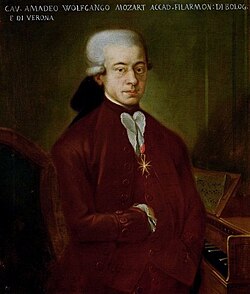
Wolfgang Amadeus Mozart (1756–1791) was an Austrian composer widely regarded as one of the greatest and most influential figures in the history of Western music. A child prodigy, he began performing across Europe at age six and went on to compose more than 600 works, including symphonies, operas, concertos, and chamber music, before his untimely death at age 35 in Vienna. More Less
1743
% complete
In 1743, Leopold Mozart, Wolfgang's father, was appointed as the fourth violinist in the musical establishment of Count Leopold Anton von Firmian, the ruling Prince-Archbishop of Salzburg, establishing the family's place in Salzburg's musical life.
Image source: Leopold Mozart
Jan 27, 1756
% complete
Wolfgang Amadeus Mozart was born on 27 January 1756 to Leopold Mozart and Anna Maria, née Pertl, at Getreidegasse 9 in Salzburg. He would become one of the most celebrated composers and musicians of the Classical era.
Image source: Wolfgang Amadeus Mozart
1763
% complete
Leopold Mozart became the orchestra's deputy Kapellmeister in 1763, further advancing his standing in the Salzburg court musical establishment while nurturing his children's extraordinary talents.
May 28, 1787
% complete
The year 1787 was marked by the death of Leopold on 28 May — six months too early, since he would never learn that his lifetime goal for his son, a paid court position, was finally achieved. Biographer Eisen suggests it 'triggered a fallow period for the composer'.
1762
% complete
The young Mozart's childhood exhibitions began in 1762 with a performance at the court of Prince-elector Maximilian III of Bavaria in Munich, followed by appearances at the Imperial Courts in Vienna and Prague.
Image source: Mozart family grand tour
1764 - 1765
% complete
A particularly significant influence on the young Mozart was Johann Christian Bach, whom he visited in London in 1764 and 1765 during his family's grand tour.
Image source: Johann Christian Bach
Oct 1, 1767 - Dec 1768
% complete
The family went again to Vienna in late 1767, where both Wolfgang and his sister Nannerl caught smallpox during an outbreak, though they quickly recovered. They remained in Vienna until December 1768.
Dec 1769 - Mar 1771
% complete
Mozart's first Italian tour lasted from December 1769 to March 1771. In Milan, he wrote the opera Mitridate, re di Ponto (1770), which was performed with success.
Image source: Mitridate, re di Ponto
Aug 1771 - Mar 1773
% complete
Mozart returned with his father twice to Milan (August–December 1771; October 1772 – March 1773) for the composition and premieres of Ascanio in Alba (1771) and Lucio Silla (1772).
Image source: Lucio Silla
1773 - 1775
% complete
An important part of Mozart's output at this time was violin concertos: he wrote one in 1773 and four more in 1775, works that remain staples of the violin repertoire.
Image source: Violin Concerto No. 5 (Mozart)
Mar 13, 1773
% complete
After finally returning with his father from Italy on 13 March 1773, Mozart was employed as a court musician by Prince-Archbishop Hieronymus Colloredo, ruler of Salzburg.
Image source: Hieronymus von Colloredo
Jul 14, 1773 - Mar 1775
% complete
Mozart and his father visited Vienna from 14 July to 26 September 1773, and Munich from 6 December 1774 to March 1775. Some of his quartets from this period have fugal finales, probably influenced by Haydn's recently published Opus 20 set.
1775
% complete
The situation for Mozart in Salzburg worsened in 1775 when the court theatre was closed, especially since the other theatre in Salzburg was primarily reserved for visiting troupes.
Jan 1, 1777 - Mar 31, 1777
% complete
In 1776 Mozart turned his efforts to piano concertos, culminating in the E♭ concerto K. 271 of early 1777, considered by critics to be a breakthrough work — Charles Rosen called it 'perhaps the first unequivocal masterpiece in [the] classical style'.
1777 - 1778
% complete
In 1777, when Mozart was visiting Augsburg on his job-hunting tour, he was deeply impressed by Johann Andreas Stein's pianos and shared his admiration in detailed letters to his father. His scatological-humour-filled letters to his cousin Maria Anna Thekla Mozart also date from around this period.
Image source: Johann Andreas Stein
Aug 1777 - Sep 23, 1777
% complete
In August 1777 Mozart resigned his position at Salzburg and on 23 September ventured out once more in search of employment, accompanied by his mother, with visits to Munich, Augsburg, Mannheim, and Paris.
Mar 14, 1778
% complete
There were prospects of employment in Mannheim, but they came to nothing, and Mozart left for Paris on 14 March 1778 to continue his search for a position.
Jun 12, 1778 - Jun 18, 1778
% complete
In Paris, Mozart's symphonies including the Symphony No. 31 (Paris) were performed on 12 and 18 June 1778, along with the Concerto for Flute and Harp in C major.
Image source: Concerto for Flute, Harp, and Orchestra (Mozart)
Jul 3, 1778
% complete
The nadir of the visit occurred when Mozart's mother was taken ill and died on 3 July 1778 in Paris, a devastating loss that later biographers noted triggered fallow periods in Mozart's productivity.
Image source: Anna Maria Mozart
Sep 1778 - Jan 15, 1779
% complete
After leaving Paris in September 1778 for Strasbourg, Mozart lingered in Mannheim and Munich still hoping for an appointment elsewhere, but finally returned to Salzburg on 15 January 1779 and took up his new appointment, though his discontent remained undiminished.
1779 - 1780
% complete
Alex Ross writes that 'the golden mean runs through the Andante of the Sinfonia Concertante for Violin and Viola', composed in 1779–80 and regarded as one of Mozart's finest works of the period.
Image source: Sinfonia Concertante for Violin, Viola and Orchestra (Mozart)
1781
% complete
While Mozart was visiting Vienna in 1781, his quarrels with his Salzburg employers came to a head and he was dismissed. He chose to remain in Vienna as a freelance composer and performer.
Jan 1781
% complete
In January 1781 Mozart's opera Idomeneo premiered with 'considerable success' in Munich, marking one of his greatest operatic achievements.
Image source: Idomeneo
Dec 24, 1781
% complete
Mozart often performed as a pianist, notably in a competition before the Emperor with Muzio Clementi on 24 December 1781, after which he soon 'had established himself as the finest keyboard player in Vienna'.
Image source: Muzio Clementi
1782 - 1785
% complete
From 1782 to 1785 Mozart mounted concerts with himself as piano soloist, presenting three or four new concertos in each season. In 1783 he purchased a fortepiano by Anton Walter which he played frequently in concerts around Vienna.
Image source: Piano concertos by Wolfgang Amadeus Mozart
1782 - 1785
% complete
Mozart met Joseph Haydn in Vienna around 1784 and the two became friends. His string quartets (including K. 465) date from 1782 to 1785, judged a response to Haydn's Opus 33 set from 1781, and are today considered key works of the string quartet literature. K. 465 earned the nickname 'Dissonance' quartet for its chromatically suspended introduction.
Image source: Haydn Quartets (Mozart)
1782 - 1783
% complete
In 1782 and 1783 Mozart became intimately acquainted with the work of Johann Sebastian Bach and George Frideric Handel through the influence of Gottfried van Swieten, who owned many manuscripts of the Baroque masters.
Image source: Gottfried van Swieten
Apr 1782 - Aug 4, 1782
% complete
Mozart's courtship of Constanze did not go entirely smoothly; the couple briefly broke up in April 1782 over an episode involving jealousy. A letter from 31 July 1782 suggested Constanze had moved in with him. The couple were finally married on 4 August 1782 in St. Stephen's Cathedral, Vienna.
Image source: Constanze Mozart
Jul 16, 1782
% complete
Mozart prospered as a composer in Vienna, and in 1782 completed the opera Die Entführung aus dem Serail, which premiered on 16 July 1782 and achieved considerable success.
Image source: Die Entführung aus dem Serail
1783
% complete
In 1783 Mozart and his wife visited his family in Salzburg, for the first and only time after their marriage.
Dec 14, 1784
% complete
On 14 December 1784 Mozart became a Freemason, admitted to the lodge Zur Wohltätigkeit ('Beneficence'). He embraced Freemasonry and remained a lodge member for the rest of his life.
Image source: Mozart and Freemasonry
Oct 1, 1785 - Dec 31, 1785
% complete
Around the end of 1785, Mozart moved away from keyboard writing and began his famous operatic collaboration with the librettist Lorenzo Da Ponte.
Image source: Lorenzo Da Ponte
1786
% complete
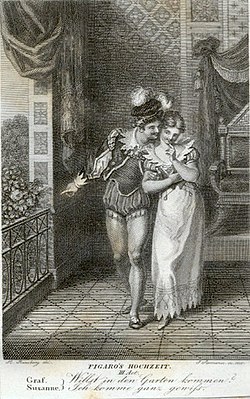
The year 1786 saw the successful premiere of Le nozze di Figaro in Vienna, the first of three operas Mozart created with Lorenzo Da Ponte.
Image source: The Marriage of Figaro
1787
% complete
In 1787 the young Ludwig van Beethoven spent several weeks in Vienna, hoping to study with Mozart, whose reputation as a composer and keyboard virtuoso had spread widely.
Image source: Ludwig van Beethoven
Oct 1787
% complete
The second Da Ponte opera premiered in October 1787 to acclaim in Prague, and was produced again, though without the same degree of success, in Vienna during 1788.
Image source: Don Giovanni
Dec 1787
% complete
In December 1787, Mozart finally obtained a steady post under aristocratic patronage. While traditionally viewed as a mere sinecure, Wolff (2012) argues the position was substantial and that some of Mozart's chamber music from this time was written as part of his imperial duties.
1786 - 1788
% complete
Around 1786 Mozart ceased to appear frequently in public concerts and his income shrank; according to Solomon, in 1788 he saw a 66% decline in income compared to his best years in 1781. By mid-1788 he and his family had moved from central Vienna to the suburb of Alsergrund.
1788 - 1790
% complete
Mozart's late masterworks include the final symphonies Nos. 39, 40 and 41, all from the summer of 1788, the Clarinet Quintet of 1789, and Così fan tutte, the last of the three Da Ponte operas, which premiered in 1790.
Image source: Symphony No. 41 (Mozart)
1789 - 1790
% complete
Around this time Mozart made two long journeys hoping to improve his fortunes: visiting Leipzig, Dresden, and Berlin in spring 1789, and Frankfurt, Mannheim, and other German cities in 1790. These broadened his reputation but involved setbacks and probably did not achieve his financial goals.
Image source: Mozart's Berlin journey
1790
% complete
Mozart's financial situation, a source of anxiety in 1790, finally began to improve as his fortunes recovered toward the end of his life.
1791 - 1883
% complete
Shortly after Mozart's death in 1791, it became a goal of publishers to produce a complete printed edition of everything he had written. With extensive scholarly contributions, this led to the Alte Mozart-Ausgabe (Old Mozart Edition), issued from 1877 until 1883.
Sep 1791
% complete
In September 1791 Mozart attended rehearsals of La clemenza di Tito in Prague; singer Michael Kelly remembered him 'on the stage with his crimson pelisse and gold-laced cocked hat, giving the time of the music to the orchestra.'
Image source: La clemenza di Tito
Nov 17, 1791
% complete
Mozart's Clarinet Concerto, K. 623's companion work of his final months, premiered on 17 November 1791, among the last major works completed before his death.
Image source: Clarinet Concerto (Mozart)
Nov 20, 1791
% complete
Mozart fell seriously ill on 20 November 1791 and took to what turned out to be his deathbed; he suffered from swelling, pain, and vomiting during his final days.
Image source: Death of Wolfgang Amadeus Mozart
Dec 5, 1791
% complete
Mozart died in his home on 5 December 1791 at 12:55 am, aged 35. If no mourners attended, that would have been consistent with Viennese burial customs; Otto Jahn (1856) wrote that Salieri, Süssmayr, van Swieten and two others were present. Modern research by Zegers et al. found a modest spike in the death rate in Vienna in late 1791, supporting claims about an epidemic.
1862
% complete
After Mozart's death, scholars such as Johann Anton André attempted to create a complete catalogue, but this was only accomplished in 1862 when Ludwig Ritter von Köchel completed the first edition of what is now called the Köchel catalogue. 2024 marked the completion of its ninth edition, edited by Neal Zaslaw.
Image source: Köchel catalogue
Or browse the full history timeline directory, with more than 2,000 topics.
This Wolfgang Amadeus Mozart timeline was generated with the help of AI, using information found on the internet.
We work hard to keep these timelines accurate, but mistakes do get through. If you spot one, email us at [email protected] and we'll fix it for future visitors.
Generate yours with AI or build it from scratch, for free.
Export your timeline, add your own events, edit or remove AI-generated events, and much more
No credit card required.
Cancel anytime.
Cancel anytime.
You can create an unlimited number of timelines with up to 10 events on each one, customize how they look, export them to PDF, PNG, PowerPoint, CSV, and Excel, and share them with a link. Paid plans raise the event limit and add features like spreadsheet imports and collaborators.
Yes. You can cancel your subscription from your account page at any time, and you will not be charged again. Your subscription stays active for the rest of the period you already paid for.
Yes. We will email you a reminder before the annual renewal, and we will also email you a receipt.
Yes. You can email us within 15 days of any payment, and we will issue you a full refund.
Check out our pricing docs or send us an email anytime: [email protected].