-
Use Cases
-
Resources
-
Pricing
Henri Matisse (1869–1954) was a French artist renowned for his revolutionary use of color and expressive draughtsmanship. As a leading figure of Fauvism and a pioneer of modern art, Matisse's career spanned painting, sculpture, printmaking, and his famous late-career paper cut-outs, leaving a profound influence on 20th-century art. More Less
Dec 31, 1869
% complete
Henri Émile Benoît Matisse was born in Le Cateau-Cambrésis in the Nord department in Northern France on New Year's Eve in 1869, the oldest son of a wealthy grain merchant. He would become a French visual artist known for both his use of colour and his fluid and original draughtsmanship.
Image source: Henri Matisse
1887
% complete
In 1887, Matisse went to Paris to study law, working as a court administrator in Le Cateau-Cambrésis after gaining his qualification.
1889
% complete
Matisse first started to paint in 1889, after his mother brought him art supplies during a period of convalescence following an attack of appendicitis.
1891
% complete
In 1891, Matisse returned to Paris to study art at the Académie Julian under William-Adolphe Bouguereau and at the École Nationale des Beaux-Arts under Gustave Moreau.
1896
% complete
In 1896, Matisse, then an unknown art student, visited the Australian painter John Russell on the island of Belle Île off the coast of Brittany, an encounter that influenced his development as a painter.
1898
% complete
In 1898, Matisse married Amélie Noellie Parayre; the two raised Marguerite together and had two sons, Jean (born 1899) and Pierre (born 1900).
1898
% complete
In 1898, on the advice of Camille Pissarro, Matisse went to London to study the paintings of J.M.W. Turner.
1898 - 1901
% complete
Many of Matisse's paintings from 1898 to 1901 make use of a Divisionist technique he adopted after reading Paul Signac's essay, 'D'Eugène Delacroix au Néo-impressionisme'.
Feb 1899
% complete
Upon his return to Paris in February 1899, Matisse worked beside Albert Marquet and met André Derain, Jean Puy, and Jules Flandrin. That same year he made his first attempt at sculpture, a copy after Antoine-Louis Barye.
1902 - 1903
% complete
During 1902 to 1903, Matisse adopted a comparatively somber style of painting concerned with form, possibly intended to produce saleable works during this time of material hardship. Having devoted much energy to working in clay, he completed The Slave in 1903.
May 1902
% complete
In May 1902, Amélie's parents became ensnared in a major financial scandal, the Humbert Affair, which brought material hardship to the family.
1900 - 1999
% complete
During the first decade of the twentieth century, the Americans in Paris—Gertrude Stein, her brothers Leo Stein, Michael Stein, and Michael's wife Sarah—were important collectors and supporters of Matisse's paintings.
1904
% complete
Matisse's first solo exhibition was held at Ambroise Vollard's gallery in 1904, without much success.
1904
% complete
Matisse's fondness for bright and expressive colour became more pronounced after he spent the summer of 1904 painting in St. Tropez.
1905
% complete
In 1905, Matisse travelled southwards again to work with André Derain at Collioure, producing some of the most vivid works of the emerging Fauve movement.
Oct 1905
% complete
Matisse and a group of artists now known as 'Fauves' exhibited together in a room at the Salon d'Automne in 1905. A critic's comment, printed on 17 October 1905 in Gil Blas, passed into popular usage and gave the movement its name.
Image source: Fauvism
1906
% complete
Matisse travelled to Algeria in 1906, studying African art and Primitivism, influences that deepened his expressive use of form and colour.
Apr 1906
% complete
Around April 1906, Matisse met Pablo Picasso, who was 11 years his junior. The two artists are commonly regarded as those who best helped define the revolutionary developments in the visual arts throughout the opening decades of the twentieth century.
1907
% complete
In 1907, Guillaume Apollinaire, commenting about Matisse in an article published in La Falange, wrote: 'We are not here in the presence of an extravagant or an extremist undertaking: Matisse's art is eminently reasonable.' Yet his work also encountered vehement criticism, making it difficult for him to provide for his family.
1909 - 1910
% complete
Matisse created one of his major works La Danse specially for Sergei Shchukin as part of a two-painting commission, the other being Music (1910). An earlier version of La Danse (1909) is in the collection of The Museum of Modern Art in New York City.
Image source: Dance (Matisse)
1910
% complete
After viewing a large exhibition of Islamic art in Munich in 1910, Matisse spent two months in Spain studying Moorish art. The effect on his art was a new boldness in the use of intense, unmodulated colour, as in L'Atelier Rouge (1911).
1912
% complete
The first painting of Matisse acquired by a public collection was Still Life with Geraniums (1910), acquired in 1912 by the Pinakothek der Moderne.
Image source: Still Life with Geraniums
1912 - 1913
% complete
Matisse visited Morocco in 1912 and again in 1913, spending seven months there and producing about 24 paintings and numerous drawings. While painting in Tangier he made several changes to his work, including his use of black as a colour.
1913
% complete
Matisse's painting Nu bleu (1907) was burned in effigy at the Armory Show in Chicago in 1913, illustrating the controversy provoked by his radical approach to the figure.
1917
% complete
In 1917, Matisse relocated to Cimiez on the French Riviera, a suburb of the city of Nice. The more relaxed style of his work during the 1920s gained him critical acclaim as an upholder of the classical tradition in French painting.
1930
% complete
After 1930, a new vigor and bolder simplification appeared in Matisse's work. This move toward simplification and a foreshadowing of the cut-out technique is evident in his painting Large Reclining Nude (1935).
1931 - 1989
% complete
Matisse's son Pierre Matisse (1900–1989) opened a modern art gallery in New York City during the 1930s. The Pierre Matisse Gallery, active from 1931 until 1989, represented and exhibited many European artists in New York, often for the first time.
1932
% complete
Albert Barnes convinced Matisse to produce a large mural for the Barnes Foundation, The Dance II, completed in 1932; the Foundation owns several dozen other Matisse paintings.
Image source: Barnes Foundation
Jul 1939
% complete
Matisse's wife Amélie, who suspected that he was having an affair with her young Russian émigrée companion Lydia Delectorskaya, ended their 41-year marriage in July 1939, dividing their possessions equally between them.
Jun 1940
% complete
Matisse was visiting Paris when the Nazis invaded France in June 1940, but managed to make his way back to Nice. In September 1940, he wrote Pierre: 'It seemed to me as if I would be deserting.'
1941
% complete
In 1941, Matisse was diagnosed with abdominal cancer and underwent surgery that left him reliant on a wheelchair and often bed bound. This confinement led him toward the paper cut-out as his primary medium.
1942
% complete
In 1942, Matisse's son Pierre held an exhibition in New York titled 'Artists in Exile', which was to become legendary. That same year, Matisse met Monique Bourgeois, a nurse who sometimes modelled for him.
1943
% complete
Matisse moved to the hilltop of Vence, France in 1943, where he produced his first major cut-out project for his artist's book titled Jazz. His new understanding of this medium unfolds with the 1946 introduction for Jazz.
Image source: Jazz (Henri Matisse)
1944
% complete
Matisse's student Rudolf Levy was killed in the Auschwitz concentration camp in 1944, a tragic loss among the wartime events surrounding the artist.
1946
% complete
The number of independently conceived cut-outs steadily increased following Jazz, eventually leading to the creation of mural-size works such as Oceania the Sky and Oceania the Sea of 1946. That year, Monique Bourgeois became a Dominican nun.
1948 - 1951
% complete
In 1948, Matisse began preparing designs for the Chapelle du Rosaire de Vence, painted in honor of Sister Jacques-Marie (formerly Monique Bourgeois), allowing him to expand the cut-out technique within a truly decorative context. He finished his last painting in 1951.
Image source: Chapelle du Rosaire de Vence
May 1954
% complete
In May 1954, Matisse's cut-out The Sheaf was exhibited at the Salon de Mai and met with success.
1952
% complete
In 1952, Matisse established a museum dedicated to his work, the Matisse Museum in Le Cateau, now the third-largest collection of Matisse works in France.
Image source: Matisse Museum (Le Cateau-Cambrésis)
1963
% complete
The Matisse Museum in Nice opened in 1963 and is located in the Villa des Arènes, a seventeenth-century villa in the neighbourhood of Cimiez.
Image source: Musée Matisse (Nice)
Oct 5, 2001 - Jan 20, 2002
% complete
From 5 October 2001 to 20 January 2002, the Fundación Juan March in Madrid exhibited Matisse, presenting a broad survey of his work.
Image source: Fundación Juan March
Oct 23, 2004 - Sep 25, 2005
% complete
In 2004, the Metropolitan Museum of Art, the Royal Academy of Arts, London and Le Musée Matisse organized 'Matisse: The Fabric of Dreams: His Art and His Textiles', displaying Matisse's textile collection alongside related works. The exhibit was shown at the Musée Matisse (23 October 2004–25 January 2005), the Royal Academy of Arts (5 March–30 May 2005) and the Metropolitan Museum of Art (23 June–25 September 2005).
Sep 8, 2005
% complete
Matisse's The Plum Blossoms (1948) was purchased on 8 September 2005 for the Museum of Modern Art by Henry Kravis and museum president Marie-Josée Drouin. It had not been seen by the public since 1970.
Image source: Prunus mume
Mar 7, 2012 - Mar 17, 2013
% complete
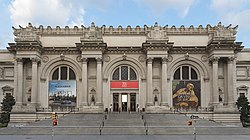
In 2012, 'Matisse: In Search of True Painting' was organized by The Metropolitan Museum of Art, New York, in collaboration with the Statens Museum for Kunst, Copenhagen, and the Centre Pompidou, Paris. The exhibit was shown at the Centre Pompidou (7 March–18 June 2012), the Statens Museum for Kunst (14 July–28 October 2012), and the Metropolitan Museum of Art (4 December 2012–17 March 2013).
Image source: Metropolitan Museum of Art
Apr 2014 - Feb 10, 2015
% complete
'Henri Matisse: The Cut-Outs' was exhibited at London's Tate Modern from April to September 2014, featuring 130 works encompassing his practice from 1937 to 1954. The show then moved to New York's Museum of Modern Art, on display from 12 October 2014 until 10 February 2015.
Image source: Tate Modern
Oct 30, 2015 - Jan 18, 2016
% complete
From 30 October 2015 through 18 January 2016, the Morgan Library & Museum held an exhibit of Matisse's book illustration projects titled 'Graphic Passion: Matisse and the Book Arts'.
Image source: Morgan Library & Museum
2018
% complete
In 2018, Matisse's work was exhibited alongside that of Joan Miró, Le Corbusier, Raymond Hains and Éric Sandillon at the Museum of Decorative Arts and Design in Riga, Latvia.
Image source: Latvian Museum of Decorative Arts and Design
May 1, 2022 - Sep 10, 2022
% complete
From 1 May to 10 September 2022, the Museum of Modern Art exhibited Matisse's painting The Red Studio, along with paintings and drawings closely related to the work.
Image source: The Red Studio
Oct 13, 2023 - May 27, 2024
% complete
In 2023, the Metropolitan Museum of Art and the Museum of Fine Arts, Houston co-organized 'Vertigo of Color: Matisse, Derain, and the Origins of Fauvism', examining their work together and the birth of Fauvism. The Met exhibited the show 13 October 2023 to 21 January 2024; the Museum of Fine Arts, Houston showed it 25 February–27 May 2024.
Apr 4, 2025 - Aug 24, 2025
% complete
From 4 April to 24 August 2025, the Musée d'Art Moderne de Paris exhibited 'Matisse and Marguerite: Through Her Father's Eyes', focusing on the relationship between Matisse and his daughter Marguerite.
Image source: Musée d'Art Moderne de Paris
Mar 7, 2026 - Jun 1, 2026
% complete
From 7 March–1 June 2026, the Art Institute of Chicago will exhibit 'Matisse's Jazz: Rhythms in Color', featuring his vibrant compositions combined with his original text collected in the unbound book Jazz.
Image source: Art Institute of Chicago
Mar 11, 2026 - Oct 25, 2026
% complete
The Baltimore Museum of Art will exhibit three shows of Matisse's work in 2026: 'Fratino and Matisse: To See This Light Again' (11 March–6 September), pairing Matisse's works with painter Louis Fratino; 'Matisse and Martinique: Portraits and Poetry' (18 March–25 October), focusing on lithographs for poems by John-Antoine Nau; and 'Matisse in Vence: The Stations of the Cross' (29 March–28 June), exhibiting drawings for the Stations of the Cross mural created for the Chapel of the Rosary in Vence.
Image source: Baltimore Museum of Art
Mar 24, 2026 - Jul 26, 2026
% complete
From 24 March–26 July 2026, the Grand Palais, Paris was expected to exhibit 'Matisse 1941 – 1954', featuring over 300 paintings, drawings, books and cut-out gouaches retracing the period between 1941 and 1954, accompanied by the catalog Color Unbound: Henri Matisse 1941-1954 by Claudine Grammont.
Image source: Grand Palais
Apr 9, 2026 - May 22, 2026
% complete
From 9 April–22 May 2026, Acquavella Galleries will exhibit 'Matisse: The Pursuit of Harmony', featuring more than 50 paintings, sculptures and works on paper on loan from public and private collections, with examples spanning five decades of his work.
Image source: Acquavella Galleries
Nov 3, 1954
% complete
Matisse died of a heart attack at the age of 84 on 3 November 1954. According to David Rockefeller, his final work was the design for a stained-glass window installed at the Union Church of Pocantico Hills, whose installation was completed in 1956.
1976
% complete
A crater on the planet Mercury was named Matisse in his honor in 1976.
Image source: Matisse (crater)
Or browse the full history timeline directory, with more than 2,000 topics.
This Henri Matisse timeline was generated with the help of AI, using information found on the internet.
We work hard to keep these timelines accurate, but mistakes do get through. If you spot one, email us at [email protected] and we'll fix it for future visitors.
Generate yours with AI or build it from scratch, for free.
Export your timeline, add your own events, edit or remove AI-generated events, and much more
No credit card required.
Cancel anytime.
Cancel anytime.
You can create an unlimited number of timelines with up to 10 events on each one, customize how they look, export them to PDF, PNG, PowerPoint, CSV, and Excel, and share them with a link. Paid plans raise the event limit and add features like spreadsheet imports and collaborators.
Yes. You can cancel your subscription from your account page at any time, and you will not be charged again. Your subscription stays active for the rest of the period you already paid for.
Yes. We will email you a reminder before the annual renewal, and we will also email you a receipt.
Yes. You can email us within 15 days of any payment, and we will issue you a full refund.
Check out our pricing docs or send us an email anytime: [email protected].