-
Use Cases
-
Resources
-
Pricing
William Henry Harrison was the 9th President of the United States and the first to die in office. A celebrated military leader known as 'Old Tippecanoe' for his victory at the Battle of Tippecanoe, he served the shortest presidency in American history, lasting only 31 days before his death from illness in April 1841. More Less
Feb 9, 1773
% complete
William Henry Harrison was born on February 9, 1773, at Berkeley Plantation, the home of the Harrison family of Virginia on the James River in Charles City County. He became the last United States president not born as an American citizen.
Image source: William Henry Harrison
1781 - 1784
% complete
Harrison's father served in the Virginia legislature and as the fifth governor of Virginia from 1781 to 1784, during the years of and after the American Revolutionary War.
Image source: Benjamin Harrison V
1790 - 1791
% complete
After his Episcopalian father removed him from college, possibly for religious reasons, Harrison briefly studied at an academy in Southampton County and with his brother Benjamin Harrison VI in Richmond before going to Philadelphia in 1790 to study medicine under Robert Morris's care following his father's death in 1791. He later withdrew from Penn but was recorded as a non-graduate alumnus of Penn's medical school class of 1793.
1793 - 1799
% complete
Harrison's older brother Carter Bassett Harrison represented Virginia in the House of Representatives from 1793 to 1799.
Image source: Carter Bassett Harrison
Nov 25, 1795
% complete
Harrison met Anna Tuthill Symmes of North Bend, Ohio in 1795 when he was 22. They eloped and were married on November 25, 1795, at the North Bend home of Stephen Wood, treasurer of the Northwest Territory. Anna frequently suffered poor health during their marriage yet outlived William by 23 years, dying on February 25, 1864, at age 88.
Image source: Anna Harrison
Aug 16, 1791
% complete
On August 16, 1791, within 24 hours of meeting Lee, William Harrison, age 18, was commissioned as an ensign in the United States Army and assigned to the First American Regiment.
1792
% complete
Harrison was promoted to lieutenant after Major General 'Mad Anthony' Wayne took command of the western army in 1792, following a disastrous defeat under Arthur St. Clair.
1793
% complete
In 1793, Harrison became Wayne's aide-de-camp and acquired the skills to command an army on the frontier.
Aug 20, 1794
% complete
Harrison participated in Wayne's decisive victory at the Battle of Fallen Timbers on August 20, 1794, an American military victory that ended the Northwest Indian War.
Image source: Battle of Fallen Timbers
1795
% complete
Harrison was a signatory of the Treaty of Greenville in 1795, as witness to Wayne, the principal negotiator for the United States.
Image source: Treaty of Greenville
May 1, 1797 - Jun 1, 1798
% complete
Harrison was promoted to captain in May 1797 and resigned from the Army on June 1, 1798, to pursue a political career.
Nov 7, 1811
% complete
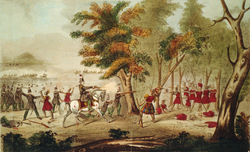
In 1811, Harrison led a military force against Tecumseh's confederacy at the Battle of Tippecanoe, for which he earned the nickname 'Old Tippecanoe'. The dispute was the catalyst of a disagreement between Harrison and the Department of War that continued into the War of 1812.
Image source: Battle of Tippecanoe
Jun 18, 1812
% complete
Congress declared war on June 18, 1812, and Harrison left Vincennes to seek a military appointment. He was promoted to major general in the Army during the War of 1812, and the outbreak of war with the British led to continued conflict with Indians in the Northwest.
Image source: War of 1812
Oct 5, 1813
% complete
Harrison received reinforcements in 1813, took the offensive, and led American infantry and cavalry north to battle. His army defeated the British, and Tecumseh was killed, on October 5, 1813, at the Battle of the Thames in Upper Canada.
Image source: Battle of the Thames
1814
% complete
Secretary of War John Armstrong Jr. clashed with Harrison, and he resigned from the army in 1814, shortly before the conclusion of the War of 1812, returning to his family and farm in North Bend, Ohio.
Jul 1, 1798
% complete
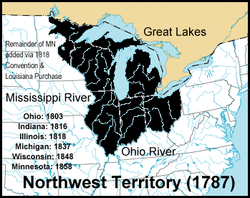
President John Adams appointed Harrison as secretary of the Northwest Territory in July 1798, marking the beginning of his political career after he campaigned among friends and family for a post in the territorial government.
Image source: Northwest Territory
Mar 4, 1799 - May 14, 1800
% complete
The Northwest Territory's population reached a sufficient number to have a congressional delegate in October 1799, and Harrison ran for election, becoming the territory's first delegate at age 26. He served in the Sixth United States Congress from March 4, 1799, to May 14, 1800.
1800
% complete
As chairman of the Committee on Public Lands, Harrison promoted the Land Act of 1800, which made it easier to buy Northwest Territory land in smaller tracts at a lower cost. The Indiana Territory was formally established by law that year.
Image source: Land Tax (England)
May 13, 1800
% complete
On May 13, 1800, President John Adams appointed Harrison as governor of the Indiana Territory, based on his ties to the west and his apparent neutral political stances. His governorship was confirmed by the Senate and he resigned from Congress to become the first Indiana territorial governor in 1801.
Jan 10, 1801
% complete
Harrison began his duties on January 10, 1801, at Vincennes, the capital of the Indiana Territory. He founded a university at Vincennes in 1801, which was incorporated as Vincennes University on November 29, 1806.
Image source: Vincennes, Indiana
1803 - 1809
% complete
Through multiple treaties with American Indian tribes, Harrison acquired millions of acres for the nation. In 1805 alone, he succeeded in acquiring as many as 51,000,000 acres after plying five chiefs with alcohol, comprising two-thirds of Illinois and sizable chunks of Wisconsin and Missouri. The Treaty of Grouseland (1805) appeased some Indians, and the Treaty of Fort Wayne (1809) purchased more than 2.5 million acres from the Potawatomi, Delaware, Miami, and Eel River tribes, raising new tensions along the frontier.
Image source: Treaty of Fort Wayne (1809)
1803 - 1807
% complete
In 1803, Harrison lobbied Congress to temporarily suspend for ten years Article VI of the Northwest Ordinance prohibiting slavery in the Indiana Territory. Lacking that suspension, in 1807 the territorial legislature enacted laws authorizing indentured servitude. He also donated $100 in 1806 and $20 in 1808 to support Lemen's abolition efforts and fund Bethel Baptist Church.
Image source: Northwest Ordinance
1803 - 1809
% complete
Presidents Thomas Jefferson and James Madison, both Democratic-Republicans, reappointed Harrison as governor of the Indiana Territory in 1803, 1806, and 1809.
1804 - Jul 4, 1805
% complete
In 1804, Harrison was assigned to administer the civilian government of the District of Louisiana. He conducted the district's affairs for five weeks until the Louisiana Territory was formally established on July 4, 1805, when Brigadier General James Wilkinson assumed the duties of governor.
Image source: District of Louisiana
1805
% complete
In 1805, Harrison built a plantation-style home near Vincennes that he named Grouseland, in tribute to the birds on the property.
Image source: Grouseland
1810
% complete
After the Indiana Territory held elections for its legislature in 1809, the Territory's general assembly convened in 1810, and its anti-slavery faction immediately repealed the indenturing laws previously enacted. After 1809, the legislature assumed more authority and the territory advanced toward statehood.
Image source: Indiana Territory
Aug 1, 1810
% complete
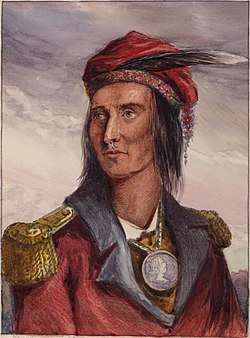
In August 1810, Tecumseh led 400 warriors down the Wabash River to meet with Harrison in Vincennes amid rising tensions over land cessions. Tecumseh was traveling in 1811, leaving Tenskwatawa in charge of Indian forces.
Image source: Tecumseh
Jun 1, 1815
% complete
President Madison appointed Harrison in June 1815 to help negotiate a second treaty with the Indians known as the Treaty of Springwells, in which the tribes ceded a large tract of land in the west, providing additional land for American purchase and settlement.
Image source: Treaty of Spring Wells
1816 - 1819
% complete
After moving to Ohio, Harrison was elected in 1816 to complete John McLean's term in the House of Representatives, representing Ohio's 1st congressional district until 1819. In May 1817, he served as one of the founding vestry members of Christ Church Episcopal congregation in downtown Cincinnati.
Image source: United States House of Representatives
1819 - 1821
% complete
Harrison was elected to the Ohio Senate in 1819 and served until 1821, having lost the election for Ohio governor in 1820. He ran again for the House in 1822 but lost to James W. Gazlay.
Image source: 2026 United States Senate special election in Ohio
1824 - 1828
% complete
In 1824, Harrison was elected to the U.S. Senate, where he served until his appointment as minister plenipotentiary cut his Senate term short in 1828.
Image source: United States Senate
Dec 22, 1828 - Mar 8, 1829
% complete
Harrison resigned from Congress and was appointed minister plenipotentiary to Gran Colombia in 1828. He arrived in Bogotá on December 22, 1828, finding the condition of Colombia saddening. Andrew Jackson recalled him upon taking office in March 1829 to make his own appointment, and Harrison returned to private life in Ohio.
Image source: Gran Colombia
1836
% complete
Harrison was the western Whig candidate for president in 1836, one of four Whig Party nominees. Local supporters had appointed him Clerk of Courts for Hamilton County, where he worked until 1840. In an address to the Hamilton County Agricultural Board in 1831, he said he had sinned in making whiskey and hoped others would stop producing liquor.
Image source: 1836 United States presidential election
Nov 1, 1840
% complete
In the 1840 presidential election, the Whigs nominated Harrison again, with John Tyler as running mate, under the slogan 'Tippecanoe and Tyler Too', and Harrison defeated Van Buren, whose administration was blamed for the economic crisis caused by the Panic of 1837. Democrats ridiculed him as 'Granny Harrison, the petticoat general'. In June 1840, a Harrison rally at the site of the Tippecanoe battle drew 60,000 people.
Image source: 1840 United States presidential election
Mar 4, 1841
% complete
Harrison took the oath of office on March 4, 1841, a cold and wet day. Following his speech, he rode through the streets in the inaugural parade, stood in a three-hour receiving line at the White House, and attended three inaugural balls, including the 'Tippecanoe' ball at Carusi's Saloon with 1,000 guests who had paid $10 per person.
Image source: Inauguration of William Henry Harrison
Mar 24, 1841
% complete
Three weeks after taking office, on March 24, 1841, Harrison took his daily morning walk to local markets without a coat or hat and fell seriously ill nine days before his death.
Apr 4, 1841
% complete
Harrison died on April 4, 1841, exactly one month after taking the oath of office, becoming the first president to die in office. A 2014 analysis by Mackowiak concluded he likely died of septic shock due to enteric fever (typhoid or paratyphoid fever) from contaminated White House water downstream of public sewage. He died nearly penniless, and Congress voted Anna a presidential widow's pension of $25,000, one year of his salary.
Image source: William Henry Harrison
Apr 6, 1841 - May 31, 1841
% complete
Vice President Tyler obliged and was sworn into office on April 6, 1841. On May 31, 1841, Congress passed a joint resolution confirming Tyler as president for the remainder of Harrison's term. This succession became the Tyler Precedent, followed on seven occasions until codified in the Twenty-fifth Amendment in 1967.
Image source: Tyler Precedent
Or browse the full history timeline directory, with more than 2,000 topics.
This William Henry Harrison timeline was generated with the help of AI, using information found on the internet.
We work hard to keep these timelines accurate, but mistakes do get through. If you spot one, email us at [email protected] and we'll fix it for future visitors.
Generate yours with AI or build it from scratch, for free.
Export your timeline, add your own events, edit or remove AI-generated events, and much more
No credit card required.
Cancel anytime.
Cancel anytime.
You can create an unlimited number of timelines with up to 10 events on each one, customize how they look, export them to PDF, PNG, PowerPoint, CSV, and Excel, and share them with a link. Paid plans raise the event limit and add features like spreadsheet imports and collaborators.
Yes. You can cancel your subscription from your account page at any time, and you will not be charged again. Your subscription stays active for the rest of the period you already paid for.
Yes. We will email you a reminder before the annual renewal, and we will also email you a receipt.
Yes. You can email us within 15 days of any payment, and we will issue you a full refund.
Check out our pricing docs or send us an email anytime: [email protected].