-
Use Cases
-
Resources
-
Pricing
Pablo Picasso (1881–1973) was a Spanish painter, sculptor, and printmaker widely regarded as one of the most influential artists of the 20th century. Co-founder of Cubism, he created thousands of works across multiple styles, including the iconic painting 'Guernica,' and profoundly shaped the course of modern art. More Less
Oct 25, 1881
% complete
Pablo Diego José Francisco de Paula Juan Nepomuceno María de los Remedios Cipriano de la Santísima Trinidad Ruiz y Picasso was born in Málaga, Spain. He showed an extraordinary talent for drawing from a very young age, encouraged by his father, who was a painter and art teacher.
Image source: Pablo Picasso
1889
% complete
At just seven years old, Picasso completed his first known oil painting, 'Le Picador', depicting a bullfighter on horseback. The work demonstrated his precocious talent and his early fascination with Spanish bullfighting culture.
1891
% complete
Picasso's family relocated to A Coruña in northern Galicia, where his father took a position at the School of Fine Arts. Young Pablo began formal artistic training and produced his earliest serious drawings and paintings.
1895
% complete
After the death of his sister Conchita, Picasso's family moved to Barcelona, where he gained admission to the prestigious La Llotja art academy despite his young age. He quickly outpaced many older students with his technical skill.
Oct 1, 1897
% complete
Picasso enrolled at Spain's most prestigious art school in Madrid at age 16, but he soon became disillusioned with formal instruction and spent much of his time studying masterpieces at the Prado Museum instead.
Image source: Real Academia de Bellas Artes de San Fernando
Feb 1, 1900
% complete
Picasso held his first solo exhibition at the famous Els Quatre Gats café in Barcelona, a gathering place for avant-garde artists. This introduced him to modernist ideas and helped launch his professional career.
Image source: Els Quatre Gats
Oct 1, 1900
% complete
Picasso made his first visit to Paris, the center of the European art world, alongside friend Carles Casagemas. He was exposed to the work of Impressionist and Post-Impressionist masters such as Van Gogh, Toulouse-Lautrec, and Degas.
1901 - 1904
% complete
Following the suicide of his close friend Carles Casagemas, Picasso entered his Blue Period, producing melancholic paintings in shades of blue and blue-green depicting poverty, loneliness, and despair, including works like 'The Old Guitarist'.
Image source: Picasso's Blue Period
1904 - 1906
% complete
Settling permanently in Paris at the Bateau-Lavoir studio in Montmartre, Picasso shifted to warmer pinks and oranges in his Rose Period, featuring circus performers, harlequins, and acrobats, reflecting a more optimistic mood.
Image source: Picasso's Rose Period
1908 - 1912
% complete
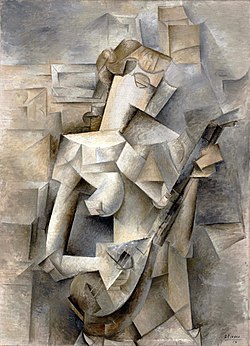
Working closely with Georges Braque, Picasso developed Analytic Cubism, breaking objects down into geometric forms and multiple viewpoints simultaneously, radically transforming the course of Western art.
Image source: Cubism
1918 - 1924
% complete
Following World War I, Picasso turned to a neoclassical style inspired by classical antiquity and Ingres, producing monumental figures with sculptural solidity, while also continuing his Cubist experiments.
1925 - 1930
% complete
Picasso engaged with the Surrealist movement led by André Breton, creating distorted, dreamlike figures and violently expressive imagery that reflected his personal turmoil and interest in the subconscious.
Image source: Surrealism
1930 - 1932
% complete
At the Château de Boisgeloup purchased near Paris, Picasso devoted himself to large-scale plaster sculpture, creating monumental heads of his mistress Marie-Thérèse Walter and exploring new three-dimensional forms.
Jul 1, 1946 - 1954
% complete
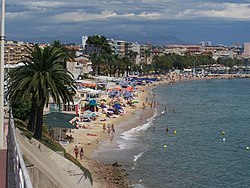
Picasso began working with clay at the Madoura pottery workshop in Vallauris in southern France, ultimately producing thousands of ceramic pieces that revitalized the local pottery industry and blended painting with craft traditions.
Image source: Vallauris
1907
% complete
Picasso painted his revolutionary work 'Les Demoiselles d'Avignon', featuring fragmented, angular figures influenced by Iberian sculpture and African masks. The painting shocked even his closest friends and laid the groundwork for Cubism.
Image source: Les Demoiselles d'Avignon
May 1, 1912
% complete
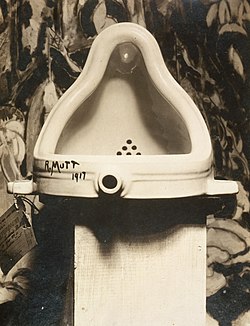
Picasso created one of the first collages by pasting oilcloth printed with a chair caning pattern onto a canvas, pioneering Synthetic Cubism and introducing real-world materials into fine art.
Image source: Found object
May 18, 1917
% complete
Picasso traveled to Rome to design sets and costumes for Sergei Diaghilev's Ballets Russes production of Erik Satie's 'Parade'. During this period he met dancer Olga Khokhlova, whom he would later marry.
Image source: Parade (ballet)
1930 - 1937
% complete
Over seven years Picasso produced 100 etchings known as the Vollard Suite, exploring themes including the sculptor's studio, the Minotaur myth, and his relationship with Marie-Thérèse Walter.
Image source: Vollard Suite
Mar 14, 1932
% complete
During a prolific period, Picasso painted 'Girl before a Mirror', a vibrant portrait of Marie-Thérèse Walter rendered in bold colors that explored themes of youth, vanity, and mortality through mirrored reflections.
Image source: Girl before a Mirror
May 1, 1937 - Jun 4, 1937
% complete
In response to the Nazi bombing of the Basque town of Guernica, Picasso created his monumental mural in black, white, and gray. It became one of the most powerful anti-war artworks ever made and toured internationally to raise awareness.
Image source: Guernica (Picasso)
Jan 18, 1951
% complete
Picasso painted this anti-war work condemning the Korean War, depicting armed soldiers facing naked women and children. It echoed the composition of 'Guernica' and Goya's 'Third of May 1808'.
Image source: Massacre in Korea
Jul 12, 1918
% complete
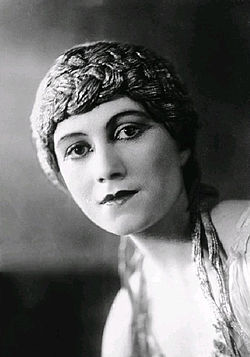
Picasso married Russian ballerina Olga Khokhlova in Paris. The couple moved into an elegant apartment and their son Paulo was born in 1921, though the marriage eventually deteriorated.
Image source: Olga Khokhlova
Jul 18, 1936 - Apr 1, 1939
% complete
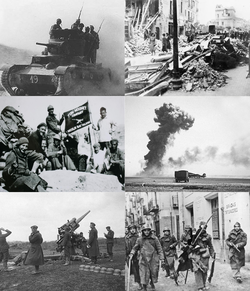
The outbreak of the Spanish Civil War deeply affected Picasso, who remained committed to the Republican cause. The conflict would directly inspire his most famous political work, 'Guernica'.
Image source: Spanish Civil War
Sep 3, 1939 - Aug 25, 1944
% complete
Unlike many artists who fled, Picasso remained in German-occupied Paris throughout World War II. His style darkened during this time, and he continued painting works including 'The Charnel House', reflecting wartime suffering.
1943 - 1953
% complete
Picasso met young painter Françoise Gilot, who became his companion and muse for nearly a decade. She bore two of his children, Claude and Paloma, before leaving him in 1953, later writing the memoir 'Life with Picasso'.
Image source: Françoise Gilot
1944
% complete
Following the liberation of Paris, Picasso joined the French Communist Party and remained a member until his death, participating in peace movements and international communist congresses throughout the postwar era.
Image source: French Communist Party
1955
% complete
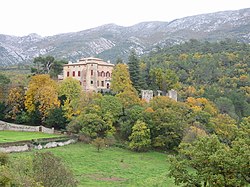
Picasso moved into Villa La Californie in Cannes with Jacqueline Roque, whom he married in 1961. From there he produced variations on masterpieces by Velázquez, Delacroix, and Manet.
Image source: Château of Vauvenargues
1956
% complete
Major retrospective exhibitions were held around the world honoring Picasso's extraordinary career, cementing his status as the most celebrated living artist and drawing massive international audiences.
1968 - Apr 8, 1973
% complete
In his final years Picasso worked with astonishing energy, producing hundreds of paintings, prints, and drawings characterized by raw, sexually charged imagery that anticipated Neo-Expressionism decades later.
Image source: Guernica (Picasso)
Apr 8, 1973
% complete
Picasso died of pulmonary edema at his estate Notre-Dame-de-Vie in Mougins, France, at age 91. He left behind tens of thousands of works, and his legacy continues to profoundly influence modern and contemporary art.
Or browse the full history timeline directory, with more than 2,000 topics.
This Pablo Picasso timeline was generated with the help of AI, using information found on the internet.
We work hard to keep these timelines accurate, but mistakes do get through. If you spot one, email us at [email protected] and we'll fix it for future visitors.
Generate yours with AI or build it from scratch, for free.
Export your timeline, add your own events, edit or remove AI-generated events, and much more
No credit card required.
Cancel anytime.
Cancel anytime.
You can create an unlimited number of timelines with up to 10 events on each one, customize how they look, export them to PDF, PNG, PowerPoint, CSV, and Excel, and share them with a link. Paid plans raise the event limit and add features like spreadsheet imports and collaborators.
Yes. You can cancel your subscription from your account page at any time, and you will not be charged again. Your subscription stays active for the rest of the period you already paid for.
Yes. We will email you a reminder before the annual renewal, and we will also email you a receipt.
Yes. You can email us within 15 days of any payment, and we will issue you a full refund.
Check out our pricing docs or send us an email anytime: [email protected].