-
Use Cases
-
Resources
-
Pricing
Leonardo da Vinci (1452–1519) was an Italian Renaissance polymath whose genius spanned painting, sculpture, anatomy, engineering, architecture, and science. Born in Vinci, Tuscany, he created some of the world's most famous artworks, including the Mona Lisa and The Last Supper, while also designing visionary machines centuries ahead of their time. His notebooks reveal relentless curiosity about nature, the human body, flight, and mechanics, making him the quintessential 'Renaissance man.' More Less
Apr 15, 1452
% complete
Leonardo di ser Piero da Vinci was born on 15 April 1452 in, or close to, the Tuscan hill town of Vinci, about 35 kilometres from Florence. He was born out of wedlock to Piero da Vinci, a Florentine legal notary, and Caterina di Meo Lippi, from the lower class.
Image source: Leonardo da Vinci
1453
% complete
Having been betrothed to her the previous year, Leonardo's father Ser Piero married Albiera Amadori. After her death in 1464, he went on to have three subsequent marriages.
1457
% complete
Tax records indicate that by at least 1457 Leonardo lived in the household of his paternal grandfather, Antonio da Vinci, though it is possible he spent earlier years in the care of his mother in Vinci, either in Anchiano or Campo Zeppi in the parish of San Pantaleone.
1469
% complete
Ser Piero, a descendant of a long line of notaries, established an official residence in Florence by at least 1469 and had a successful career there.
1476
% complete
Court records show that in 1476, when Leonardo was aged twenty-four, he and three other young men were charged with sodomy in an incident involving a known male prostitute. It has been claimed since the 16th century that his relationships were of a sexual or erotic nature.
1480
% complete
An anonymous early biographer, Anonimo Gaddiano, claims that in 1480 Leonardo was living with the Medici and often worked in the garden of the Piazza San Marco in Florence, where a Neoplatonic academy of artists, poets and philosophers organised by the Medici met.
Image source: House of Medici
1482
% complete
In 1482, Leonardo was sent as an ambassador by Lorenzo de' Medici to Ludovico il Moro, who ruled Milan between 1479 and 1499. In a letter to Ludovico he wrote that he could create all sorts of machines both for the protection of a city and for siege. Leonardo worked in Milan from 1482 until 1499.
Image source: Ludovico Sforza
1485
% complete
In the spring of 1485, Leonardo travelled to Hungary on behalf of the Sforza to meet King Matthias Corvinus, and was commissioned by him to paint a Madonna.
Image source: Matthias Corvinus
1490
% complete
Salaì, or Il Salaino ('The Little Unclean One'), entered Leonardo's household in 1490 as an assistant. He became one of Leonardo's most enduring companions.
Image source: Salaì
1500
% complete
When Ludovico Sforza was overthrown by France in 1500, Leonardo fled Milan for Venice, accompanied by his assistant Salaì and friend, the mathematician Luca Pacioli. There he found employment as an engineer and devised a system of moveable barricades to protect the city from attack.
1502
% complete
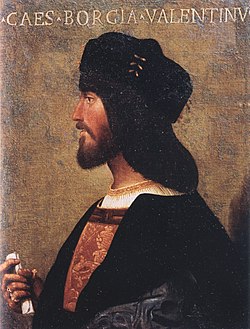
In Cesena in 1502, Leonardo entered the service of Cesare Borgia, the son of Pope Alexander VI, acting as a military architect and engineer and travelling throughout Italy with his patron. That year he also created a scheme for diverting the flow of the Arno river, a project Niccolò Machiavelli also worked on.
Image source: Cesare Borgia
1506
% complete
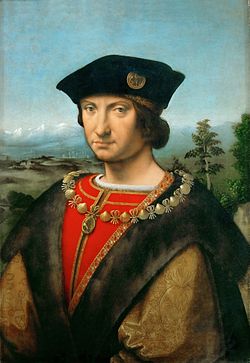
In 1506, Leonardo was summoned to Milan by Charles II d'Amboise, the acting French governor of the city. In 1507 he was in Florence sorting out a dispute with his brothers over the estate of his father, who had died in 1504, and by 1508 he was back in Milan, living in his own house in Porta Orientale.
Image source: Charles II d'Amboise
Sep 1513 - 1516
% complete
In March 1513, Lorenzo de' Medici's son Giovanni assumed the papacy as Leo X; Leonardo went to Rome that September, where he was received by the pope's brother Giuliano. From September 1513 to 1516 he lived much of his time in the Belvedere Courtyard in the Apostolic Palace, where Michelangelo and Raphael were both active.
Image source: Pope Leo X
Oct 1515
% complete
In October 1515, King Francis I of France recaptured Milan, setting the stage for Leonardo's eventual relocation to France under royal patronage.
Image source: Francis I of France
Mar 21, 1516
% complete
On 21 March 1516 Antonio Maria Pallavicini, the French ambassador to the Holy See, received a letter from Lyon sent a week previously by royal advisor Guillaume Gouffier, seigneur de Bonnivet, containing the French king's instructions to assist Leonardo in his relocation to France and informing him that the King was eagerly awaiting his arrival. Upon Francis I's invitation, Leonardo spent his last three years in France.
Oct 1517
% complete
A visit by Louis d'Aragon in October 1517, together with Giovanni Ambrogio Figino's drawing of an elderly Leonardo with his right arm wrapped in clothing, confirms an account of Leonardo's right hand being paralytic when he was 65, possibly explaining why he left works such as the Mona Lisa unfinished.
1472
% complete
By 1472, at the age of 20, Leonardo qualified as a master in the Guild of Saint Luke, the guild of artists and doctors of medicine. Even after his father set him up in his own workshop, he continued to collaborate and live with his master Verrocchio.
Image source: Guild of Saint Luke
1472 - 1475
% complete
According to Vasari, Leonardo collaborated with Verrocchio on The Baptism of Christ, painting the young angel holding Jesus's robe with skill so far superior to his master's that Verrocchio purportedly put down his brush and never painted again, though this claim is probably apocryphal.
Image source: The Baptism of Christ (Verrocchio and Leonardo)
Aug 5, 1473
% complete
Leonardo's earliest known dated work is a 1473 pen-and-ink drawing of the Arno valley, which shows the river, the mountains, Montelupo Castle and the farmlands beyond it in great detail.
Image source: Santa Maria del Popolo
Jan 1478
% complete
In January 1478, Leonardo received an independent commission to paint an altarpiece for the Chapel of Saint Bernard in the Florentine town hall, the Palazzo della Signoria, indicating his independence from Verrocchio's studio.
Image source: Palazzo Vecchio
1479
% complete
A macabre sketch done by Leonardo in Florence in 1479 shows the body of Bernardo Baroncelli, hanged in connection with the murder of Giuliano de' Medici in the Pazzi conspiracy.
Image source: Bernardo Bandini Baroncelli
Mar 1481
% complete
In March 1481, Leonardo received a commission from the monks of San Donato in Scopeto for The Adoration of the Magi. In 1482 he went to Milan at the behest of Lorenzo de' Medici, and the painting was abandoned.
Image source: Adoration of the Magi (Leonardo)
1483 - 1490
% complete
Leonardo's most remarkable portrait of this Milanese period is the Lady with an Ermine, presumed to depict Cecilia Gallerani, lover of Ludovico Sforza.
Image source: Lady with an Ermine
Nov 1494
% complete
Leonardo completed a model for the colossal equestrian horse and made detailed plans for its casting, but in November 1494 Ludovico gave the metal to his brother-in-law to be used for a cannon to defend the city from Charles VIII of France.
Image source: Leonardo's horse
1498
% complete
Toward the end of his Milanese period, in 1498, Leonardo painted his trompe-l'œil decoration of the Sala delle Asse for the Duke of Milan in the Castello Sforzesco.
Image source: Sala delle Asse
Oct 18, 1503
% complete
Leonardo had left Borgia's service and returned to Florence by early 1503, where he rejoined the Guild of Saint Luke on 18 October of that year.
Jan 1504
% complete
In January 1504, Leonardo was part of a committee formed to recommend where Michelangelo's statue of David should be placed in Florence.
Image source: David (Michelangelo)
1505
% complete
In 1505, Leonardo was commissioned to paint The Battle of Anghiari in the Salone dei Cinquecento in the Palazzo Vecchio, Florence. He devised a dynamic composition depicting four men riding raging war horses engaged in a battle for possession of a standard at the Battle of Anghiari in 1440.
Image source: The Battle of Anghiari (Leonardo)
1512
% complete
In 1512, Leonardo was working on plans for an equestrian monument for Gian Giacomo Trivulzio, but this was prevented by an invasion of a confederation of Swiss, Spanish and Venetian forces which drove the French from Milan. Leonardo stayed in the city, spending several months of 1513 at the Medici's Vaprio d'Adda villa.
Image source: Gian Giacomo Trivulzio
1490
% complete
In 1490 Leonardo was called as a consultant, together with Francesco di Giorgio Martini, for the building site of the cathedral of Pavia, and was struck by the equestrian statue of Regisole, of which he left a sketch.
Image source: Regisole
1493
% complete
In his notebooks, Leonardo first stated the 'laws' of sliding friction in 1493. His results were never published, and the friction laws were not rediscovered until 1699 by Guillaume Amontons, with whose name they are now usually associated.
Image source: Tribology
1505
% complete
Leonardo was fascinated by flight for much of his life, producing many studies including Codex on the Flight of Birds (c. 1505), as well as plans for flying machines such as a flapping ornithopter and a machine with a helical rotor.
Image source: Codex on the Flight of Birds
1509
% complete
In the 1490s Leonardo studied mathematics under Luca Pacioli and prepared a series of drawings of regular solids in skeletal form to be engraved as plates for Pacioli's book Divina proportione, published in 1509.
Image source: Divina proportione
1510 - 1511
% complete
From 1510 to 1511 Leonardo collaborated in his anatomy studies with the doctor Marcantonio della Torre, professor of Anatomy at the University of Pavia.
Image source: Marcantonio della Torre
May 2, 1519
% complete
Leonardo died at Clos Lucé on 2 May 1519 at the age of 67, possibly of a stroke.
Aug 12, 1519
% complete
On 12 August 1519, Leonardo's remains were interred in the Collegiate Church of Saint Florentin at the Château d'Amboise. Much of the château was damaged during the French Revolution, leading to the church's demolition in 1802, and the current location of his remains is unclear.
1524
% complete
At the time of his death in 1524, Salaì owned a painting referred to as Joconda in a posthumous inventory of his belongings; it was assessed at 505 lire, an exceptionally high valuation for a small panel portrait, likely referring to the Mona Lisa.
Image source: Mona Lisa
1550
% complete
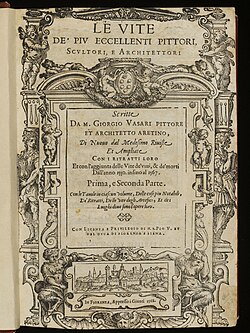
Giorgio Vasari's frequently apocryphal biography of Leonardo appeared in Lives of the Most Excellent Painters, Sculptors, and Architects (1550). Very little is known about Leonardo's childhood, and much is shrouded in myth partly because of this work.
Image source: Lives of the Most Excellent Painters, Sculptors, and Architects
1570
% complete
After Melzi's death in 1570, Leonardo's collection passed to his son, the lawyer Orazio, who initially took little interest in the journals. Some drawings were copied by an anonymous Milanese artist for a planned treatise (Codex Huygens, c. 1570), and in 1587 a household tutor named Lelio Gavardi took 13 manuscripts to Pisa before they were returned.
Image source: Francesco Melzi
1651 - 1724
% complete
Aspects of Leonardo's work on studies of anatomy, light and landscape were assembled by Melzi for publication and eventually published as A Treatise on Painting in France and Italy in 1651 and Germany in 1724, with engravings based on drawings by Nicolas Poussin.
Image source: A Treatise on Painting
1863
% complete
In 1863, fine-arts inspector general Arsène Houssaye received an imperial commission to excavate the site and discovered a partially complete skeleton with a bronze ring on one finger, white hair, and stone fragments bearing inscriptions interpreted as forming 'Leonardus Vinci'. The remains were re-interred in the chapel of Saint Hubert in 1874.
1910
% complete
The admiration for Leonardo's genius revived in the 19th century, notably by writers like Henry Fuseli in 1801, and was renewed in the 20th century most famously by Sigmund Freud in his Leonardo da Vinci, A Memory of His Childhood.
Image source: Leonardo da Vinci, A Memory of His Childhood
1925
% complete
In 1925, Houssaye's great-grandson sold the ring and a lock of hair kept by Houssaye to an American collector. Sixty years later another American acquired them, leading to their display at the Leonardo Museum in Vinci beginning on 2 May 2019, the 500th anniversary of the artist's death.
2016 - 2021
% complete
In 2016, it was announced that DNA tests would be conducted to determine whether the attribution of the excavated remains is correct. More than a decade of analysis of Leonardo's genetic genealogy by Alessandro Vezzosi and Agnese Sabato came to a conclusion in mid-2021, and in 2019 documents revealed that Houssaye had kept the ring and a lock of hair.
Nov 2017
% complete
In 2017, Salvator Mundi, attributed in whole or part to Leonardo, was sold at auction for US$450.3 million, setting a new record for the most expensive painting ever sold at public auction.
Image source: Salvator Mundi (Leonardo)
Nov 2019 - Feb 2020
% complete
On the 500th anniversary of Leonardo's death, the Louvre in Paris arranged for the largest ever single exhibit of his work, called Leonardo, running between November 2019 and February 2020.
Or browse the full history timeline directory, with more than 2,000 topics.
This Leonardo da Vinci timeline was generated with the help of AI, using information found on the internet.
We work hard to keep these timelines accurate, but mistakes do get through. If you spot one, email us at [email protected] and we'll fix it for future visitors.
Generate yours with AI or build it from scratch, for free.
Export your timeline, add your own events, edit or remove AI-generated events, and much more
No credit card required.
Cancel anytime.
Cancel anytime.
You can create an unlimited number of timelines with up to 10 events on each one, customize how they look, export them to PDF, PNG, PowerPoint, CSV, and Excel, and share them with a link. Paid plans raise the event limit and add features like spreadsheet imports and collaborators.
Yes. You can cancel your subscription from your account page at any time, and you will not be charged again. Your subscription stays active for the rest of the period you already paid for.
Yes. We will email you a reminder before the annual renewal, and we will also email you a receipt.
Yes. You can email us within 15 days of any payment, and we will issue you a full refund.
Check out our pricing docs or send us an email anytime: [email protected].