-
Use Cases
-
Resources
-
Pricing
Raphael (Raffaello Sanzio da Urbino) was an Italian painter and architect of the High Renaissance, celebrated alongside Michelangelo and Leonardo da Vinci as one of the great masters of his era. Renowned for works such as The School of Athens and the Raphael Rooms in the Vatican, he combined grace, clarity, and harmonious composition to define Renaissance ideals before his early death at age 37. More Less
Mar 28, 1483
% complete
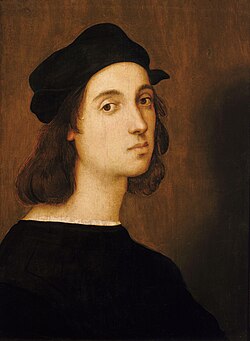
Raffaello Sanzio da Urbino, now generally known as Raphael, was born on March 28 or April 6, 1483 in Urbino. According to Vasari, he was born on Good Friday, which in 1483 fell on March 28.
Image source: Raphael
1491
% complete
Raphael's mother Màgia died in 1491 when he was only eight years old, followed a few years later by his father, who had already remarried.
Aug 1, 1494
% complete
Raphael's father died on August 1, 1494, leaving the eleven-year-old Raphael orphaned. His father had been a painter at the court of Urbino.
1495 - 1500
% complete
An alternative theory holds that Raphael received at least some training from Timoteo Viti, who acted as court painter in Urbino from 1495. Luca Signorelli, based in nearby Città di Castello until 1498, may also have influenced him.
1500
% complete
Most modern historians agree that Raphael worked as an assistant to Pietro Perugino from around 1500. Perugino's influence on his early work was very clear: 'probably no other pupil of genius has ever absorbed so much of his master's teaching as Raphael did,' according to Wölfflin.
1500 - 1501
% complete
The Baronci Altarpiece was commissioned in 1500 and finished in 1501. It was among Raphael's earliest documented commissions; today only some cut sections and a preparatory drawing remain.
Image source: Baronci Altarpiece
Dec 1500
% complete
In December 1500, Raphael was described as a 'master', meaning he was considered fully trained, despite being only seventeen years old.
1502
% complete
In 1502 Raphael went to Siena at the invitation of Pinturicchio, another pupil of Perugino, who knew him to be 'a draughtsman of the highest quality', to help with cartoons and designs for a fresco series in the Piccolomini Library of Siena Cathedral.
1503
% complete
Raphael produced important early works for Città di Castello, such as the Mond Crucifixion (c. 1503), for Perugia such as the Oddi Altarpiece, and the Brera Marriage of the Virgin (1504).
1504 - 1508
% complete
Castiglione moved to Urbino in 1504, when Raphael was no longer based there but frequently visited, and they became good friends. Castiglione later depicted Urbino court life as a model of Italian humanist virtues in The Book of the Courtier, published in 1528.
Image source: Baldassare Castiglione
1500 - 1506
% complete
The most striking influence on Raphael's work during these years was Leonardo da Vinci, who returned to Florence from 1500 to 1506. Leonardo's compositions and techniques profoundly shaped Raphael's development.
Image source: Leonardo da Vinci
1504 - 1508
% complete
Raphael led a 'nomadic' life working in various centres in Northern Italy but spent a good deal of time in Florence from about 1504. Though traditionally called a 'Florentine period' of about 1504–08, he was possibly never a continuous resident there.
Oct 1504
% complete
In October 1504, the mother of the next Duke of Urbino wrote a letter of recommendation to the Gonfaloniere of Florence: 'The bearer of this will be found to be Raphael, painter of Urbino, who, being greatly gifted in his profession has determined to spend some time in Florence to study.'
1505
% complete
Frescoes in Perugia of about 1505 show a new monumental quality in the figures, which may represent the influence of Fra Bartolomeo, who Vasari says was a friend of Raphael.
Image source: Fra Bartolomeo
1508
% complete
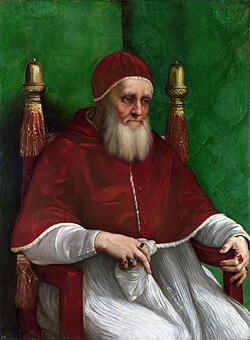
In 1508, Raphael moved to Rome at the invitation of Pope Julius II, to work on the Apostolic Palace at the Vatican, where he would reside for the rest of his life.
Image source: Pope Julius II
1510
% complete
In about 1510, Raphael was asked by Bramante to judge contemporary copies of Laocoön and His Sons, the celebrated ancient sculpture that had recently been rediscovered in Rome.
Image source: Laocoön and His Sons
1510 - 1520
% complete
Raphael made no prints himself, but entered into a collaboration with Marcantonio Raimondi to produce engravings of his designs, creating many of the most famous Italian prints of the century and playing an important role in the rise of the reproductive print.
Image source: Marcantonio Raimondi
1511
% complete
Raphael completed the first section of his Vatican work in 1511. The reaction of other artists to the daunting force of Michelangelo became the dominating question in Italian art for the following few decades.
Image source: Raphael Rooms
1513
% complete
The death of Julius II in 1513 did not interrupt the work at all, as he was succeeded by the Medici Pope Leo X, with whom Raphael formed an even closer relationship and who continued to commission him.
Image source: Pope Leo X
1514
% complete
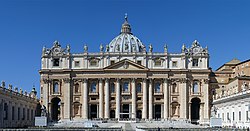
After Bramante's death in 1514, Raphael was named architect of the new St Peter's, adding major architectural responsibilities to his painting and workshop activities.
Image source: St. Peter's Basilica
1514
% complete
Raphael never married, but in 1514 became engaged to Maria Bibbiena, Cardinal Bibbiena's niece. He seems to have been talked into it by his friend the cardinal, and his lack of enthusiasm is shown by the marriage never taking place before her death in 1520.
Aug 1514
% complete
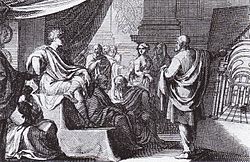
Raphael asked Marco Fabio Calvo to translate Vitruvius's Four Books of Architecture into Italian; this translation he received around the end of August 1514, supporting his growing architectural work.
Image source: Vitruvius
1515
% complete
In 1515, Raphael was given powers as Prefect over all antiquities unearthed within, or a mile outside, the city of Rome, reflecting his authority on ancient monuments.
1517 - 1520
% complete
From 1517 until his death, Raphael lived in the Palazzo Caprini, at the corner between piazza Scossacavalli and via Alessandrina in the Borgo, in rather grand style in a palace designed by Bramante.
Image source: Palazzo Caprini
1519
% complete
According to Marino Sanuto the Younger's diary, in 1519 Raphael offered to transport an obelisk from the Mausoleum of Augustus to St Peter's, demonstrating his engagement with Rome's ancient monuments.
Image source: Mausoleum of Augustus
1520
% complete
Maria Bibbiena, Raphael's fiancée, died in 1520 before their marriage ever took place, confirming what many saw as Raphael's lack of enthusiasm for the engagement arranged by her uncle, Cardinal Bibbiena.
Apr 6, 1520
% complete
Raphael died on Good Friday, 6 April 1520, which was possibly his 37th birthday. He was still at the height of his powers at his death. Vasari says he had also been born on a Good Friday and attributed his death to exhaustion brought on by unceasing romantic interests while working on the Loggia.
1520
% complete
It is possible that Raphael saw the finished series of his works before his death—they were probably completed in 1520. His workshop team added a fourth room to the Vatican apartments after his early death, probably only including some elements designed by Raphael.
1520 - 1700
% complete
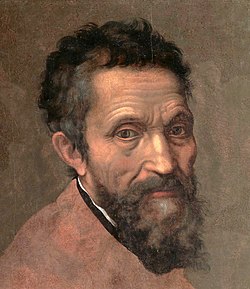
After Raphael's death, the influence of his great rival Michelangelo exceeded his until the 18th and 19th centuries, when Raphael's more serene and harmonious qualities were again regarded as the highest models.
Image source: Michelangelo
1527
% complete
After Raphael's death, most of the artists of his great workshop were later scattered, and some killed, by the violent Sack of Rome in 1527, ending one of the most influential artistic workshops in history.
Image source: Sack of Rome (1527)
1528
% complete
Court life in Urbino became established as the model of the virtues of the Italian humanist court through Baldassare Castiglione's depiction of it in his classic work The Book of the Courtier, published in 1528, immortalizing the world Raphael came from.
Image source: The Book of the Courtier
1550
% complete
The opinion generally held in the middle of the sixteenth century was that Raphael was the ideal balanced painter, universal in his talent and satisfying all absolute standards, whereas Michelangelo was seen as an eccentric genius, brilliant but unbalanced.
1675 - 1875
% complete
Raphael's period of greatest influence was from the late 17th to late 19th centuries, when his perfect decorum and balance were greatly admired, making him the supreme model for academic art across Europe.
1800 - 1900
% complete
Reynolds was less enthusiastic about Raphael's panel paintings, but their slight sentimentality made them enormously popular in the 19th century. As Wölfflin wrote of Raphael's Madonnas: 'We have been familiar with them from childhood onwards, through a far greater mass of reproductions than any other artist in the world has ever had...'
1810 - 1900
% complete
In Germany, Raphael had an immense influence on the religious art of the Nazarene movement and the Düsseldorf school of painting in the 19th century, whose artists revered his serene harmonies as models of Christian art.
Image source: Nazarene movement
1900
% complete
By 1900, Raphael's popularity was surpassed by Michelangelo and Leonardo, perhaps as a reaction against the etiolated Raphaelism of 19th-century academic artists such as Bouguereau, marking a shift in critical taste away from his idealized harmony.
1952
% complete
Although art historian Bernard Berenson in 1952 termed Raphael the 'most famous and most loved' master of the High Renaissance, art historians Leopold and Helen Ettlinger noted that Raphael's lesser popularity in the 20th century was obvious from the contents of art library shelves.
Or browse the full history timeline directory, with more than 2,000 topics.
This Raphael timeline was generated with the help of AI, using information found on the internet.
We work hard to keep these timelines accurate, but mistakes do get through. If you spot one, email us at [email protected] and we'll fix it for future visitors.
Generate yours with AI or build it from scratch, for free.
Export your timeline, add your own events, edit or remove AI-generated events, and much more
No credit card required.
Cancel anytime.
Cancel anytime.
You can create an unlimited number of timelines with up to 10 events on each one, customize how they look, export them to PDF, PNG, PowerPoint, CSV, and Excel, and share them with a link. Paid plans raise the event limit and add features like spreadsheet imports and collaborators.
Yes. You can cancel your subscription from your account page at any time, and you will not be charged again. Your subscription stays active for the rest of the period you already paid for.
Yes. We will email you a reminder before the annual renewal, and we will also email you a receipt.
Yes. You can email us within 15 days of any payment, and we will issue you a full refund.
Check out our pricing docs or send us an email anytime: [email protected].