
-
Use Cases
-
Resources
-
Pricing
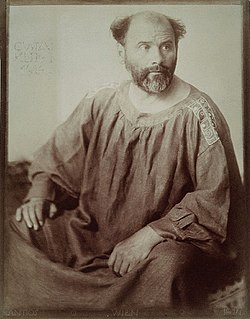
Gustav Klimt (1862–1918) was an Austrian Symbolist painter and one of the most prominent members of the Vienna Secession movement. Renowned for his gilded, decorative style and works such as 'The Kiss' and 'Portrait of Adele Bloch-Bauer I,' Klimt's art explored themes of love, sexuality, and the human condition, leaving an indelible mark on modern art. More Less
Jul 14, 1862
% complete
Gustav Klimt was born on July 14, 1862, in Baumgarten near Vienna, Austria, the second of seven children of Ernst Klimt, a gold engraver, and Anna Klimt. His father's craft would later be echoed in Klimt's famous use of gold leaf in his paintings.
Image source: Gustav Klimt
1876
% complete
At age fourteen, Klimt received a scholarship to study architectural painting at the Vienna School of Arts and Crafts (Kunstgewerbeschule), where he trained under painters Ferdinand Laufberger and later Julius Victor Berger.
Image source: University of Applied Arts Vienna
1877
% complete
Klimt joined his brother Ernst and fellow artist Franz Matsch to form a successful team of decorative painters known as the 'Company of Artists,' receiving commissions for murals and theatrical decorations across Austria.
1886 - 1888
% complete
The Klimt brothers and Matsch executed ceiling paintings for Vienna's Burgtheater. Klimt's contributions showcased his growing skill in figurative painting and helped establish his reputation in the imperial capital.
Image source: Burgtheater
1888
% complete
In recognition of his artistic achievements, particularly his mural work for the Burgtheater and Kunsthistorisches Museum, Emperor Franz Joseph I of Austria awarded Klimt the Golden Order of Merit.
Dec 1892
% complete
Klimt's younger brother Ernst died unexpectedly, a profound personal loss that coincided with the death of Klimt's father earlier that year. These events marked a turning point toward the more personal, symbolic direction of his art.
Image source: Ernst Klimt
1897
% complete
Klimt led a breakaway group of artists from the conservative Künstlerhaus, founding the Vienna Secession to promote innovative art and exhibit works by international avant-garde artists such as Rodin, Monet, and Van Gogh.
Image source: Vienna Secession
1898
% complete
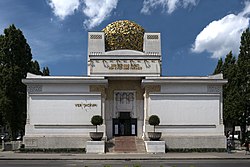
The Secession's exhibition hall, designed by Joseph Maria Olbrich and crowned with its famous golden dome of laurel leaves, opened in Vienna as a permanent home for the movement's exhibitions.
Jan 1898 - 1903
% complete
The official journal of the Vienna Secession, Ver Sacrum ('Sacred Spring'), began publication, featuring groundbreaking graphic design and illustrations by Klimt and other Secession members, uniting fine and applied arts.
Image source: Ver Sacrum (magazine)
1898
% complete
Klimt created this defiant painting of the goddess of wisdom, which served as an emblem of the Secession movement, symbolizing reason, rebellion against tradition, and the new artistic spirit.
Image source: Pallas Athena (Klimt)
1899
% complete
Klimt exhibited Nuda Veritas ('Naked Truth'), featuring a poem critical of Austrian cultural establishment, further asserting the Secession's confrontational stance toward conventional art and society.
Image source: Gustav Klimt
1901 - 1902
% complete
Klimt painted his monumental Beethoven Frieze, a seven-meter-long work inspired by Wagner's interpretation of Beethoven's Ninth Symphony, celebrating humanity's quest for happiness through art.
Image source: Beethoven Frieze
1905
% complete
Citing disagreements over exhibition strategy and commercial orientation, Klimt and his circle of supporters resigned from the Secession, marking the end of his presidency and direct involvement in the movement he co-founded.
1900
% complete
Klimt's Philosophy, the first of three university faculty paintings commissioned for the University of Vienna, was displayed at the Paris Exposition Universelle and provoked outrage in Vienna for its dark, pessimistic symbolism.
Image source: Klimt University of Vienna Ceiling Paintings
1900 - 1918
% complete
For nearly two decades Klimt spent every summer on the Attersee in the Salzkammergut region, producing more than fifty landscapes, including Birch Forest and Apple Tree I, noted for their pointillist-like texture.
Image source: Attersee (lake)
1901
% complete
The second faculty painting, Medicine, drew fierce criticism from physicians and politicians for its unflinching depiction of human suffering and the cycle of life, deepening the scandal surrounding the commission.
1903
% complete
Visits to the churches of Ravenna, Italy, exposed Klimt to the glittering gold Byzantine mosaics that profoundly influenced his so-called Golden Phase, characterized by flatness, gold leaf, and mosaic-like patterning.
1903
% complete
The third and final faculty painting, Jurisprudence, presented a nightmarish vision of judgment. The trio of paintings was never installed at the university and was ultimately destroyed by fire in 1945.
1904 - 1907
% complete
Klimt produced Water Serpents, an erotic composition of intertwined female figures amid swirling water and ornamental decoration, exemplifying the sensuality that pervaded his mature work.
Image source: Water Serpents II
1905 - 1911
% complete
Klimt accepted a major commission from banker Adolphe Stoclet, creating the Stoclet Frieze, a mosaic-inlaid decorative cycle including the famous Expectation and Fulfilment panels for Josef Hoffmann's Brussels palace.
Image source: Stoclet Palace
1905
% complete
Klimt painted the sister of philosopher Ludwig Wittgenstein, one of his celebrated society portraits combining realistic rendering of the face with elaborate decorative backgrounds typical of his Golden Period.
Image source: Margaret Stonborough-Wittgenstein
1907
% complete
Klimt finished this dazzling golden portrait of Viennese society hostess Adele Bloch-Bauer, often called the 'Woman in Gold.' It became one of his most famous works and the subject of a celebrated restitution case decades later.
Image source: Portrait of Adele Bloch-Bauer I
1908
% complete
Klimt finished The Kiss (Der Kuss), his iconic depiction of embracing lovers enveloped in shimmering gold. Purchased by the Austrian government before it was even complete, it remains one of the most beloved images in Western art.
Image source: The Kiss (Klimt)
Jun 1908 - Oct 1908
% complete
A landmark exhibition organized by Klimt's circle in Vienna displayed sixteen of Klimt's paintings, including The Kiss, alongside decorative arts and architecture, cementing his stature despite earlier scandals.
1910
% complete
Klimt exhibited Death and Life, a powerful allegory contrasting a swirling mass of living figures with a dark skeletal figure of Death. It won first prize at the 1911 International Art Exhibition in Rome.
Image source: Death and Life
1912
% complete
Klimt painted a second portrait of Adele Bloch-Bauer, abandoning gold leaf in favor of vibrant color and looser brushwork, reflecting his evolving style after the Golden Phase.
Image source: Adele Bloch-Bauer
1913
% complete
Klimt painted The Virgin (Die Jungfrau), a kaleidoscopic composition of a reclining woman surrounded by swirling robes and ornament, showcasing his late-career mastery of color and pattern.
Image source: The Maiden (Klimt)
1917 - 1918
% complete
In his final years Klimt worked on The Bride and other canvases, appointed honorary member of the Academy of Fine Arts Munich and Vienna, and continued painting portraits and allegories until his death.
Feb 6, 1918
% complete
Klimt suffered a stroke in January 1918 during the influenza epidemic, contracted pneumonia, and died on February 6, 1918. He was buried at the Hietzing cemetery in Vienna, leaving many works unfinished.
May 1945
% complete
Retreating SS forces burned Schloss Immendorf castle in Lower Austria, destroying thirteen major Klimt paintings stored there, including the three University of Vienna ceiling paintings and several landscapes.
Image source: Schloss Immendorf
Or browse the full history timeline directory, with more than 2,000 topics.
This Gustav Klimt timeline was generated with the help of AI, using information found on the internet.
We work hard to keep these timelines accurate, but mistakes do get through. If you spot one, email us at [email protected] and we'll fix it for future visitors.
Generate yours with AI or build it from scratch, for free.
Export your timeline, add your own events, edit or remove AI-generated events, and much more
No credit card required.
Cancel anytime.
Cancel anytime.
You can create an unlimited number of timelines with up to 10 events on each one, customize how they look, export them to PDF, PNG, PowerPoint, CSV, and Excel, and share them with a link. Paid plans raise the event limit and add features like spreadsheet imports and collaborators.
Yes. You can cancel your subscription from your account page at any time, and you will not be charged again. Your subscription stays active for the rest of the period you already paid for.
Yes. We will email you a reminder before the annual renewal, and we will also email you a receipt.
Yes. You can email us within 15 days of any payment, and we will issue you a full refund.
Check out our pricing docs or send us an email anytime: [email protected].