-
Use Cases
-
Resources
-
Pricing
Michelangelo Buonarroti (1475–1564) was an Italian Renaissance sculptor, painter, architect, and poet, widely regarded as one of the greatest artists of all time. This timeline traces his life, from his early apprenticeships in Florence through iconic works such as the Pietà, David, the Sistine Chapel ceiling, The Last Judgment, and his architectural designs for St. Peter's Basilica. More Less
Mar 6, 1475
% complete
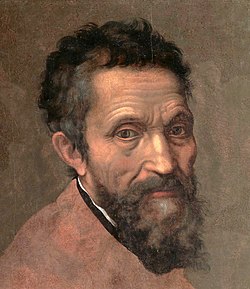
Michelangelo di Lodovico Buonarroti Simoni was born on 6 March 1475 in Caprese, known today as Caprese Michelangelo, a small town situated in Valtiberina, near Arezzo, Tuscany. He would become an Italian sculptor, painter, architect, and poet of the High Renaissance.
Image source: Michelangelo
1481
% complete
During his mother's prolonged illness and after her death in 1481, when he was six years old, Michelangelo lived with a nanny and her husband, a stonecutter, in the town of Settignano, where his father owned a marble quarry and a small farm.
1488
% complete
In 1488, at the age of 13, Michelangelo was apprenticed to the painter Domenico Ghirlandaio, beginning his formal artistic training in Florence.
1489
% complete
When in 1489 Lorenzo de' Medici, de facto ruler of Florence, asked Ghirlandaio for his two best pupils, Ghirlandaio sent Michelangelo and Francesco Granacci to the Medici court.
1490 - 1492
% complete
From 1490 to 1492, Michelangelo attended the Platonic Academy, a Humanist academy founded by the Medicis, which exposed him to Renaissance philosophy and thought.
Image source: Platonic Academy (Florence)
Apr 8, 1492
% complete
Lorenzo de' Medici's death on 8 April 1492 changed Michelangelo's circumstances, disrupting his position at the Medici court in Florence.
Image source: Lorenzo de' Medici
1495
% complete
Towards the end of 1495, the political situation in Florence was calmer; the city, previously under threat from the French, was no longer in danger as Charles VIII had suffered defeats.
1498
% complete
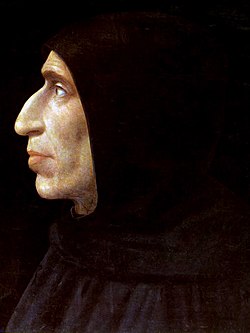
The Republic was changing after the fall of its leader, anti-Renaissance priest Girolamo Savonarola, who was executed in 1498, followed by the rise of the gonfaloniere Piero Soderini.
Image source: Girolamo Savonarola
1499
% complete
Michelangelo returned to Florence in 1499, where he would soon undertake some of his most celebrated commissions.
1527
% complete
In 1527, Florentine citizens, encouraged by the sack of Rome, threw out the Medici and restored the republic.
Image source: Siege of Florence (1529–1530)
1493
% complete
In the months following Lorenzo's death, Michelangelo carved a polychrome wooden Crucifix (1493) as a gift to the prior of the Florentine church of Santo Spirito, which had allowed him to do anatomical studies of corpses from the church's hospital.
1493 - 1494
% complete
Between 1493 and 1494, Michelangelo bought a block of marble and carved a larger-than-life statue of Hercules.
Jan 20, 1494
% complete
On 20 January 1494, after heavy snowfalls, Lorenzo's heir Piero de Medici commissioned a statue made of snow, and Michelangelo again entered the court of the Medici.
Jun 25, 1496
% complete
Michelangelo arrived in Rome on 25 June 1496 at the age of 21, marking the start of an important phase of his career in the papal city.
Nov 1497
% complete
In November 1497, the French ambassador to the Holy See, Cardinal Jean de Bilhères-Lagraulas, commissioned him to carve a Pietà, a sculpture showing the Virgin Mary grieving over the body of Jesus.
Image source: Pietà (Michelangelo)
1502
% complete
The Taddei Tondo of 1502 shows the Christ Child frightened by a Bullfinch, a symbol of the Crucifixion, and is carved in shallow relief, a technique often employed by Donatello and Desiderio da Settignano.
Image source: Taddei Tondo
1504
% complete
Michelangelo completed his most famous work, the statue of David, in 1504. It now stands in the Accademia, and in 1910 a marble replica was raised in its place in the square.
Image source: David (Michelangelo)
1505
% complete
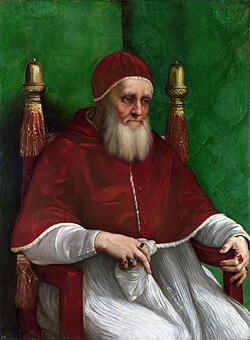
In 1505 Michelangelo was invited back to Rome by the newly elected Pope Julius II and commissioned to build the Pope's tomb, which was to include forty statues and be finished in five years.
Image source: Tomb of Pope Julius II
Apr 17, 1506
% complete
On 17 April 1506, Michelangelo left Rome in secret for Florence, remaining there until the Florentine government pressed him to return to the pope.
1516
% complete
The tomb is located in the Church of San Pietro in Vincoli in Rome and is most famous for the central figure of Moses, completed in 1516. From 1513 to 1516 Pope Leo encouraged Michelangelo to continue work on Julius's tomb before relations soured over Urbino.
Image source: Moses (Michelangelo)
1520
% complete
In 1520, the work was abruptly cancelled by his financially strapped patrons before any real progress had been made.
1504
% complete
In early 1504 Leonardo da Vinci had been commissioned to paint The Battle of Anghiari in the council chamber of the Palazzo Vecchio, depicting the battle between Florence and Milan in 1440, setting up a famous rivalry with Michelangelo's work for the same hall.
Image source: The Battle of Anghiari (Leonardo)
1508 - 1512
% complete
During this period, Michelangelo painted the ceiling of the Sistine Chapel, which took approximately four years to complete (1508–1512). The work has been described as restoring light to a world that for centuries had been plunged into darkness.
Image source: Sistine Chapel ceiling
1534
% complete
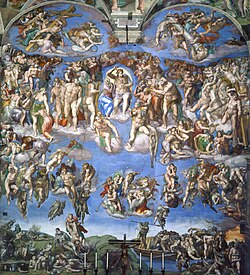
He left Florence for Rome in 1534. Shortly before his death that year, Pope Clement VII commissioned Michelangelo to paint a fresco of The Last Judgment on the altar wall of the Sistine Chapel.
1550
% complete
At the Council of Trent, shortly before Michelangelo's death in 1564, it was decided to obscure the genitals in The Last Judgment, and Daniele da Volterra, an apprentice of Michelangelo, was commissioned to make the alterations. They were completed in 1550.
Image source: The Last Judgment (Michelangelo)
1513
% complete
In 1513, Pope Julius II died and was succeeded by Pope Leo X, the second son of Lorenzo de' Medici, changing Michelangelo's patronage relationships.
Image source: Pope Julius II
1520
% complete
Also in 1520, the Medici came back to Michelangelo with another grand proposal, this time for a family funerary chapel in the Basilica of San Lorenzo.
Image source: Medici Chapels
1521
% complete
Pope Leo X died in 1521 and was succeeded briefly by the austere Adrian VI, and then by his cousin Giulio Medici as Pope Clement VII, who would become an important patron of Michelangelo.
Image source: Pope Clement VII
1524
% complete
In 1524, Michelangelo received an architectural commission from the Medici pope for the Laurentian Library at San Lorenzo's Church. The library was not opened until 1571, and the vestibule remained incomplete until 1904.
Image source: Laurentian Library
1528 - 1529
% complete
A siege of the city ensued, and Michelangelo went to the aid of his beloved Florence by working on the city's fortifications from 1528 to 1529. The city fell in 1530 and the Medici were restored to power under Alessandro Medici.
1546
% complete
In 1546 Michelangelo produced the highly complex ovoid design for the pavement of the Campidoglio and began designing an upper storey for the Farnese Palace.
Image source: Piazza del Campidoglio
1546 - 1564
% complete
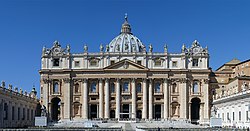
In 1546, Michelangelo was appointed architect of St Peter's Basilica, taking on the job of completing it, begun to Bramante's design with several intermediate designs. Foundations had been laid in 1506 after fifty years of replacing the Constantinian basilica. His design influenced churches for centuries, including Sant'Andrea della Valle and St Paul's Cathedral.
Image source: St. Peter's Basilica
1530
% complete
It is thought that Michelangelo hid for two months in a small chamber under the Medici chapels in the Basilica of San Lorenzo with light from just a tiny window, making many charcoal and chalk drawings which remained hidden until the room was rediscovered in 1975 and opened to visitors in 2023.
1532
% complete
Michelangelo first met the young Roman patrician Tommaso dei Cavalieri in 1532, when Cavalieri was 23 and Michelangelo was 57. He wrote him the longest sequence of poems, displaying deep loving feeling.
Image source: Tommaso dei Cavalieri
1536 - 1547
% complete
Late in life, Michelangelo nurtured a friendship with the poet and noble widow Vittoria Colonna, marchioness of Pescara, whom he met in Rome around 1536 or 1538; she became one of his closest friends until her death in 1547.
Image source: Vittoria Colonna
1542 - 1543
% complete
In 1542, Michelangelo met Cecchino dei Bracci who died only a year later, inspiring Michelangelo to write 48 funeral epigrams.
Image source: Cecchino dei Bracci
1542
% complete
In a letter from late 1542, Michelangelo blamed the tensions between Julius II and himself on the envy of Bramante and Raphael, saying of the latter, 'all he had in art, he got from me'.
Feb 18, 1564
% complete
Michelangelo died in Rome on 18 February 1564, at the age of 88, leaving behind one of the most remarkable legacies in art history as sculptor, painter, architect, and poet of the High Renaissance.
1623
% complete
Michelangelo's grandnephew, Michelangelo Buonarroti the Younger, published the poems in 1623 with the gender of pronouns changed, removing words or insisting they be read allegorically and philosophically.
Or browse the full history timeline directory, with more than 2,000 topics.
This Michelangelo timeline was generated with the help of AI, using information found on the internet.
We work hard to keep these timelines accurate, but mistakes do get through. If you spot one, email us at [email protected] and we'll fix it for future visitors.
Generate yours with AI or build it from scratch, for free.
Export your timeline, add your own events, edit or remove AI-generated events, and much more
No credit card required.
Cancel anytime.
Cancel anytime.
You can create an unlimited number of timelines with up to 10 events on each one, customize how they look, export them to PDF, PNG, PowerPoint, CSV, and Excel, and share them with a link. Paid plans raise the event limit and add features like spreadsheet imports and collaborators.
Yes. You can cancel your subscription from your account page at any time, and you will not be charged again. Your subscription stays active for the rest of the period you already paid for.
Yes. We will email you a reminder before the annual renewal, and we will also email you a receipt.
Yes. You can email us within 15 days of any payment, and we will issue you a full refund.
Check out our pricing docs or send us an email anytime: [email protected].