-
Use Cases
-
Resources
-
Pricing
Antoni Gaudí (1852–1926) was a Spanish Catalan architect renowned for his distinctive Modernisme style, blending nature-inspired organic forms, vibrant colors, and innovative structural techniques. His masterpieces in Barcelona, including the Sagrada Família, Park Güell, Casa Batlló, and Casa Milà, have made him one of history's most influential architects. More Less
Jun 25, 1852
% complete
Antoni Gaudí i Cornet was born in Reus or Riudoms, Catalonia, Spain, to a family of coppersmiths. His father's craftsmanship is often cited as an early influence on Gaudí's appreciation for three-dimensional forms and skilled manual work.
Image source: Antoni Gaudí
1860
% complete
As a child, Gaudí suffered from rheumatism, which kept him from playing with other children. He spent much time observing nature, fostering the deep fascination with natural forms that would later define his architecture.
1869
% complete
Gaudí moved to Barcelona to prepare for and pursue architectural studies. The vibrant city of Barcelona, undergoing rapid expansion with the Eixample district's construction, would become the canvas for nearly all his work.
1873
% complete
Gaudí enrolled at the Barcelona School of Architecture, where he studied under professors such as Lluís Domènech i Montaner. He worked as a draftsman to support himself during his studies.
Image source: Polytechnic University of Catalonia
1875
% complete
While still a student, Gaudí worked as a draftsman for architect Josep Fontserè on Parc de la Ciutadella and for architect Joan Martorell, whose Gothic Revival style influenced him. Martorell later recommended Gaudí for the Sagrada Família project.
Image source: Joan Martorell
1878
% complete
Gaudí graduated from the Barcelona School of Architecture in 1878. Elies Rogent, the school director, famously remarked that he had awarded a degree either to a madman or a genius.
1887
% complete
In 1887 Gaudí traveled to Paris and visited Italy, seeing Gothic cathedrals and classical architecture firsthand. These travels deepened his understanding of historical styles that he would reinterpret in his own work.
1878
% complete
Shortly after graduating, Gaudí designed an elegant showcase for the Esteban Comella glove shop, exhibited at the Paris World's Fair. It caught the attention of Eusebi Güell, beginning their lifelong patronage relationship.
Image source: Exposition Universelle (1878)
1878
% complete
Industrialist Eusebi Güell saw Gaudí's work at the Paris Exposition in 1878 and became his most important patron. Güell commissioned many of Gaudí's greatest works, including Palau Güell and Park Güell.
Image source: Eusebi Güell
1883 - 1885
% complete
Gaudí designed El Capricho, a villa in Comillas, Cantabria, built between 1883 and 1885. The whimsical building features sunflower-themed tiles and showcases his emerging Orientalist style.
Image source: El Capricho
1884 - 1887
% complete
For Eusebi Güell's estate at Pedralbes, Gaudí designed entrance pavilions and stables between 1884 and 1887. The dragon gate, inspired by the mythological Garden of the Hesperides, foreshadowed his mature style.
1888 - 1889
% complete
Built between 1888 and 1889, the Colegio de las Teresianas features austere brickwork, slender parabolic arches, and symbolic religious details, demonstrating Gaudí's ability to combine simplicity with expressive structural innovation.
1889 - 1890
% complete
Gaudí undertook restoration work at the Cistercian Monastery of Poblet in Tarragona around 1889-1890, reflecting his deep interest in medieval Catalan religious architecture and heritage preservation.
Image source: Poblet Abbey
1891 - 1892
% complete
Built between 1891 and 1892 in León, Casa Botines combined commercial space with apartments in a neo-Gothic style. The building features statues of Saint George slaying the dragon and demonstrates Gaudí's growing reputation beyond Catalonia.
Image source: Casa Botines
1895 - 1901
% complete
Gaudí designed the Bodegas Güell wine cellars at Garraf near Sitges, built between 1895 and 1901. The structure uses local limestone and catenary arches, exemplifying his integration of function, material, and landscape.
Image source: Bodegas Güell
1883
% complete
Gaudí took over the design of the Basílica de la Sagrada Família after Francisco de Paula del Villar resigned. He devoted over four decades of his life to this project, transforming it into his most iconic masterpiece.
Image source: Sagrada Família
1883 - 1885
% complete
Casa Vicens, built between 1883 and 1885 for Manuel Vicens i Montaner, was Gaudí's first major commission. Its Moorish-inspired design featuring colorful ceramic tiles marked the beginning of Gaudí's distinctive architectural language.
Image source: Casa Vicens
1886 - 1890
% complete
Palau Güell, a townhouse for Eusebi Güell completed in 1890, featured innovative parabolic arches and rooftop chimneys. It was one of Gaudí's first works to gain wide recognition and earned UNESCO World Heritage status in 1984.
Image source: Palau Güell
1889 - 1913
% complete
Gaudí was commissioned to build the neo-Gothic Episcopal Palace in Astorga, León, after the original architect died. Construction stretched intermittently until 1913, featuring his signature use of stone, ceramics, and organic forms.
Image source: Episcopal Palace, Astorga
1898 - 1917
% complete
Gaudí designed the church for the workers' colony of Colonia Güell, building only its crypt between 1908 and 1917. There he perfected the funicular model method using hanging chains to determine optimal structural forms.
Image source: Church of Colònia Güell
1900 - 1909
% complete
Built between 1900 and 1909, Bellesguard was a manor house on the site of a former castle associated with King Martin I of Aragon. Gaudí blended Gothic revival elements with modernist innovation in this lesser-known work.
Image source: Bellesguard
1900 - 1914
% complete
Commissioned by Eusebi Güell as a residential garden city, Park Güell became one of Gaudí's most celebrated creations. Its serpentine bench, mosaic salamander, and organic structures showcase his trencadís mosaic technique.
Image source: Park Güell
1904 - 1915
% complete
From around 1904 to 1915, Gaudí carried out restoration work on the Cathedral of Palma de Mallorca, including redesigning the choir stalls and main altar, experimenting with lighting solutions he would later apply at Sagrada Família.
Image source: Palma Cathedral
1904 - 1906
% complete
Between 1904 and 1906, Gaudí completely renovated Casa Batlló for textile magnate Josep Batlló. Its skeletal facade, dragon-scale roof, and undulating walls earned it the nickname 'Casa dels Ossos' (House of Bones).
Image source: Casa Batlló
1906 - 1912
% complete
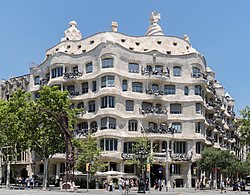
Casa Milà, known as La Pedrera ('the quarry'), was built between 1906 and 1912. Its self-supporting stone facade, sculptural rooftop chimneys, and innovative apartment layout made it one of the most radical buildings of its era.
Image source: Casa Milà
1910 - 1918
% complete
During the 1910s, Gaudí developed plaster models and sketches for the Nativity and Passion facades of the Sagrada Família. Many original drawings were destroyed in 1936, but surviving models guided later construction.
1915
% complete
After 1915, Gaudí abandoned all other commissions and dedicated himself exclusively to the Sagrada Família. He lived frugally on-site in a workshop, personally supervising construction and even begging for donations to fund the project.
Jun 7, 1926
% complete
On June 7, 1926, Gaudí was hit by a tram on Gran Via in Barcelona while walking to the Sant Felip Neri church for confession. Due to his shabby appearance, taxi drivers refused to take him, delaying medical care.
Jun 10, 1926
% complete
Gaudí died on June 10, 1926, at the Hospital de la Santa Creu in Barcelona, three days after the accident. He was buried in the crypt of the Sagrada Família, and thousands attended his funeral procession through the streets of Barcelona.
Or browse the full history timeline directory, with more than 2,000 topics.
This Antoni Gaudí timeline was generated with the help of AI, using information found on the internet.
We work hard to keep these timelines accurate, but mistakes do get through. If you spot one, email us at [email protected] and we'll fix it for future visitors.
Generate yours with AI or build it from scratch, for free.
Export your timeline, add your own events, edit or remove AI-generated events, and much more
No credit card required.
Cancel anytime.
Cancel anytime.
You can create an unlimited number of timelines with up to 10 events on each one, customize how they look, export them to PDF, PNG, PowerPoint, CSV, and Excel, and share them with a link. Paid plans raise the event limit and add features like spreadsheet imports and collaborators.
Yes. You can cancel your subscription from your account page at any time, and you will not be charged again. Your subscription stays active for the rest of the period you already paid for.
Yes. We will email you a reminder before the annual renewal, and we will also email you a receipt.
Yes. You can email us within 15 days of any payment, and we will issue you a full refund.
Check out our pricing docs or send us an email anytime: [email protected].