
-
Use Cases
-
Resources
-
Pricing
The Trojan War is one of the most famous conflicts of Greek mythology, a decade-long war fought between the Achaeans (Greeks) and the city of Troy in Asia Minor. Sparked by the abduction (or elopement) of Helen by the Trojan prince Paris, the war features legendary heroes such as Achilles, Hector, Odysseus, and Agamemnon. Its story was immortalized in Homer's Iliad and Odyssey, blending myth, legend, and possible historical memory of a real Bronze Age conflict around the 12th century BCE. More Less
1280 BC
% complete
In the Alaksandu treaty (c. 1280 BC) the king of the city is named Alaksandu, and Paris's name in the Iliad (among other works) is Alexander, suggesting a possible connection.
Image source: Alaksandu
1274 BC
% complete
Formerly under the Hittites, the Assuwa confederation defected after the battle of Kadesh between Egypt and the Hittites (c. 1274 BC).
1230 BC
% complete
In 1230 BC Hittite king Tudhaliya IV (c. 1240–1210 BC) campaigned against this federation, attempting to restore Hittite control in western Anatolia.
Image source: Tudḫaliya IV
1210 BC - 1205 BC
% complete
Under Arnuwanda III (c. 1210–1205 BC) the Hittites were forced to abandon the lands they controlled on the coast of the Aegean.
1900 - 2000
% complete
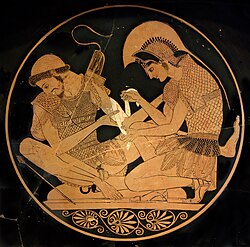
Since the twentieth century, scholars have attempted to draw conclusions based on Hittite and Egyptian texts that date to the time of the Trojan War.
Image source: Trojan War
1275 BC
% complete
The glorious and rich city Homer describes was believed to be Troy VI by many twentieth century AD authors, and destroyed about 1275 BC, probably by an earthquake.
Image source: Late Bronze Age Troy
1180 BC
% complete
Troy VIIa was destroyed around 1180 BC; it was long considered a poorer city and dismissed as a candidate for Homeric Troy, but since the excavation campaign of 1988 it has come to be regarded as the most likely candidate.
1850 - 1860
% complete
By the mid-nineteenth century AD, both the war and the city were widely seen as non-historical.
1868
% complete
In 1868, the German archaeologist Heinrich Schliemann met Frank Calvert, who convinced Schliemann that Troy was at what is now Hisarlık in modern-day Turkey.
Image source: Frank Calvert
1870
% complete
Around 1870 it was generally agreed in Western Europe that the Trojan War had never happened and Troy never existed.
1977
% complete
Investigations into the geology of the region around Troy started in 1977, laying groundwork for later findings about the ancient landscape.
1988
% complete
Since the excavation campaign of 1988, Troy VIIa has come to be regarded as the most likely candidate for Homeric Troy.
Nov 2001
% complete
In November 2001, geologist John C. Luce presented the results of investigations into the geology of the region that had started in 1977, shedding light on the plain where the war was said to have been fought.
1250 BC - 1150 BC
% complete
The Trojan War was a legendary conflict in Greek mythology that took place around the thirteenth or early twelfth century BC, pitting the Greeks against the city of Troy.
1200 BC
% complete
In the legend, the Greek forces consisted of 28 contingents from mainland Greece, the Peloponnese, the Dodecanese islands, Crete, and Ithaca, comprising 1186 pentekonters, ships with 50 rowers.
1200 BC - 1100 BC
% complete
The ancient Greeks believed that Troy was located near the Dardanelles and that the Trojan War was a historical event of the twelfth or thirteenth centuries BC.
410 BC
% complete
Thucydides says that according to tradition there were about 1200 ships, and that the Boeotian ships had 120 men, while Philoctetes's ships only had the fifty rowers, these probably being maximum and minimum crew sizes.
1194 BC - 1184 BC
% complete
Those who believe the stories derive from a specific historical conflict usually date it to the twelfth or eleventh century BC, often preferring Eratosthenes' dates 1194–1184 BC, which roughly correspond to archaeological evidence of a catastrophic burning of Troy VII and the Late Bronze Age collapse.
430 BC
% complete
Among ancient attempts to date the war, Herodotus placed it around 1250 BC, one of many differing chronological estimates proposed by classical authors.
320 BC
% complete
The philosopher Dicaearchus gave 1212 BC as the date of the Trojan War, part of the wide array of chronological proposals by ancient scholars.
300 BC
% complete
The historian Timaeus assigned the Trojan War to 1193 BC in his chronological reckoning of legendary events.
260 BC
% complete
The Parian marble chronicle dated the Trojan War to 1209 BC or 1208 BC, contributing to the range of ancient estimates of the conflict's date.
230 BC
% complete
Eratosthenes gave the dates 1194–1184 BC (with 1184 BC/1183 BC for the fall of Troy), which are often preferred by those who link the legend to a specific historical conflict.
220 BC
% complete
Sosibius proposed 1172 BC as the date of the Trojan War, adding to the diversity of ancient chronological traditions.
210 BC
% complete
Ephorus gave 1135 BC as the date of the Trojan War, among the latest of the ancient estimates.
200 BC
% complete
Douris gave 1334 BC as the date of the Trojan War, the earliest major estimate; taken together, the ancient dates bring the average to around 1220 BC.
150 BC
% complete
Eretes gave 1291 BC as his estimate for the Trojan War, one of the many competing ancient chronologies.
550 BC
% complete
The myth of Helen being switched is attributed to the sixth century BC Sicilian poet Stesichorus, while for Homer the Helen in Troy was one and the same.
1956
% complete
Helen of Troy (1956) is one of the modern-day adaptations of the Trojan War story, bringing the legend to the big screen.
Image source: Helen of Troy (film)
1961
% complete
The Trojan Horse (1961) is a modern-day screen adaptation depicting the famous wooden horse stratagem of the Trojan War.
Image source: The Trojan Horse (film)
2004
% complete
Troy (2004) is a major Hollywood adaptation of the Trojan War, loosely based on Homer's Iliad.
Image source: Troy (film)
2011
% complete
The Song of Achilles (2011) by Madeline Miller is a modern novel retelling the Trojan War through the eyes of Patroclus.
Image source: The Song of Achilles
2026
% complete
The Odyssey (2026) is a modern-day adaptation connected to the Trojan War cycle of stories.
Image source: The Odyssey (2026 film)
Or browse the full history timeline directory, with more than 2,000 topics.
This Trojan War timeline was generated with the help of AI, using information found on the internet.
We work hard to keep these timelines accurate, but mistakes do get through. If you spot one, email us at [email protected] and we'll fix it for future visitors.
Generate yours with AI or build it from scratch, for free.
Export your timeline, add your own events, edit or remove AI-generated events, and much more
No credit card required.
Cancel anytime.
Cancel anytime.
You can create an unlimited number of timelines with up to 10 events on each one, customize how they look, export them to PDF, PNG, PowerPoint, CSV, and Excel, and share them with a link. Paid plans raise the event limit and add features like spreadsheet imports and collaborators.
Yes. You can cancel your subscription from your account page at any time, and you will not be charged again. Your subscription stays active for the rest of the period you already paid for.
Yes. We will email you a reminder before the annual renewal, and we will also email you a receipt.
Yes. You can email us within 15 days of any payment, and we will issue you a full refund.
Check out our pricing docs or send us an email anytime: [email protected].