-
Use Cases
-
Resources
-
Pricing
Burrhus Frederic Skinner (1904–1990) was an American psychologist, behaviorist, author, inventor, and social philosopher best known for developing the theory of operant conditioning. His research on reinforcement and punishment shaped modern behavioral psychology, education, and animal training. He invented the operant conditioning chamber (the 'Skinner Box') and the teaching machine, and authored influential works including 'The Behavior of Organisms' (1938), 'Walden Two' (1948), and 'Beyond Freedom and Dignity' (1971). More Less
Mar 20, 1904
% complete
Burrhus Frederic Skinner was born on March 20, 1904. He would grow up to become an American psychologist, behaviorist, inventor, and social philosopher whose work profoundly shaped the field of psychology.
1926
% complete
Skinner received his Bachelor of Arts in English literature in 1926 before turning toward psychology.
1926
% complete
After receiving his Bachelor of Arts in English literature in 1926, Skinner attended Harvard University, where he would later conduct influential research and teach for decades.
1931
% complete
Skinner received a PhD from Harvard in 1931 and remained there as a researcher for some years, beginning the experimental work that would define his career.
1936
% complete
In 1936, Skinner married Yvonne "Eve" Blue, beginning a marriage that lasted until his death in 1990.
1936
% complete
In 1936, Skinner went to the University of Minnesota in Minneapolis to teach, continuing to develop his research on operant conditioning.
Image source: B. F. Skinner
1943
% complete
During World War II, Skinner trained pigeons through operant conditioning to peck a camera obscura screen showing incoming targets on individual screens, resulting in the missile being guided towards the targeted ship through just the peck coming from the pigeon.
1945
% complete
In 1945, Skinner moved to Indiana University, where he served as chair of the psychology department from 1946 to 1947 before returning to Harvard.
1946 - 1947
% complete
At Indiana University, Skinner chaired the psychology department from 1946 to 1947, an administrative role he held before returning to Harvard as a tenured professor.
1948
% complete
In 1948, Skinner returned to Harvard University as a tenured professor, where he was appointed the Edgar Pierce Professor of Psychology, a position he held until his retirement in 1974.
1948 - 1974
% complete
Skinner held the title of Edgar Pierce Professor of Psychology at Harvard University from 1948 until his retirement in 1974, based at Harvard from the 1950s to the 90s according to his daughter Debora.
1973
% complete
In 1973, Skinner was one of the signers of the Humanist Manifesto II, reflecting his secular humanist social philosophy.
1974
% complete
Skinner retired from Harvard in 1974 after serving as Edgar Pierce Professor of Psychology since 1948. His public exposure had increased in the 1970s, and he remained active even after retirement until his death.
1989
% complete
In 1989, Skinner was diagnosed with leukemia, about a year before his death.
Aug 18, 1990
% complete
Skinner died on August 18, 1990, in Cambridge, Massachusetts, after being diagnosed with leukemia the previous year.
1997
% complete
Yvonne "Eve" Blue, Skinner's wife, died in 1997 and is buried in Mount Auburn Cemetery in Cambridge, Massachusetts.
1938
% complete
Skinner's ideas about behaviorism were largely set forth in his first book, The Behavior of Organisms (1938). In it, he defined negative reinforcement as synonymous with punishment, a definition later revised in Science and Human Behavior (1953).
Image source: The Behavior of Organisms
1948
% complete
Skinner imagined the application of his behavioral ideas to the design of a human community in his 1948 utopian novel, Walden Two, one of the books for which he is popularly known.
Image source: Walden Two
1953
% complete
In Science and Human Behavior (1953), Skinner re-defined negative reinforcement, revising the definition he had originally given in The Behavior of Organisms (1938), where it had been synonymous with punishment.
Image source: Human behavior
1957
% complete
Using experimental tools, Skinner and Charles Ferster produced Skinner's most influential experimental work, outlined in their 1957 book Schedules of Reinforcement.
Image source: Reinforcement
1957
% complete
Skinner's analysis of human behavior culminated in his work Verbal Behavior, published in 1957 (sometimes cited as 1958), which applied operant conditioning principles to language.
Image source: Verbal Behavior
1959
% complete
Cumulative Record: A Selection of Papers was first published in 1959, with subsequent editions appearing in 1961, 1972, and 1999 as Cumulative Record: Definitive Edition.
1968
% complete
In The Technology of Teaching (1968), Skinner included a chapter on why teachers fail, arguing that teachers have not been given an in-depth understanding of teaching and learning.
Image source: Educational technology
1971
% complete
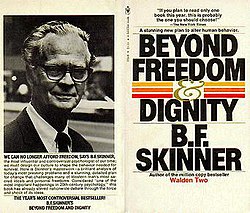
Skinner is popularly known mainly for his books Walden Two (1948) and Beyond Freedom and Dignity (1971), for which he made the cover of Time magazine.
Image source: Beyond Freedom and Dignity
1981
% complete
Writing in 1981, Skinner pointed out that Darwinian natural selection is, like reinforced behavior, "selection by consequences", linking evolutionary theory with his behavioral analysis.
Oct 1945
% complete
Skinner's article in Ladies Home Journal, titled "Baby in a Box", caught the eye of many readers and contributed to public skepticism about his air crib device, even though reports came back positive that children and parents enjoyed using the crib.
Image source: B. F. Skinner
1959
% complete
American linguist Noam Chomsky published a highly critical review of Skinner's Verbal Behavior in the linguistics journal Language in 1959, a landmark critique in the cognitive revolution against behaviorism.
1968
% complete
Brown and Jenkins observed autoshaping procedures in 1968, a process like which seemed to guide terminal responses that reflected classical rather than operant conditioning, challenging Skinner's adventitious reinforcement explanation.
1971
% complete
Staddon and Simmelhag, while finding similar behavior, failed to find support for Skinner's "adventitious reinforcement" explanation for it, arguing instead that terminal responses reflect classical conditioning.
1977
% complete
Staddon argued in 1977 that the causation of interim activities, such as schedule-induced polydipsia seen with rats, cannot be traced to adventitious reinforcement, and its details remain obscure.
2004
% complete
In 2004, therapist Lauren Slater repeated a claim in her book Opening Skinner's Box that Skinner may have used his baby daughter Deborah in some of his experiments. Debora was quoted by the Guardian responding to the claim, saying her father allegedly put her for a few hours a day in a laboratory box.
2005
% complete
In her 2005 book Animals in Translation, animal behaviorist Temple Grandin claimed that Skinner attempted to touch her legs without consent during a meeting and that she verbally rebuffed him. She repeated this claim in a 2006 NPR interview and a 2018 interview with the Center for Autism and Related Disorders, though her accounts varied on whether he asked permission first.
Image source: Temple Grandin
1967
% complete
In 1967, Kat Kinkade and others founded the Twin Oaks Community in Virginia, using Skinner's utopian novel Walden Two as a blueprint for their intentional community.
Image source: Twin Oaks Community, Virginia
Jun 2002
% complete
A June 2002 survey listed Skinner as the most influential psychologist of the 20th century, cementing his legacy despite ongoing controversies over behaviorism.
2024
% complete
The 2024 Ig Nobel Peace Prize was awarded for experiments to see the feasibility of housing live pigeons inside missiles to guide the flight paths of the missiles, referencing Skinner's wartime Project Pigeon research.
Image source: Ig Nobel Prize
Or browse the full history timeline directory, with more than 2,000 topics.
This B. F. Skinner timeline was generated with the help of AI, using information found on the internet.
We work hard to keep these timelines accurate, but mistakes do get through. If you spot one, email us at [email protected] and we'll fix it for future visitors.
Generate yours with AI or build it from scratch, for free.
Export your timeline, add your own events, edit or remove AI-generated events, and much more
No credit card required.
Cancel anytime.
Cancel anytime.
You can create an unlimited number of timelines with up to 10 events on each one, customize how they look, export them to PDF, PNG, PowerPoint, CSV, and Excel, and share them with a link. Paid plans raise the event limit and add features like spreadsheet imports and collaborators.
Yes. You can cancel your subscription from your account page at any time, and you will not be charged again. Your subscription stays active for the rest of the period you already paid for.
Yes. We will email you a reminder before the annual renewal, and we will also email you a receipt.
Yes. You can email us within 15 days of any payment, and we will issue you a full refund.
Check out our pricing docs or send us an email anytime: [email protected].