-
Use Cases
-
Resources
-
Pricing
Carl Gustav Jung (1875–1961) was a Swiss psychiatrist and psychoanalyst who founded analytical psychology. Once a close collaborator of Sigmund Freud, Jung broke away to develop his own theories, including the concepts of the collective unconscious, archetypes, introversion and extraversion, individuation, and synchronicity. His work profoundly influenced psychiatry, anthropology, literature, and religious studies. More Less
Jul 26, 1875
% complete
Carl Gustav Jung was born in Kesswil, Switzerland, into a family of Protestant clergy. His father was a poor rural pastor in the Swiss Reformed Church, and Jung's early exposure to religious themes and his mother's psychological instability deeply influenced his later interest in the inner life and the psyche.
Image source: Carl Jung
1879
% complete
After his father received a better position, the Jung family moved to Klein-Hüningen near Basel. Jung spent much of his childhood in relative isolation, developing a rich inner fantasy life that he would later draw upon when formulating his theories of the unconscious.
1895
% complete
Jung began studying medicine at the University of Basel. He initially intended to specialize in archaeology but was drawn to psychiatry after reading Krafft-Ebing's textbook, which convinced him that the study of psychic phenomena could unite his scientific and spiritual interests.
Image source: University of Basel
Dec 1900
% complete
Jung completed his medical studies at the University of Zurich (Basel and Zurich) with a dissertation on the occult psychology of mediums, titled 'On the Psychology and Pathology of So-Called Occult Phenomena,' which foreshadowed his lifelong interest in the unconscious.
Feb 14, 1903
% complete
Jung married Emma Rauschenbach, heiress to a wealthy Swiss industrial family. Their marriage lasted until her death in 1955, and Emma herself became a respected analyst and author on the Grail legend and the anima concept.
Image source: Emma Jung
Dec 1900
% complete
Jung became an assistant to Eugen Bleuler at the Burghölzli clinic in Zurich, one of Europe's leading psychiatric institutions. There he conducted pioneering word association experiments that provided empirical evidence for the existence of emotionally charged unconscious complexes.
Image source: Burghölzli
Mar 3, 1907
% complete
Jung met Sigmund Freud in Vienna, and they reportedly talked for thirteen hours straight. Freud saw in Jung a potential heir to psychoanalysis, and Jung became an enthusiastic champion of Freud's ideas, helping establish the movement beyond Vienna.
Image source: The Freud/Jung Letters
1909
% complete
Freud and Jung traveled together to the United States to deliver lectures at Clark University in Worcester, Massachusetts. The lectures introduced American audiences to psychoanalysis, though tensions between the two men were already beginning to surface during this voyage.
Image source: Clark University
1910
% complete
Jung was appointed the first president of the International Psychoanalytical Association at Freud's urging, cementing his position as the designated successor to Freud within the young psychoanalytic movement.
Image source: International Psychoanalytical Association
Jan 1913
% complete
The relationship between Jung and Freud ruptured completely over theoretical disagreements, particularly regarding the nature of libido and the role of sexuality. Jung resigned as editor of the psychoanalytic journal, and Freud wrote that they should abandon their personal relationship entirely.
1913 - 1916
% complete
Following the break with Freud and his resignation from the University of Zurich professorship, Jung underwent a period of intense self-experimentation, recording visions and fantasies in the 'Red Book' (Liber Novus). This crisis generated many of his core concepts, including active imagination and the collective unconscious.
Image source: The Red Book (Jung)
1916
% complete
Jung and his followers established the Psychological Club in Zürich to organize the growing community of analysts practicing his method. This institution became a hub for the development and dissemination of analytical psychology.
Jan 1925
% complete
During his American travels, Jung visited the Taos Pueblo in New Mexico, where conversations with Mountain Lake, a Pueblo elder, deepened his reflections on the differences between Western and non-Western consciousness and the universality of religious symbolism.
Image source: Taos Pueblo
1925 - 1926
% complete
Jung traveled to East Africa, including Kenya and Uganda, where he studied the psychology of indigenous peoples firsthand. These journeys reinforced his belief in universal archetypal structures underlying human symbolism across cultures.
1932 - 1958
% complete
Jung maintained a decades-long intellectual friendship with Nobel laureate physicist Wolfgang Pauli, who analyzed his own dreams with Jung. Their correspondence explored parallels between quantum physics and depth psychology, culminating in joint explorations of the psychophysical problem.
Image source: Wolfgang Pauli
1933 - 1939
% complete
Jung assumed the presidency of the Germany-based International General Medical Society for Psychotherapy during the Nazi era. His role remains controversial, as critics have debated whether his actions accommodated the Nazi regime or protected Jewish members of the society.
1935
% complete
Jung became a central figure at the annual Eranos meetings at Ascona, Switzerland, an interdisciplinary conference where scholars explored mythology, religion, and symbolism. His Eranos talks, often illustrated by mandalas and alchemical imagery, shaped generations of scholars in depth psychology and religious studies.
Image source: Eranos Foundation
1937
% complete
Jung delivered the prestigious Terry Lectures at Yale on 'Psychology and Religion,' arguing that the psyche has an inherently religious function and that neglecting this dimension leads to neurosis. The lectures were published as 'Psychology and Religion.'
Image source: Psychology of religion
1912
% complete
In 'Wandlungen und Symbole der Libido' ('Symbols of Transformation'), Jung departed from Freud's sexual theory of libido, reinterpreting it as generalized psychic energy. This work precipitated the decisive break between Jung and Freud.
1917
% complete
In essays written during and after his period of inner turmoil, notably 'On the Psychology of the Unconscious,' Jung articulated his concepts of the collective unconscious and archetypes, universal patterns shared by all humanity that manifest in myths, dreams, and symbols across cultures.
Image source: Collective unconscious
1921
% complete
In 'Psychological Types,' Jung introduced his influential typology of introversion and extraversion along with the functions of thinking, feeling, sensation, and intuition. This work laid the foundation for later personality assessments such as the Myers-Briggs Type Indicator.
Image source: Psychological Types
1933
% complete
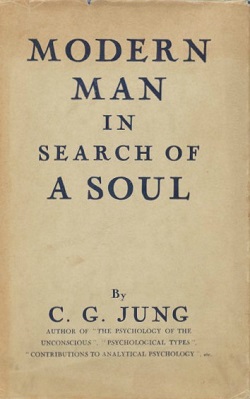
This collection of essays presented Jung's views on the spiritual crisis of modern life, dream analysis, and the relationship between psychology and religion, making his ideas accessible to a broad general audience and establishing his reputation beyond specialist circles.
Image source: Modern Man in Search of a Soul
1951 - 1952
% complete
Jung published 'Aion,' a study of the archetype of the self and the symbol of the fish in Christianity, followed by his monograph on synchronicity with physicist Wolfgang Pauli, proposing that meaningful coincidences reflect an acausal ordering principle connecting psyche and matter.
1952
% complete
In 'Answer to Job,' Jung offered a provocative psychological analysis of the Book of Job, arguing that the biblical God image undergoes a transformation requiring incarnation in man. The book scandalized theologians but is considered among his most daring works.
Image source: Answer to Job
1955
% complete
Jung's final major work examined alchemical symbolism as a projection of individuation processes, completing his three-decade investigation of alchemy as a key to the psychology of the unconscious and the union of conscious and unconscious elements of the psyche.
Image source: The Collected Works of C. G. Jung
Nov 27, 1955
% complete
Emma Jung died after a long illness. Her death profoundly affected Carl Jung, who had relied on her steadfast partnership throughout his career. She had made significant contributions to analytical psychology herself, including her study of the Holy Grail myth.
1957 - 1983
% complete
Begun under Jung's supervision and completed after his death, the twenty-volume Collected Works edited by Herbert Read, Michael Fordham, and Gerhard Adler systematized his writings and made analytical psychology accessible to scholars worldwide, becoming the standard reference edition of his oeuvre.
Jun 6, 1961
% complete
Carl Jung died at his home in Küsnacht on Lake Zürich at the age of 85. He left behind a vast body of work encompassing analytical psychology, the theory of archetypes and the collective unconscious, psychological types, and profound contributions to the study of religion, mythology, and alchemy.
1962
% complete
Aniela Jaffé compiled Jung's autobiographical recollections, dictated near the end of his life, into 'Memories, Dreams, Reflections.' The book offered an intimate account of his inner life, childhood experiences, encounters with Freud, and confrontation with the unconscious, becoming his most widely read work.
Image source: Memories, Dreams, Reflections
1962 - 2021
% complete
Jung's typology inspired the Myers-Briggs Type Indicator and numerous other instruments, while his ideas about archetypes, the shadow, introversion, and the collective unconscious permeated literature, film, and popular psychology, ensuring his lasting influence far beyond academic circles.
Image source: Myers–Briggs Type Indicator
2009
% complete
Nearly fifty years after Jung's death, his illuminated manuscript known as the Red Book (Liber Novus) was finally published in a facsimile edition. The lavishly illustrated record of his self-exploration revealed the visionary origins of his mature psychology and caused a major scholarly reassessment of his work.
Or browse the full history timeline directory, with more than 2,000 topics.
This Carl Jung timeline was generated with the help of AI, using information found on the internet.
We work hard to keep these timelines accurate, but mistakes do get through. If you spot one, email us at [email protected] and we'll fix it for future visitors.
Generate yours with AI or build it from scratch, for free.
Export your timeline, add your own events, edit or remove AI-generated events, and much more
No credit card required.
Cancel anytime.
Cancel anytime.
You can create an unlimited number of timelines with up to 10 events on each one, customize how they look, export them to PDF, PNG, PowerPoint, CSV, and Excel, and share them with a link. Paid plans raise the event limit and add features like spreadsheet imports and collaborators.
Yes. You can cancel your subscription from your account page at any time, and you will not be charged again. Your subscription stays active for the rest of the period you already paid for.
Yes. We will email you a reminder before the annual renewal, and we will also email you a receipt.
Yes. You can email us within 15 days of any payment, and we will issue you a full refund.
Check out our pricing docs or send us an email anytime: [email protected].