
-
Use Cases
-
Resources
-
Pricing
1540
When the Hernando de Soto expedition entered the Southeast in 1540, the region was inhabited by peoples belonging to several mound-building cultures.
1700
A social hierarchy associated with earlier Cherokee organization had disappeared long before the eighteenth century.
1790
A Cherokee myth recorded in the late eighteenth century described a group called the Moon-eyed people as having lived in Cherokee territory before the Cherokee arrived.
1797
Colonel Leonard Marbury described the group in 1797 in a communication to Benjamin Smith Barton, providing one of the recorded historical references associated with the tradition.
1800 - 1830
Much of what is known about pre-nineteenth-century Cherokee culture and society comes from papers collected or written by American writer John Howard Payne.
1808
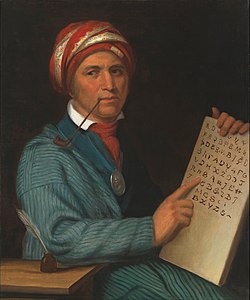
Sequoyah began developing a writing system for the Cherokee language around 1808. The system became the Cherokee syllabary.
1820 - 1900
Another major source of early Cherokee cultural history consists of nineteenth-century materials written by didanvwisgi, or Cherokee medicine men, using the Cherokee syllabary.
1821
After moving with his people to Alabama, Sequoyah completed his Cherokee syllabary by 1821 and began promoting its use.
May 1540
The first known Cherokee contact with Europeans occurred in late May 1540, when Hernando de Soto’s Spanish expedition passed through Cherokee country near present-day Embreeville, Tennessee, called Guasili by the Spaniards.
1567
A second Spanish expedition passed through Cherokee country in 1567 under the leadership of Juan Pardo.
1650
Regular encounters between Cherokee communities and English colonists began during the mid-seventeenth century.
Image source: Cherokee
1650
Around 1650, the Cherokee were estimated to number approximately 22,500 people. They lived mainly in independent towns and smaller villages along river valleys in the southern Appalachian Mountains.
1654 - 1986
Some historians have connected the Rechahecrians of the 1656 account with the Erie, an Iroquoian people displaced from the southern shore of Lake Erie during the Beaver Wars. Robert J. Conley and others later proposed that the Erie were identical to the Cherokee, although the claim lacks consensus.
Image source: Erie people

1656
English settlers in Virginia Colony recorded that six or seven hundred people identified as Mahocks, Nahyssans, and Rechahecrians encamped at Bloody Run near present-day Richmond, creating a possible early Anglo-Cherokee contact.
1673
Abraham Wood sent English traders James Needham and Gabriel Arthur from Fort Henry into Overhill Cherokee country west of the Appalachians.
1674
In 1674, the Shawnee captured Gabriel Arthur and discovered that he was a white man.
Jun 1674
In June 1674, the chief of Chota escorted Gabriel Arthur back to his English settlement in Virginia.
1690 - 1700
By the late seventeenth century, colonial traders from Virginia and Carolina were making regular journeys to Cherokee lands, although few written accounts of those trips survive.
1690
Virginia colonists began trading with the Cherokee in the late seventeenth century.
1700 - 1720
By the eighteenth century, South Carolina had overtaken Virginia as the principal colonial trading partner of the Cherokee.
1700
In the late seventeenth and early eighteenth centuries, the Cherokee were among the most populous and powerful southeastern Indian confederacies.
1700 - 1800
The English and Cherokee formed an alliance in the Southeast that remained strong for much of the eighteenth century.
1705
In 1705, traders complained that they were losing business to the Indian slave trade, which was instigated and supported by South Carolina governor James Moore.
1710 - 1715
Allied with the English, the Cherokee and Chickasaw fought the French-allied Shawnee from 1710 to 1715 and forced the Shawnee to move north.
Image source: Beaver Wars

1712 - 1713
The Cherokee allied with the English, Yamasee, and Catawba in late 1712 and early 1713 against the Tuscarora during the Second Tuscarora War.
Image source: Tuscarora War

Jan 1716
In January 1716, Cherokee warriors murdered a delegation of Muscogee Creek leaders visiting at Tugaloo, marking Cherokee entry into the Yamasee War.
1717
The conflict ended in 1717 with peace treaties between South Carolina and the Creek.
1721
In 1721, the Cherokee ceded lands to South Carolina.
1722
By 1722, the Cherokee had been accepted as the sixth nation in the League of the Iroquois.
Image source: Iroquois

1730
At Nikwasi in 1730, Sir Alexander Cuming persuaded the Cherokee to crown Moytoy of Tellico as emperor. Moytoy agreed to recognize King George II as the Cherokee protector.
1735
In 1735, the Cherokee were estimated to have 64 towns and villages and approximately 6,000 fighting men.
1738 - 1739
Smallpox epidemics broke out among the Cherokee in 1738 and 1739. Lacking natural immunity to the newly introduced disease, Cherokee communities suffered severe effects.
1741
Moytoy’s son Amo-sgasite attempted to succeed him as emperor in 1741, but the Cherokee instead elected Old Hop of Chota as their own leader.
1753 - 1755
Battles broke out from 1753 to 1755 between the Cherokee and Muscogee over disputed hunting grounds in North Georgia.
1755
The Cherokee-Muscogee conflict culminated in the Battle of Taliwa in 1755 near present-day Ball Ground, Georgia, where the Cherokee defeated the Muscogee.
1756
The Cherokee fought alongside the British in the French and Indian War in 1756, but serious misunderstandings quickly damaged the alliance.
Image source: French and Indian War

1760 - 1761
Strained relations between the Cherokee and British allies resulted in the Anglo-Cherokee War, beginning in 1760.
Image source: Anglo-Cherokee War

1763
King George III issued the Royal Proclamation of 1763, forbidding British settlement west of the Appalachian crest in an attempt to protect the Cherokee and other Indigenous peoples from colonial encroachment.
Image source: Royal Proclamation of 1763

1769 - 1772
Predominantly Virginian settlers squatting on Cherokee lands in Tennessee formed the Watauga Association between 1769 and 1772.
Image source: Watauga Association

1773 - 1774
The settlement disputes and conflicts in the Ohio Valley helped spark Dunmore’s War, which lasted from 1773 to 1774.
1776
In 1776, Cherokee forces allied with the Shawnee and led by Cornstalk attacked settlers in South Carolina, Georgia, Virginia, the Washington District, and North Carolina.
Image source: Cherokee–American wars

1777
In 1777, most surviving Cherokee town leaders signed treaties with the newly established states during the American Revolutionary War.
1780 - 1800
In the late eighteenth century, the Cherokee moved or settled farther south and west, more deeply into Georgia and Alabama.
1788 - 1827
Early nineteenth-century Cherokee leadership included Principal Chiefs Little Turkey from 1788 to 1801, Black Fox from 1801 to 1811, and Pathkiller from 1811 to 1827.
Image source: Cherokee Nation

1788 - 1825
After 1788, the Cherokee seat of government was at Ustanali, near present-day Calhoun, Georgia.
1806 - 1810
After Cherokee leaders made land giveaways for personal benefit, a group of young chiefs, including Ridge and Hicks, emerged between 1806 and 1810. They promoted unity and collective tribal ownership as essential to Cherokee survival.
1815
In 1815, the United States government established a Cherokee Reservation in Arkansas.
1816 - 1817
In 1816 and 1817, Andrew Jackson led an effort to force the Cherokee to migrate west of the Mississippi River and surrender their southeastern lands to the United States.
Image source: Andrew Jackson

1825
In 1825, nearby New Echota became the Cherokee capital, replacing Ustanali as the seat of the Cherokee government.
1828 - 1866
John Ross became Principal Chief of the Cherokee in 1828 and remained in that position until his death in Washington, DC, in 1866.
1829
The Cherokee constitution delineated the boundaries of Cherokee land. In 1829, the Cherokee government imposed the death penalty on anyone who illegally sold Cherokee land.
1830
The Indian Removal Act of 1830 provided the federal authority later used to remove most Cherokee people from their southeastern homeland.
Image source: Indian Removal Act

Jun 1830
In June 1830, a Cherokee delegation led by Chief John Ross brought grievances about tribal sovereignty and state government authority to the United States Supreme Court in Cherokee Nation v. Georgia.
Image source: Cherokee Nation v. Georgia

1838 - 1839
Most Cherokee were forcibly relocated westward to Indian Territory in 1838 and 1839. The migration is known as the Trail of Tears, or Nvna Daula Tsvyi in Cherokee.
Image source: Trail of Tears

Jun 22, 1839
On June 22, 1839, Major Ridge, John Ridge, and Elias Boudinot were assassinated in the Cherokee Nation, Indian Territory, by a party of 25 Ross supporters.
1866
Under an 1866 treaty with the United States, the Cherokee agreed to grant tribal citizenship to people who had been held as slaves by Cherokee citizens and their descendants, commonly known as Cherokee freedmen.
1880 - 1900
By the late nineteenth century, the United States government promoted individual family landownership and subsistence farming as a means of assimilating Native Americans.
1887
The Dawes Act of 1887 provided for the division of communal tribal lands into individual allotments, generally assigned to heads of tribal-member households.
1890 - 1900
By the late nineteenth century, the Eastern Band of Cherokees lived under the constraints of a segregated society in the American South.
Image source: Eastern Band of Cherokee Indians

Mar 18, 1895
A case brought by Cherokee Freedmen trustee and advocate resulted in an $903,365 judgment for the Cherokee Nation against the United States on March 18, 1895, concerning rights and citizenship under the 1866 treaty.
1898
The Curtis Act of 1898 advanced the breakup of Native American governments and communal landholding.
Image source: Curtis Act of 1898

2000
In the twenty-first century, leaders of the Cherokee people define Cherokee identity in political and citizenship terms through enrollment in one of three federally recognized tribes: the Eastern Band of Cherokee Indians, the Cherokee Nation, or the United Keetoowah Band of Cherokee Indians.
2000
In the twenty-first century, carvings representing several Cherokee syllabary symbols were discovered in a Kentucky cave identified as a sacred burial site of a Cherokee chief.
2000
A nearby carved date found with the Kentucky cave symbols may read 1808 or 1818, potentially linking the site to the early development of the Cherokee syllabary.
Or browse the full history timeline directory, with more than 2,500 topics.
This Cherokee History timeline was generated with the help of AI, using information found on the internet.
We work hard to keep these timelines accurate, but mistakes do get through. If you spot one, email us at [email protected] and we'll fix it for future visitors.
Generate yours with AI or build it from scratch, for free.
Export your timeline, add your own events, edit or remove AI-generated events, and much more
No credit card required.
Cancel anytime.
Cancel anytime.
You can create an unlimited number of timelines with up to 10 events on each one, customize how they look, export them to PDF, PNG, PowerPoint, CSV, and Excel, and share them with a link. Paid plans raise the event limit and add features like spreadsheet imports and collaborators.
Yes. You can cancel your subscription from your account page at any time, and you will not be charged again. Your subscription stays active for the rest of the period you already paid for.
Yes. We will email you a reminder before the annual renewal, and we will also email you a receipt.
Yes. You can email us within 15 days of any payment, and we will issue you a full refund.
Check out our pricing docs or send us an email anytime: [email protected].