-
Use Cases
-
Resources
-
Pricing
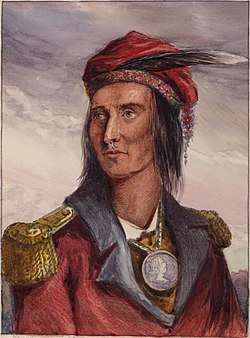
Tecumseh (c. 1768–1813) was a Shawnee chief and charismatic orator who sought to unite Native American tribes into a confederacy to resist U.S. expansion into their lands. Alongside his brother Tenskwatawa (the Prophet), he built a pan-tribal movement centered at Prophetstown, allied with the British during the War of 1812, and died at the Battle of the Thames in 1813. More Less
1759
% complete
Around 1759, Puckeshinwau and Methoataaskee, Tecumseh's parents, moved to the Ohio Country as part of a Shawnee effort to reunite in their traditional homeland after being displaced by the Iroquois in the 17th-century Beaver Wars.
1763
% complete
In 1763, the British Empire laid claim to the Ohio Country following its victory in the French and Indian War, setting the stage for growing conflict with Native American inhabitants.
Image source: Tecumseh
Mar 9, 1768
% complete
Tecumseh was born in Shawnee territory in what is now Ohio. The best evidence suggests a birthdate of March 9, 1768, though estimates range from 1764 to 1771. In that same year, the Iroquois ceded land south of the Ohio River, including present-day Kentucky, to the British.
1774
% complete
Shawnees attempted to organize resistance against colonial occupation of the region, culminating in the 1774 Battle of Point Pleasant, in which Puckeshinwau, Tecumseh's father, was killed.
Image source: Battle of Point Pleasant
1777
% complete
When the American Revolutionary War began in 1775, many Shawnees allied with the British and raided into Kentucky. In 1777, Tecumseh's family moved from the Scioto River to a Kispoko town on the Mad River, near present-day Springfield, Ohio.
1780 - 1782
% complete
General George Rogers Clark led a major expedition into Shawnee territory in 1780. The Shawnees relocated northwest along the Great Miami River, but Clark returned in 1782 and destroyed those villages too, forcing the Shawnees further north near present-day Bellefontaine, Ohio.
Image source: George Rogers Clark
1783
% complete
After the American Revolutionary War ended in 1783, the United States claimed lands north of the Ohio River by right of conquest. In response, Indians convened a great intertribal conference at Lower Sandusky in the summer of 1783.
Jan 1786
% complete
In January 1786, Moluntha, civil chief of the Mekoche Shawnee division, signed the Treaty of Fort Finney, surrendering most of Ohio to the Americans.
Image source: Fort Finney (Ohio)
1788
% complete
In 1788, Tecumseh, his older brother Cheeseekau, and their family moved westward, relocating near Cape Girardeau, Missouri.
Oct 1, 1789 - Dec 31, 1789
% complete
In late 1789 or early 1790, Tecumseh traveled south with Cheeseekau to live with the Chickamauga Cherokees near Lookout Mountain in what is now Tennessee.
1790 - 1792
% complete
Cheeseekau led about forty Shawnees in raids against colonists. Historical records indicate that Tecumseh and Cheeseekau lived with the Chickamaugans and participated in multitribal attacks on white settlements from 1790 to 1792.
1791
% complete
In 1791, Tecumseh returned with eight warriors, including his younger brother Lalawéthika (later known as Tenskwatawa), to the Ohio Country to take part in the Northwest Indian War as a minor leader.
Image source: Northwest Indian War
1792
% complete
Tecumseh was with Cheeseekau when he was killed in an unsuccessful attack on Buchanan's Station near Nashville in 1792. Tecumseh returned to the Ohio Country at the end of 1792 and fought in several more skirmishes.
Image source: Buchanan's Station
1794
% complete
As a young war leader, Tecumseh joined Shawnee Chief Blue Jacket's armed struggle against further American encroachment, which ended in defeat at the Battle of Fallen Timbers in 1794, a bitter defeat for the Indians.
Image source: Battle of Fallen Timbers
1795
% complete
Tecumseh did not attend the signing of the Treaty of Greenville (1795), in which about two-thirds of Ohio and portions of present-day Indiana were ceded to the United States, marking the loss of most of Ohio.
Image source: Treaty of Greenville
1796
% complete
By 1796, Tecumseh was both the civil and war chief of a Kispoko band of about 50 warriors and 250 people. He took a wife, Mamate, and had a son, Paukeesaa, born about 1796.
1798
% complete
Tecumseh's band moved to various locations before settling in 1798 close to Delaware Indians, along the White River near present-day Anderson, Indiana, where he lived for the next eight years.
1805
% complete
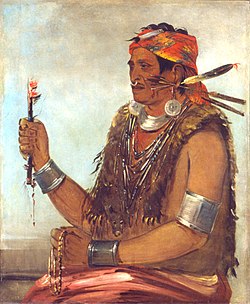
In 1805, Tecumseh's younger brother Tenskwatawa founded a religious movement calling upon Native Americans to reject European influences and return to a more traditional lifestyle. That same year, Tecumseh began preaching, drawing upon ideas espoused by earlier prophets such as the Delaware prophet Neolin.
Image source: Tenskwatawa
1806
% complete
In 1806, Tecumseh and Lalawéthika, now known as the Shawnee Prophet, established a new town near the ruins of Fort Greenville (present-day Greenville, Ohio), where the 1795 Treaty of Greenville had been signed.
1806 - 1807
% complete
In 1806 and 1807, Tecumseh and Blue Jacket traveled to Chillicothe, the capital of the new U.S. state of Ohio. Rumors of war between the United States and Great Britain followed the Chesapeake incident of June 1807.
1808
% complete
In 1808, Tecumseh and Tenskwatawa established Prophetstown, a village north of present-day Lafayette, Indiana, that grew into a large, multi-tribal community. Jortner (2011) argues that Prophetstown was effectively an independent city-state.
Image source: Prophetstown State Park
Sep 1809
% complete
A major turning point came in September 1809, when William Henry Harrison, governor of the Indiana Territory, negotiated the Treaty of Fort Wayne, purchasing 2.5 to 3 million acres of land in present-day Indiana and Illinois.
Image source: Treaty of Fort Wayne (1809)
Aug 1810
% complete
In August 1810, Tecumseh met with William Henry Harrison at Vincennes, capital of the Indiana Territory, which resulted in a standoff that became legendary.
Nov 1810
% complete
In November 1810, Tecumseh visited Fort Malden in Upper Canada to ask British officials for assistance in the coming war, but the British were noncommittal, urging restraint.
Image source: Fort Malden
May 1811 - Jul 1811
% complete
In May 1811, Tecumseh visited Ohio to recruit warriors among the Shawnees, Wyandots, and Senecas. In July 1811, he again met Harrison at Vincennes. The Great Comet of 1811 and the New Madrid earthquake were interpreted by many Native Americans as omens supporting his confederacy.
Sep 1811
% complete
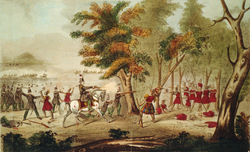
In September 1811, while Tecumseh was in the South recruiting allies, Harrison marched toward Prophetstown with about 1,000 men.
Image source: Battle of Tippecanoe
Nov 1811
% complete
Americans under William Henry Harrison defeated Tenskwatawa at the Battle of Tippecanoe and destroyed Prophetstown, a major blow to Tecumseh's confederacy.
Jun 1812
% complete
By the time the United States declared war on Great Britain in June 1812, as many as 800 warriors had gathered around the rebuilt Prophetstown. In June 1812, Tecumseh arrived at Fort Malden in Amherstburg to join his cause with the British in the War of 1812.
Image source: War of 1812
Aug 1812
% complete
In the War of 1812, Tecumseh joined his cause with the British, recruited warriors, and helped capture Detroit in August 1812.
Image source: Siege of Detroit
Sep 1812
% complete
In September 1812, Tecumseh and Roundhead led 600 warriors to assist in an attack on Fort Wayne, but the siege failed before they arrived. Tecumseh stayed in the Prophetstown region for the remainder of 1812, coordinating Native American war efforts.
Image source: Siege of Fort Wayne
Apr 1813
% complete
After the Americans suffered defeat at the Battle of Frenchtown in January 1813, they pushed back toward Detroit under Harrison. Tecumseh returned to Amherstburg in April 1813. His defense of American prisoners became a cornerstone of his legend, the ultimate proof of his inherent nobility.
Image source: Battle of Frenchtown
Jul 1813
% complete
Tecumseh and Procter returned to Fort Meigs in July 1813, Tecumseh with 2,500 warriors, the largest contingent he would ever lead.
Image source: Siege of Fort Meigs
Sep 10, 1813
% complete
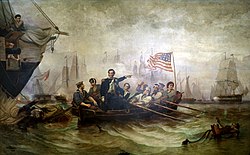
After the American naval victory in the Battle of Lake Erie on September 10, 1813, Procter decided to retreat from Amherstburg. Tecumseh reluctantly retreated with the British into Upper Canada.
Image source: Battle of Lake Erie
Oct 5, 1813
% complete
American troops led by Richard Mentor Johnson engaged the retreating British and Native forces at the Battle of the Thames on October 5, 1813, during which Tecumseh was killed, ending his efforts to unite Native Americans.
Image source: Battle of the Thames
1814
% complete
In negotiations ending the War of 1812, the British attempted to honor promises made to Tecumseh by insisting upon the creation of a Native American barrier state in the Old Northwest. The Treaty of Ghent (1814) called for Native American lands to be restored to their 1811 boundaries, something the United States had no intention of doing.
Image source: Treaty of Ghent
1816
% complete
In 1816, another account claimed a different soldier had fired the fatal shot. Sugden (1985) presented the evidence and argued that Johnson's claim was the strongest, though not conclusive. Johnson became Vice President in 1837, his fame largely based on his claim to have killed Tecumseh.
Image source: Richard Mentor Johnson
1844 - 1995
% complete
Tecumseh inspired numerous works: George Jones's play Tecumseh; or, The Prophet of the West (1844), Mary Catherine Crowley's novel Love Thrives in War (1903), Fritz Steuben's German novels beginning with The Flying Arrow (1930), Brave Warrior (1952 film), East German film Tecumseh (1972), James Alexander Thom's Panther in the Sky (1989), Eckert's A Sorrow in Our Hearts (1992), and TV movie Tecumseh: The Last Warrior (1995).
1931 - 1941
% complete
In 1931, alleged bones of Tecumseh were examined. Nevertheless, in 1941 the remains were buried on nearby Walpole Island in a ceremony honoring Tecumseh. St-Denis (2005) concluded that Tecumseh was likely buried on the battlefield and his remains have been lost.
1931
% complete
Tecumseh is honored in Canada as a hero who played a major role in Canada's defense in the War of 1812. Canadian writers such as Charles Mair (Tecumseh: A Drama, 1886) celebrated him as a Canadian patriot. In 1931, the Canadian government designated Tecumseh as a person of national historic significance.
1973
% complete
The outdoor drama Tecumseh! has been performed near Chillicothe, Ohio, since 1973, keeping the story of the Shawnee leader alive for modern audiences.
Image source: Tecumseh
2024
% complete
In 2024, the main-belt asteroid 47069 Tecumseh was named in his honor by the International Astronomical Union (IAU).
2024
% complete
Also in 2024, Firaxis Games worked with chief Ben Barnes and other members of the Shawnee Tribe to create a historically accurate depiction of Tecumseh in the video game Civilization VII.
Image source: Civilization VII
Or browse the full history timeline directory, with more than 2,000 topics.
This Tecumseh timeline was generated with the help of AI, using information found on the internet.
We work hard to keep these timelines accurate, but mistakes do get through. If you spot one, email us at [email protected] and we'll fix it for future visitors.
Generate yours with AI or build it from scratch, for free.
Export your timeline, add your own events, edit or remove AI-generated events, and much more
No credit card required.
Cancel anytime.
Cancel anytime.
You can create an unlimited number of timelines with up to 10 events on each one, customize how they look, export them to PDF, PNG, PowerPoint, CSV, and Excel, and share them with a link. Paid plans raise the event limit and add features like spreadsheet imports and collaborators.
Yes. You can cancel your subscription from your account page at any time, and you will not be charged again. Your subscription stays active for the rest of the period you already paid for.
Yes. We will email you a reminder before the annual renewal, and we will also email you a receipt.
Yes. You can email us within 15 days of any payment, and we will issue you a full refund.
Check out our pricing docs or send us an email anytime: [email protected].