-
Use Cases
-
Resources
-
Pricing
1848
After the Mexican–American War ended, the United States gained ownership of what is today Navajoland.
1860 - 1864
During the mid-19th century, especially in the 1860s, U.S. Army campaigns using a scorched-earth policy forced most Navajo people to abandon their homes.
1864
The main body of Navajo, numbering about 8,000 adults and children, was marched roughly 300 miles to imprisonment at Bosque Redondo.
1864 - 1868
Following the Long Walk, Navajo people were held at Bosque Redondo under the U.S. government's reservation and military system.
1868
The Treaty of 1868 established the Navajo Indian Reservation, and Navajo people left Bosque Redondo for the treaty territory.
Image source: Long Walk of the Navajo
1868
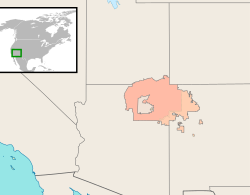
The reservation was first established within New Mexico Territory, initially covering approximately 3.3 million acres.
Image source: Navajo Nation
Jun 1, 1868
At Bosque Redondo, Barboncito, Armijo, and other Navajo leaders signed the treaty that enabled the Navajo return and established the Navajo Indian Reservation.
Image source: Treaty of Bosque Redondo
Jul 25, 1868
Congress ratified the Navajo Treaty with President Andrew Johnson, formalizing the agreement and the reservation's initial legal basis.
Oct 28, 1878
President Rutherford B. Hayes signed an executive order extending the reservation boundary 20 miles west, its first post-1868 expansion.
1887 - 1934
Allotments of land to individual Navajo households under the Dawes Act helped shape the reservation's eastern border, and the program continued until 1934.
Image source: Dawes Act
1905
President Theodore Roosevelt issued an executive order adding the region around Aneth, Utah; Congress confirmed the addition in 1933.
1934
After repeated additions and allotments, the reservation reached its current boundaries in 1934 and retained its sovereignty.
1996
Elouise Cobell filed a class-action lawsuit against the federal government on behalf of an estimated 250,000 to 500,000 Native American plaintiffs whose trust accounts lacked accurate accounting.
Image source: Cobell v. Salazar
2009 - 2017
A provision associated with Salazar in 2009 established a nearly $2 billion fund to buy fractionated interests and restore land to tribal reservations. Through March 2017, Navajo members received $104 million and 155,503 acres returned to the Nation.
Jul 2009
The Bennett Freeze Agreement, completed in July 2009 under President Barack Obama, ended a long-running social and legal conflict involving the Navajo and Hopi Nations and neighboring communities.
1892
BIA Agent David L. Shipley established the Navajo Court of Indian Offenses and appointed its judges.
1927
U.S. federal agents initiated Chapters as local government entities modeled on counties or townships in the United States.
1933
By 1933, more than 100 Chapters operated across the Navajo Nation.
1934 - 1953
Under the Indian Reorganization Act, the federal government encouraged tribes to adopt constitutional-style governments. Navajo leaders expressed concerns about effects on livestock and mineral development.
1950
The Navajo Tribal Council decided in 1950 that judges should be elected.
1958 - 1959
The Navajo Tribal Council created a separate judicial branch on October 16, 1958. The Navajo Nation Government Judicial Branch became effective on April 1, 1959.
Apr 15, 1969
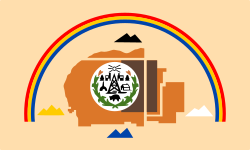
The tribe changed its official name to the Navajo Nation, a designation displayed on its seal.
1978 - 1985
In 1978, the Navajo Tribal Council established a Supreme Judicial Council, which functioned as a political body rather than a court. The Judicial Reform Act of 1985 eliminated it.
1989 - 1990
The Title II Amendment of 1989 established the Navajo Nation government as a three-part system, and related conceptual additions expanded the new government on April 1, 1990.
Dec 15, 1989 - Apr 1, 1990
The Navajo Nation Presidency in its current form was created on December 15, 1989, following federal guidance on establishing the judicial, legislative, and executive model. The government expanded on April 1, 1990.
1994
The Tribal Council rejected a proposal to change the official designation from Navajo to Diné, a traditional name for the people.
1998
The Navajo Tribal Council passed the Local Governance Act in 1998, expanding the political roles of the existing 110 Chapters.
2006
A committee advocating for a Navajo Constitution began working toward a Navajo constitutional convention in 2006.
2017
The Navajo Nation Council rejected legislation to change the name to Diné Nation, citing possible confusion and frustration among Navajo citizens and non-Navajos.
1900
By 1900, the weaving of traditional Navajo blankets had been replaced by rug-making as a major expression of Navajo textile production.
1933
During the Great Depression, the Bureau of Indian Affairs attempted to mitigate environmental damage caused by overgrazing on reservations.
1956
The first well in the Aneth Extension was drilled in 1956.
1959
The Navajo Nation Council created the Diné Development Corporation in 1959; it was later privatized.
1961 - 2010
Chevron's P&M McKinley Mine opened in 1961 as the first large-scale surface coal mine in New Mexico and closed in January 2010.
1963
The Navajo Mine opened near Fruitland, New Mexico, in 1963 and later employed about 350 people.
1985
KTNN was established as a Navajo Nation Enterprise in 1985. The commercial AM 660 station provides information and entertainment.
Image source: KTNN
1990
Congress passed the Radiation Exposure Compensation Act in 1990, addressing claims related to radiation exposure.
2008 - 2011
The Navajo Nation pursued wind projects, including a proposed 500-megawatt farm discussed in 2008 and an 85-megawatt Big Boquillas Ranch project approved in December 2010. The Salt River Project was announced as the first utility customer in August 2011.
2011
Environmental activism by Diné CARE helped lead to cancellation of the proposed Desert Rock Power Plant in 2011.
2019
As part of a transition away from coal energy, the Navajo Generating Station shut down in 2019.
2019
By 2019, about 15,000 houses inhabited by approximately 60,000 residents lacked electricity. The authority was electrifying roughly 400 to 450 houses annually.
2020
During the COVID-19 pandemic, Ireland donated to the Navajo and Hopi Nations through a program called pay it forward.
Image source: COVID-19 pandemic in the Navajo Nation
2020
The number of Navajo tribal members increased to 399,494 in 2020, surpassing the Cherokee Nation as the largest tribal group by enrollment.
Mar 17, 2020
The COVID-19 pandemic was first documented in the Navajo Nation on March 17, 2020.
1968 - 1979
The Navajo Nation Council founded the college in 1968 as the first tribal college in the United States. It opened in 1979 as the Navajo Skill Center.
1984
Teachers on the Navajo Nation began teaching students in the Navajo language as mandated by the Nation.
1985
The Navajo Skill Center was renamed Crownpoint Institute of Technology in 1985.
2006
Crownpoint Institute of Technology was renamed Navajo Technical College in 2006.
2013
Navajo Technical College was designated Navajo Technical University in 2013 in recognition of its expanded academic programs.
Dec 30, 2024
Navajo Nation President Buu Nygren signed legislation making the Navajo language the official language of the Navajo Nation.
2025
In 2025, reports estimated that approximately 170,000 people spoke Navajo at home.
Or browse the full history timeline directory, with more than 2,500 topics.
This Navajo History timeline was generated with the help of AI, using information found on the internet.
We work hard to keep these timelines accurate, but mistakes do get through. If you spot one, email us at [email protected] and we'll fix it for future visitors.
Generate yours with AI or build it from scratch, for free.
Export your timeline, add your own events, edit or remove AI-generated events, and much more
No credit card required.
Cancel anytime.
Cancel anytime.
You can create an unlimited number of timelines with up to 10 events on each one, customize how they look, export them to PDF, PNG, PowerPoint, CSV, and Excel, and share them with a link. Paid plans raise the event limit and add features like spreadsheet imports and collaborators.
Yes. You can cancel your subscription from your account page at any time, and you will not be charged again. Your subscription stays active for the rest of the period you already paid for.
Yes. We will email you a reminder before the annual renewal, and we will also email you a receipt.
Yes. You can email us within 15 days of any payment, and we will issue you a full refund.
Check out our pricing docs or send us an email anytime: [email protected].