-
Use Cases
-
Resources
-
Pricing
Cholera pandemics are a series of devastating outbreaks of the waterborne bacterial disease cholera, caused by Vibrio cholerae. Beginning in 1817 in the Ganges Delta of India, seven major pandemics spread across Asia, Europe, Africa, and the Americas over two centuries. These outbreaks killed millions, drove major advances in epidemiology—such as John Snow's work in London—and led to modern sanitation systems and public health infrastructure. The seventh pandemic, caused by the El Tor strain, began in 1961 and continues today in parts of Africa, Asia, and the Caribbean. More Less
1817
% complete
Cholera, an acute diarrheal infection caused by Vibrio cholerae, had long been endemic in the Ganges Delta of India. Trade routes, pilgrimages, and British colonial movements helped carry the disease beyond its historic home, setting the stage for a series of global pandemics beginning in the early 19th century.
Image source: Cholera
1817 - 1824
% complete
The first cholera pandemic originated in Bengal and spread across Southeast Asia, the Middle East, and East Africa. It reached as far as China and the Caspian Sea region, killing hundreds of thousands and marking the first time cholera spread globally from its Indian homeland.
Image source: 1817–1824 cholera pandemic
1829 - 1837
% complete
The second pandemic spread from India through Russia to Europe, reaching London, Paris, and Berlin by 1831-1832. It also crossed the Atlantic to North America in 1832, causing widespread panic and prompting some of the earliest public health responses to epidemic disease.
Image source: 1826–1837 cholera pandemic
1846 - 1860
% complete
The third pandemic was the deadliest of the 19th century outbreaks, spreading from India across Asia, Europe, Africa, and the Americas. Russia lost over a million people, and the pandemic's devastation spurred major advances in medical research into the disease's causes.
Image source: 1846–1860 cholera pandemic
1863 - 1875
% complete
The fourth pandemic began in the Ganges Delta and spread via Muslim pilgrimage routes to Mecca, then across the Middle East, Europe, Africa, and North America. The Hajj became a major transmission hub, prompting quarantine measures at ports throughout the Mediterranean.
Image source: 1863–1875 cholera pandemic
1881 - 1896
% complete
The fifth pandemic again originated in India and spread through Asia, Africa, South America, and parts of Europe. Improved understanding of waterborne transmission allowed many European cities to avoid catastrophic losses, though Hamburg suffered a devastating outbreak in 1892.
Image source: 1881–1896 cholera pandemic
1884 - 1885
% complete
A violent cholera outbreak struck Naples, Italy, killing thousands and exposing the failures of local sanitation. The crisis prompted reforms in Italian public health infrastructure and drew international attention to the links between poverty, sanitation, and epidemic disease.
Aug 1892 - Nov 1892
% complete
Hamburg, which relied on untreated water from the Elbe River while neighboring Altona used filtered water, suffered one of Europe's worst cholera epidemics. Over 8,000 people died, providing dramatic proof of water filtration's protective effect and spurring German sanitary reform.
1899 - 1923
% complete
The sixth pandemic emerged from India and swept through the Middle East, Eastern Europe, Russia, and Africa. It largely spared Western Europe and the Americas thanks to improved sanitation, but caused enormous mortality in regions with inadequate water infrastructure.
Image source: 1899–1923 cholera pandemic
1851
% complete
European powers convened the first International Sanitary Conference in Paris to coordinate responses to cholera and other epidemic diseases. Though it produced limited practical results, it marked the beginning of international cooperation on public health that eventually led to the World Health Organization.
1892
% complete
As cholera raged in Europe, New York City health authorities imposed strict quarantines on arriving immigrants, detaining thousands on offshore islands such as Hoffman and Swinburne. The aggressive measures kept the city free of epidemic cholera despite heavy immigration traffic.
Image source: History of cholera
1992
% complete
The World Health Organization established the Global Task Force on Cholera Control to coordinate surveillance, prevention, and response efforts worldwide. The task force brings together partners to support affected countries with technical guidance, vaccines, and outbreak control strategies.
Image source: Cholera
Dec 2016
% complete
After years of denial, the United Nations publicly acknowledged its involvement in introducing cholera to Haiti and announced a new approach to combat the epidemic. The admission followed independent scientific studies tracing the outbreak strain to Nepalese peacekeepers.
Image source: 2010s Haiti cholera outbreak
Oct 2017
% complete
Global health partners launched 'Ending Cholera: A Global Roadmap to 2030,' targeting a 90% reduction in cholera deaths and elimination of transmission in up to 20 countries by 2030. The strategy emphasizes multisectoral approaches combining WASH improvements, surveillance, vaccination, and community engagement.
1854
% complete
Italian anatomist Filippo Pacini microscopically identified a comma-shaped bacterium in the intestines of cholera victims during the Florence outbreak of 1854. Although his discovery was largely ignored at the time, he is now credited as the true discoverer of Vibrio cholerae.
Image source: Filippo Pacini
Sep 1854
% complete
During a severe London outbreak, physician John Snow mapped cholera cases and identified the contaminated Broad Street water pump as the source. His epidemiological investigation provided compelling evidence that cholera spread through contaminated water rather than bad air, laying the foundation for modern epidemiology.
Image source: 1854 Broad Street cholera outbreak
1883
% complete
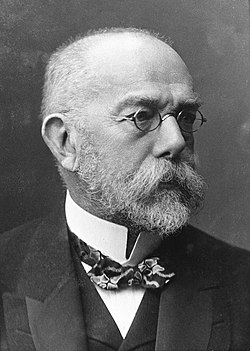
German physician Robert Koch isolated Vibrio cholerae during an outbreak in Egypt and India, confirming the bacterial cause of cholera. His work established the germ theory basis for understanding the disease and enabled the development of diagnostic methods and vaccines.
Image source: Robert Koch
1892
% complete
Bacteriologist Waldemar Haffkine developed the first effective cholera vaccine and tested it on himself before deploying mass vaccination campaigns in India. His killed whole-cell vaccine significantly reduced cholera mortality among vaccinated populations during later outbreaks.
Image source: Waldemar Haffkine
1905
% complete
Scientists identified the El Tor biotype of Vibrio cholerae at the El Tor quarantine station in Egypt, tracing infections among pilgrims returning from Mecca. This strain would later drive the seventh pandemic due to its longer environmental survival and milder but more numerous infections.
Image source: Vibrio cholerae
2001
% complete
The WHO prequalified oral cholera vaccines such as Dukoral, followed later by Shanchol and Euvichol, enabling their use in mass vaccination campaigns. Oral vaccines proved safe, affordable, and effective even in emergency settings, transforming cholera control strategy.
Image source: Cholera vaccine
2018
% complete
Expanded production of the Euvichol-Plus oral cholera vaccine increased the global stockpile managed by the International Coordinating Group, allowing faster deployment of millions of doses during outbreaks. Vaccine supply remains a critical constraint in responding to simultaneous epidemics.
1961 - 1975
% complete
The seventh pandemic, caused by the El Tor biotype, began in Sulawesi, Indonesia, and spread across Asia, the Middle East, Africa, and eventually Europe. Unlike earlier pandemics, it persisted for decades and remains ongoing in many regions today.
Image source: Seventh cholera pandemic
1970
% complete
The El Tor strain entered West Africa in 1970, striking Guinea, Sierra Leone, Liberia, and Nigeria. Africa had previously been largely untouched by cholera pandemics, and the continent has since borne the majority of the global cholera burden.
Jan 1991 - 1996
% complete
Cholera returned to Latin America for the first time in a century when an outbreak began in coastal Peru, likely linked to contaminated seafood and water. The epidemic spread to most countries in Central and South America, causing over a million cases and roughly 10,000 deaths.
Image source: History of cholera
Jul 1994 - Aug 1994
% complete
Following the Rwandan genocide, hundreds of thousands of refugees crowded into camps near Goma, Zaire, with no clean water or sanitation. Cholera and dysentery exploded through the camps, killing tens of thousands within weeks in one of history's deadliest rapid-onset epidemics.
Image source: Great Lakes refugee crisis
Aug 2008 - Jul 2009
% complete
Amid economic collapse and the breakdown of water and sanitation infrastructure, Zimbabwe suffered its worst recorded cholera epidemic. Nearly 100,000 cases were reported with over 4,000 deaths, exposing how political and economic crises can fuel public health disasters.
Image source: 2008 Zimbabwean cholera outbreak
Oct 2010 - 2019
% complete
Ten months after Haiti's devastating earthquake, cholera erupted near a UN peacekeeping base whose sewage contaminated the Artibonite River. The epidemic sickened over 800,000 Haitians and killed nearly 10,000, becoming the worst cholera outbreak in recent history and sparking controversy over UN accountability.
Oct 2016 - 2020
% complete
Yemen's civil war devastated water systems and healthcare, producing the world's largest cholera epidemic since records began. Suspected cases exceeded 2.5 million with thousands of deaths, demonstrating how conflict-driven infrastructure collapse enables explosive disease transmission.
Image source: 2016–2022 Yemen cholera outbreak
Mar 2019 - Apr 2019
% complete
Cyclones Idai and Kenneth devastated Mozambique, flooding Beira and surrounding regions and destroying water infrastructure. Cholera broke out in crowded displacement camps within days, infecting thousands before emergency vaccination campaigns and relief efforts brought it under control.
Image source: Cyclone Idai
Mar 2022 - 2023
% complete
Malawi experienced its deadliest cholera outbreak on record, driven by Cyclone Ana flooding and strained health systems. Cases surpassed 58,000 with over 1,700 deaths, prompting large-scale vaccination campaigns and international emergency assistance.
Or browse the full history timeline directory, with more than 2,000 topics.
This Cholera Pandemics timeline was generated with the help of AI, using information found on the internet.
We work hard to keep these timelines accurate, but mistakes do get through. If you spot one, email us at [email protected] and we'll fix it for future visitors.
Generate yours with AI or build it from scratch, for free.
Export your timeline, add your own events, edit or remove AI-generated events, and much more
No credit card required.
Cancel anytime.
Cancel anytime.
You can create an unlimited number of timelines with up to 10 events on each one, customize how they look, export them to PDF, PNG, PowerPoint, CSV, and Excel, and share them with a link. Paid plans raise the event limit and add features like spreadsheet imports and collaborators.
Yes. You can cancel your subscription from your account page at any time, and you will not be charged again. Your subscription stays active for the rest of the period you already paid for.
Yes. We will email you a reminder before the annual renewal, and we will also email you a receipt.
Yes. You can email us within 15 days of any payment, and we will issue you a full refund.
Check out our pricing docs or send us an email anytime: [email protected].