
-
Use Cases
-
Resources
-
Pricing
The history of heart surgery traces humanity's journey to repair the most vital of organs. Long considered untouchable by surgeons, the heart became accessible through pioneering efforts in the late 19th and early 20th centuries. Key milestones include Daniel Hale Williams' successful pericardium repair in 1893, Ludwig Rehn's first successful heart suture in 1896, the development of the heart-lung machine by John Gibbon in 1953 enabling open-heart surgery, the first human heart transplant by Christiaan Barnard in 1967, and the rise of bypass grafting, valve replacement, and minimally invasive techniques. Today, cardiac surgery continues to evolve with robotic assistance and artificial hearts. More Less
1801
% complete
In 1801, Francisco Romero performed one of the earliest known operations on the pericardium, the sac surrounding the heart, in the city of Almería, Spain. His pioneering work predates most other recorded cardiac surgery and represents a remarkable early achievement in the field.
1810
% complete
In 1810, French military surgeon Dominique Jean Larrey performed an operation on the pericardium, further establishing the feasibility of surgery involving the structures around the heart during the 19th century.
Image source: Dominique Jean Larrey
1891
% complete
In 1891, American surgeon Henry Dalton carried out one of the earliest operations on the pericardial sac in the United States, contributing to the gradual acceptance of cardiac-adjacent surgery in modern medicine.
Image source: Henry Dalton
1893
% complete
In 1893, Daniel Hale Williams performed a successful operation on the pericardium, one of the earliest such procedures. As an African-American surgeon, his achievement was a landmark moment in both medical history and the history of diversity in medicine.
Image source: Daniel Hale Williams
Sep 4, 1895
% complete
On September 4, 1895, Axel Cappelen performed the first surgery on the heart itself at Rikshospitalet in Kristiania, now Oslo, Norway. The patient had been stabbed in the left axilla and was in deep shock upon arrival. Cappelen accessed the chest through a left thoracotomy and repaired the bleeding wound.
1900
% complete
After the turn of the century, operations on the great vessels became common. These included repairs of aortic coarctation, creation of Blalock–Thomas–Taussig shunts, and closure of patent ductus arteriosus, expanding the scope of cardiovascular surgery significantly.
Image source: Blalock–Thomas–Taussig shunt
Nov 29, 1944
% complete
Alfred Blalock, Helen Taussig, and Vivien Thomas performed the first successful palliative pediatric cardiac operation at Johns Hopkins Hospital on November 29, 1944, in a one-year-old girl with Tetralogy of Fallot. Their work is widely regarded as the birth of modern cardiac surgery.
Nov 29, 1944
% complete
Patient Eileen Saxon received the historic first Blalock–Thomas–Taussig procedure. Her case was dramatically portrayed by HBO in the 2004 television film Something the Lord Made, which depicted the collaboration between Alfred Blalock, Helen Taussig, and Vivien Thomas.
Image source: Something the Lord Made
Sep 2, 1952
% complete
Walton Lillehei assisted at the University of Minnesota on September 2, 1952, in an early open-heart operation using hypothermia. Lillehei would go on to become one of the most influential figures in the development of open-heart surgery techniques.
1953
% complete
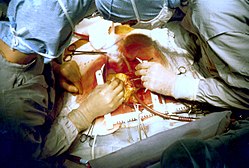
In 1953, Alexander Alexandrovich Vishnevsky conducted the first cardiac surgery under local anesthesia, demonstrating an alternative approach to operative management of heart surgery patients in the Soviet Union.
Image source: Cardiac surgery
1956
% complete
In 1956, John Carter Callaghan performed the first documented open-heart surgery in Canada, bringing advanced cardiac surgical capabilities to North America beyond the United States.
1925
% complete
In 1925, Henry Souttar operated successfully on a young woman with mitral valve stenosis. This was the first successful operation on the heart valves, though the technique was not widely adopted for years afterward.
1947
% complete
In 1947, Thomas Sellors of Middlesex Hospital in London operated on a Tetralogy of Fallot patient with pulmonary stenosis and successfully divided the stenosed pulmonary valve, demonstrating that congenital valve defects could be surgically corrected.
1948
% complete
Also in 1948, four surgeons carried out successful operations for mitral valve stenosis resulting from rheumatic fever. These landmark procedures established valve surgery as a viable treatment for rheumatic heart disease.
Image source: Mitral stenosis
1948
% complete
In 1948, Russell Brock, probably unaware of Sellors's work, used a specially designed dilator in three cases of pulmonary stenosis, independently advancing the surgical treatment of pulmonary valve obstruction.
Image source: Russell Brock, Baron Brock
1978
% complete
In 1978, Victor Skumin described Skumin syndrome, a 'cardioprosthetic psychopathological syndrome' associated with mechanical heart valve implants, characterized by irrational fear, anxiety, depression, sleep disorder, and weakness. It highlighted the psychological dimension of prosthetic valve surgery.
Image source: Victor Skumin
1945
% complete
In 1945, Soviet pathologist Nikolai Sinitsyn successfully transplanted a heart from one frog to another frog and from one dog to another dog, providing early experimental groundwork for future organ transplantation efforts.
Dec 3, 1967
% complete
Christiaan Barnard performed the world's first human-to-human heart transplant on Louis Washkansky on December 3, 1967, at Groote Schuur Hospital in Cape Town, South Africa. The operation made history worldwide despite Washkansky's death from pneumonia 18 days later.
Image source: Christiaan Barnard
Dec 6, 1967
% complete
Barely three days after Barnard's transplant, Adrian Kantrowitz performed the first pediatric heart transplant on December 6, 1967, at Maimonides Hospital (now Maimonides Medical Center) in Brooklyn, New York.
Jan 6, 1968
% complete
Norman Shumway performed the first adult heart transplant in the United States on January 6, 1968, at Stanford University Hospital. Shumway's later work established Stanford as a leading center for cardiac transplantation.
Jul 1952
% complete
In July 1952, Forest Dodrill was the first to use a mechanical pump in a human to bypass the left side of the heart whilst allowing the patient's lungs to oxygenate the blood, in order to operate on the mitral valve. It was a major step toward mechanical circulatory support.
1953
% complete
In 1953, John Heysham Gibbon of Jefferson Medical School in Philadelphia reported the first successful use of extracorporeal circulation by means of an oxygenator. Although he abandoned the method after subsequent failures, his heart-lung machine became foundational to modern cardiac surgery.
Image source: John Heysham Gibbon
1954
% complete
In 1954, Walton Lillehei performed a series of successful operations using the controlled cross-circulation technique, in which the patient's mother or father served as a living 'heart-lung machine'. This bold approach enabled intracardiac repair before reliable mechanical bypass existed.
Feb 25, 1960
% complete
On February 25, 1960, Nazih Zuhdi performed the first total intentional hemodilution open-heart surgery on Terry Gene Nix, age 7, at Mercy Hospital in Oklahoma City. The technique reduced the need for donor blood in heart-lung machines.
Mar 1961
% complete
In March 1961, Zuhdi, Carey, and Greer performed open-heart surgery on a child aged three and a half using the total intentional hemodilution machine, further validating the technique in pediatric patients.
Or browse the full history timeline directory, with more than 2,000 topics.
This History of Heart Surgery timeline was generated with the help of AI, using information found on the internet.
We work hard to keep these timelines accurate, but mistakes do get through. If you spot one, email us at [email protected] and we'll fix it for future visitors.
Generate yours with AI or build it from scratch, for free.
Export your timeline, add your own events, edit or remove AI-generated events, and much more
No credit card required.
Cancel anytime.
Cancel anytime.
You can create an unlimited number of timelines with up to 10 events on each one, customize how they look, export them to PDF, PNG, PowerPoint, CSV, and Excel, and share them with a link. Paid plans raise the event limit and add features like spreadsheet imports and collaborators.
Yes. You can cancel your subscription from your account page at any time, and you will not be charged again. Your subscription stays active for the rest of the period you already paid for.
Yes. We will email you a reminder before the annual renewal, and we will also email you a receipt.
Yes. You can email us within 15 days of any payment, and we will issue you a full refund.
Check out our pricing docs or send us an email anytime: [email protected].