-
Use Cases
-
Resources
-
Pricing
D-Day refers to June 6, 1944, when Allied forces launched Operation Overlord, the largest seaborne invasion in history. Troops from the United States, United Kingdom, Canada, and other Allies stormed five beaches in Normandy, France—Utah, Omaha, Gold, Juno, and Sword—beginning the liberation of Western Europe from Nazi occupation during World War II. More Less
Jun 1941
% complete
After the German Army invaded the Soviet Union in June 1941, Soviet leader Joseph Stalin began pressing his new Western allies for the creation of a second front in western Europe to relieve pressure on the Eastern Front.
1942 - 1943
% complete
The naval commander responsible for D-Day planning had also been responsible for the naval planning of the invasion of North Africa in 1942, and one of the two fleets carrying troops for the invasion of Sicily the following year, experience that proved invaluable for Overlord.
Image source: Operation Torch
1942
% complete
Despite the joint announcement, British Prime Minister Winston Churchill persuaded US President Franklin D. Roosevelt that an immediate cross-Channel invasion was not feasible, delaying the opening of a second front in western Europe.
May 1942
% complete
In late May 1942, the Soviet Union and the United States made a joint announcement that a full understanding was reached with regard to the urgent tasks of creating a second front in Europe in 1942.
Image source: Normandy landings
1943
% complete
The Allies originally planned to launch the invasion of Normandy on 1 May 1944, though the date was later postponed to June to allow for additional landing craft and expanded operations.
Image source: Operation Overlord
May 1943
% complete
By mid-1943, the campaign in North Africa had been won by the Allies, removing Axis forces from the region and freeing resources for further operations in the Mediterranean and the planned invasion of northwest Europe.
Image source: Tunisian campaign
May 1943
% complete
At the Trident Conference in Washington in May 1943, the Allied leaders took the decision to undertake a cross-channel invasion of German-occupied France within the next year.
Image source: Washington Conference (1943)
Jul 1943
% complete
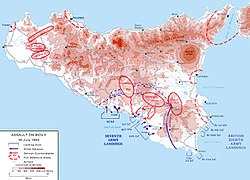
Following victory in North Africa, the Allies launched the invasion of Sicily in July 1943, gaining a foothold in southern Europe and contributing to the eventual fall of Mussolini's regime in Italy.
Image source: Allied invasion of Sicily
Aug 1943
% complete
The initial draft of the plan for Operation Overlord was accepted at the Quebec Conference in August 1943, laying out the framework for the amphibious assault on the Normandy coast.
Image source: First Quebec Conference
Sep 1943
% complete
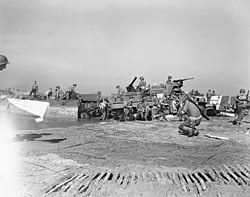
Subsequent to the conquest of Sicily, the Allies invaded the Italian mainland in September 1943, opening a new front in southern Europe and tying down German divisions.
Image source: Allied invasion of Italy
Nov 1943
% complete
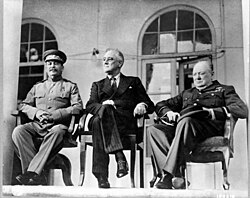
At the Tehran Conference in November 1943, Roosevelt and Churchill promised Stalin that they would open the long-delayed second front in France in May 1944.
Image source: Tehran Conference
Dec 31, 1943
% complete
On 31 December 1943, Eisenhower and Montgomery first saw the invasion plan, which proposed amphibious landings by three divisions on a 25-mile (40 km) front with two more divisions in support.
1942
% complete
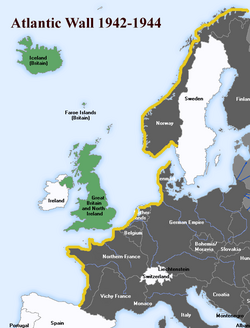
Alarmed by the Allied raids on St Nazaire and Dieppe in 1942, Hitler ordered the construction of fortifications along the Atlantic coast of the European mainland, from Spain to Norway, to protect against an expected Allied invasion.
Image source: Atlantic Wall
Dec 24, 1943 - Apr 17, 1944
% complete
During the Soviet Dnieper–Carpathian offensive, the German High Command was forced to transfer the entire II SS Panzer Corps from France, including the 9th and 10th SS Panzer Divisions, as well as the 349th Infantry Division, 507th Heavy Panzer Battalion and the 311th and 322nd StuG Assault Gun Brigades.
Image source: Dnieper–Carpathian offensive
Jan 1944
% complete
In early 1944, the German Western Front (OB West) was significantly weakened by personnel and materiel transfers to the Eastern Front, reducing its capacity to resist an Allied landing.
Image source: OB West
Mar 1944 - May 1944
% complete
The 1st SS Panzer Division 'Leibstandarte SS Adolf Hitler', the 9th, 11th, 19th and 116th Panzer divisions, alongside the 2nd SS Panzer Division 'Das Reich', arrived in France in March–May 1944 for extensive refit after suffering heavy losses during the Dnieper-Carpathian operation.
Image source: Panzer division (Wehrmacht)
Jun 1, 1944
% complete
Seven of the eleven panzer or panzergrenadier divisions stationed in France were not fully operational or only partially mobile in early June 1944, weakening Germany's armored response capability on D-Day.
Jun 6, 1944 - Jun 8, 1944
% complete
German armaments minister Albert Speer notes in his 1969 autobiography that the German high command, concerned about the susceptibility of the airports and port facilities along the North Sea coast, held a conference on 6–8 June 1944 to discuss reinforcing defences in that area.
Image source: Albert Speer
1944
% complete
Pointe du Hoc is little changed from 1944, with the terrain covered with bomb craters and most of the concrete bunkers still in place, serving as a lasting memorial to the Rangers who scaled its cliffs on D-Day.
Image source: Pointe du Hoc
Aug 30, 1944
% complete
German forces retreated east across the Seine on 30 August 1944, marking the close of Operation Overlord and the successful conclusion of the Allied campaign to liberate northwestern France.
1994
% complete
The original Pegasus Bridge, captured by British glider troops in the opening minutes of D-Day, was replaced in 1994 by one similar in appearance, and the original is housed on the grounds of a nearby museum complex.
Image source: Pegasus Bridge
2003
% complete
The Juno Beach Centre, opened in 2003 at Courseulles-sur-Mer, was funded by the Canadian federal and provincial governments, France, and Canadian veterans, commemorating Canada's role in the D-Day landings.
Image source: Juno Beach Centre
2021
% complete
The British Normandy Memorial above Gold Beach was designed by the architect Liam O'Connor and opened in 2021, honoring the British servicemen who died during the Normandy campaign.
Image source: British Normandy Memorial
Jul 2026
% complete
In July 2026, the Beaches of the D-Day Landings were designated by UNESCO as a World Heritage Site, recognizing their outstanding universal value as the site of one of history's most consequential military operations.
Jun 6, 1944
% complete
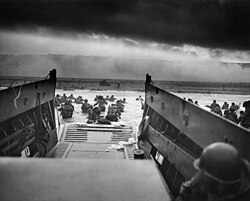
The Normandy landings were the landing operations and associated airborne operations on 6 June 1944 of the Allied invasion of Normandy in Operation Overlord during the Second World War, the largest seaborne invasion in history.
Jun 6, 1944
% complete
Among Allied losses to mines during the landings was the American destroyer USS Corry off Utah Beach, demonstrating the danger posed by German minefields to the invasion fleet.
Image source: USS Corry (DD-463)
Jun 6, 1944
% complete
Allied losses to mines also included submarine chaser USS PC-1261, a 53-metre (173 ft) patrol craft lost during the D-Day operations off the Normandy coast.
Image source: USS PC-1261
Jun 6, 1944
% complete
A 1965 report from the Counter-insurgency Information Analysis Center details the results of the French Resistance's sabotage efforts: in the southeast, 52 locomotives were destroyed on 6 June and the railway line cut in more than 500 places, hampering German reinforcements.
Image source: French Resistance
Or browse the full history timeline directory, with more than 2,000 topics.
This D-Day timeline was generated with the help of AI, using information found on the internet.
We work hard to keep these timelines accurate, but mistakes do get through. If you spot one, email us at [email protected] and we'll fix it for future visitors.
Generate yours with AI or build it from scratch, for free.
Export your timeline, add your own events, edit or remove AI-generated events, and much more
No credit card required.
Cancel anytime.
Cancel anytime.
You can create an unlimited number of timelines with up to 10 events on each one, customize how they look, export them to PDF, PNG, PowerPoint, CSV, and Excel, and share them with a link. Paid plans raise the event limit and add features like spreadsheet imports and collaborators.
Yes. You can cancel your subscription from your account page at any time, and you will not be charged again. Your subscription stays active for the rest of the period you already paid for.
Yes. We will email you a reminder before the annual renewal, and we will also email you a receipt.
Yes. You can email us within 15 days of any payment, and we will issue you a full refund.
Check out our pricing docs or send us an email anytime: [email protected].