
-
Use Cases
-
Resources
-
Pricing
Diogenes of Sinope (c. 412–323 BCE) was an ancient Greek philosopher and founder of Cynicism. Famous for his extreme asceticism—allegedly living in a large ceramic jar—and his biting wit, he mocked social conventions, wealth, and pretense, advocating a life of virtue in accordance with nature. More Less
365 BC - 285 BC
Beginning with Crates of Thebes (c. 365 – c. 285 BC), one stream of Cynicism consisted of a succession of Cynics who preserved many of Diogenes's original principles and practices, carrying his philosophy forward through subsequent generations.
Image source: Crates of Thebes

150 BC
In the second century BC, Hippobotus omitted Cynicism from his list of philosophical schools, reflecting an early debate over whether Cynicism constituted a true school of philosophy or merely a lifestyle.
300 BC
A collection of pseudepigraphic letters ascribed to Diogenes began circulating between the 3rd century BC and the first century AD, and was often treated as genuine by ancient readers.
Image source: Diogenes

100 BC - 100 AD
The collection of pseudepigraphic letters ascribed to Diogenes continued to circulate until the first century AD, frequently regarded by readers as authentic writings of the philosopher.
1475
In 1475, Davide Ghirlandaio portrayed Diogenes next to Aristotle in a fresco, bringing the Cynic philosopher into Renaissance visual culture alongside the great figures of Greek philosophy.
Image source: Davide Ghirlandaio

1509 - 1511
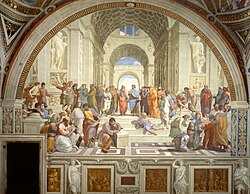
In Raphael's The School of Athens (1509–1511), Diogenes is depicted sprawled on the steps, his disheveled, weathered cloak covering only part of his body, utterly indifferent to the renowned philosophers gathered around him, especially Plato and Aristotle, who loom above him on the top step.
Image source: The School of Athens
1726
In 1726, a damaged marble bas relief from the first century AD depicting Diogenes in a jar with a dog was discovered during excavations at Monte Testaccio, near Rome.
Image source: Monte Testaccio

1750 - 1800
The fragment, part of a larger image of the legendary meeting between Diogenes and Alexander, was restored in the 18th century based on a medieval drawing, adding the figure of Alexander and a new head for Diogenes derived from a statue in the Villa Albani.
1860
Jean-Léon Gérôme's Diogènes (1860) depicts the philosopher seated at the mouth of his jar, adjusting his lamp while four dogs observed him, evoking both his asceticism and his legendary search for an honest man.
Image source: Jean-Léon Gérôme

1882
John William Waterhouse's Diogenes (1882) depicts the philosopher inside his jar, holding a scroll with a lamp nearby, as three elegant young women look on, contrasting his austere way of life with conventional society.
Image source: John William Waterhouse

This Diogenes timeline was generated with the help of AI, using information found on the internet.
We work hard to keep these timelines accurate, but mistakes do get through. If you spot one, email us at [email protected] and we'll fix it for future visitors.
Generate yours with AI or build it from scratch, for free.


